




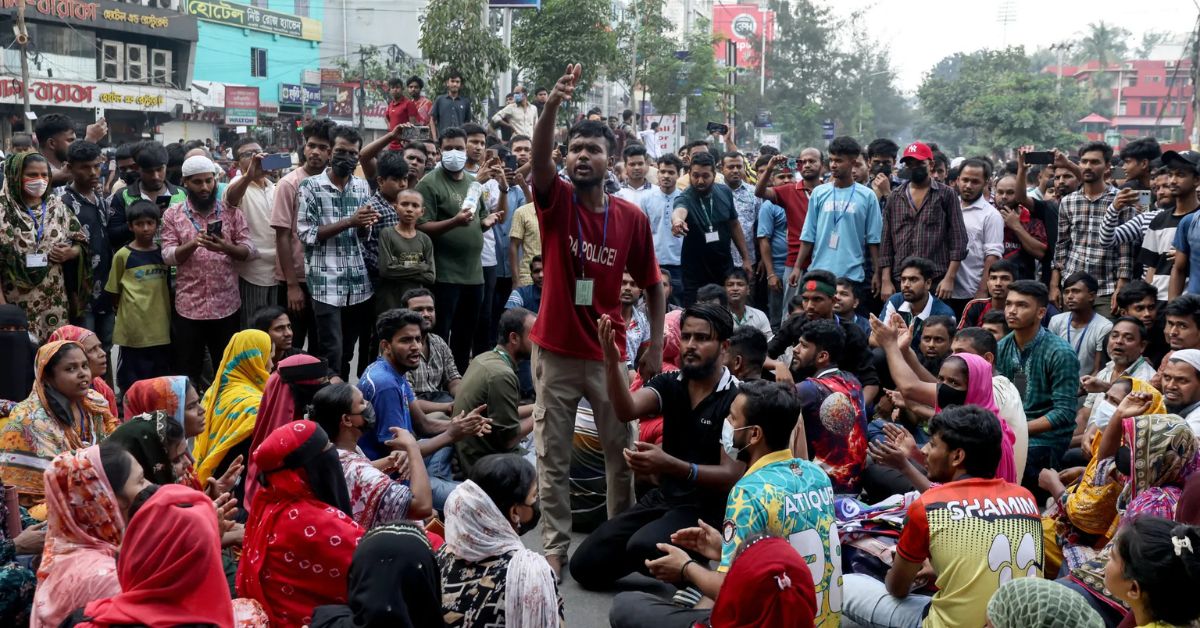

Bangladesh’s garment industry faced a fourth consecutive day of wage protests on 3 November, with factory closures and road blockades disrupting production across industrial areas around Dhaka. Workers are demanding a minimum monthly wage of Tk30,000, compared with the existing Tk12,500, citing rising living costs.
The demonstrations continued despite the government’s formation of a six-member wage board on 1 November. The unrest coincides with the production period for spring and summer export orders, increasing pressure on manufacturers supplying international clothing brands.
Where are factory operations and transport affected?
Clashes and demonstrations were reported in Ashulia, Gazipur and Dhaka’s Mirpur area. Police used tear gas and sound grenades, while factories suspended operations or declared holidays.
At least 200 factories remained closed in Savar and Ashulia on 3 November, while another 15 factories in Gazipur declared holidays, according to local reporting. These figures reflect specific industrial areas and should not be treated as a nationwide closure count.
Road disruption extended to Narayanganj, where demonstrators blocked the Dhaka-Narayanganj link road. In Gazipur, protests interrupted highway traffic, while trains temporarily stopped serving Mirpur-11 metro station in the capital.
The disturbances followed several days of interruptions. A Bangladesh Garment Manufacturers and Exporters Association (BGMEA) situation report recorded 529 factories declaring holidays on 1 November across Mirpur, Savar, Ashulia, Gazipur and Mymensingh.
What are workers seeking from the wage review?
Workers say the current minimum wage no longer meets household expenses, including rent, transport and utilities. The previous revision raised the minimum monthly wage from Tk8,000 to Tk12,500, effective from 1 December 2023.
Labour representatives have also raised concerns about employee blacklisting and dismissals, with demands extending beyond pay to reinstatement and employment practices.
The new wage board is chaired by Senior District and Sessions Judge Sheikh Ashfaqur Rahman and includes representatives of workers and employers, alongside an independent member. Labour and Employment Minister Ariful Haque Chowdhury urged the board to complete its work quickly, although no deadline for recommendations was announced when it was constituted.
BGMEA president Mahmud Hasan Khan said on 3 November that the board’s first meeting was expected the following day and could provide a timetable for the revised wage structure. Workers interviewed during the demonstrations expressed concern that a small increase would fail to cover their expenses.
What is the impact on export supply chains?
Industry representatives warned that prolonged shutdowns could delay shipments and jeopardise orders. Manufacturers also reported pressure from higher operating costs, energy-market uncertainty and weaker demand in major export markets.
However, H&M said it had experienced no major supply-chain disruption, with only a limited number of factories temporarily closed. The retailer said it was assessing potential effects on production and supported improvements in wages and working conditions.
The distinction remains significant: factory and transport interruptions have been reported, while the scale of any resulting export shipment delays has not been established.
Why the dispute matters for Bangladesh’s trade
Garments remain central to Bangladesh’s export economy. A World Bank assessment published in February 2026 put ready-made garments at 82% of national exports, illustrating the country’s exposure to disruption in this industry.
The bank has identified leather goods, footwear, plastics and light engineering as potential sources of export diversification. Its assessment also highlighted technology, skills and compliance gaps that constrain manufacturers’ access to international supply chains. These structural challenges form the wider backdrop to Bangladesh’s efforts to maintain export competitiveness and improve employment opportunities.
 Join our WhatsApp channel for more updates:
 Subscribe to our YouTube channel for more updates:




