
Summary
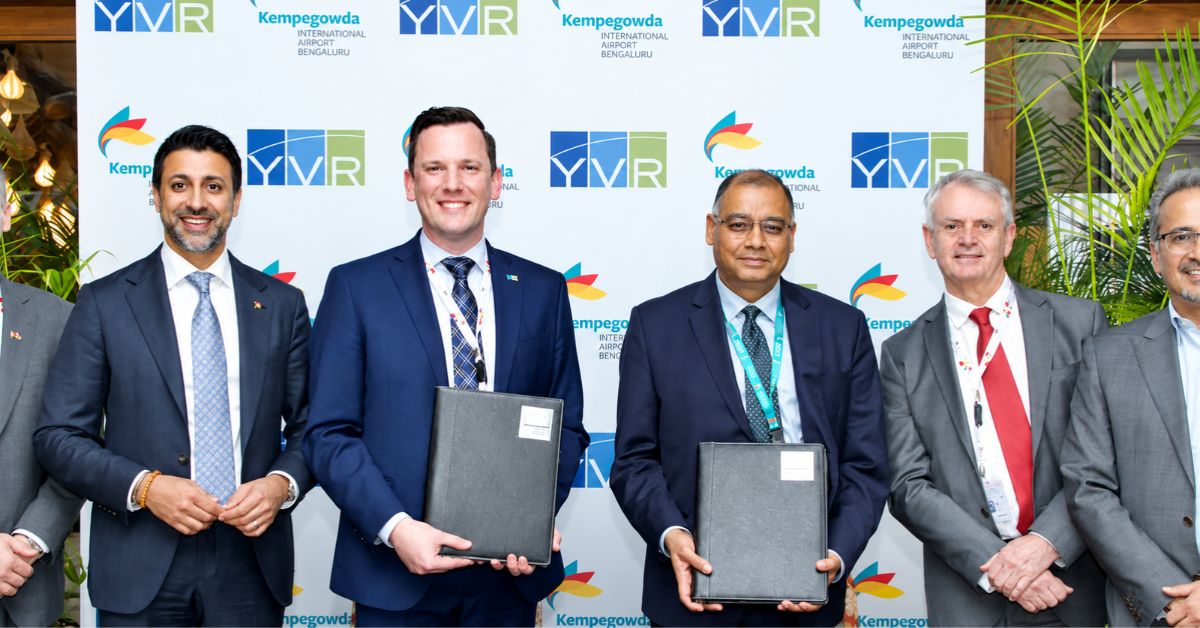
Bengaluru and Vancouver airports have signed a sister airport agreement to strengthen cargo, technology and operational cooperation between southern India and western Canada. Announced on 16 October 2026, the partnership also aims to encourage direct air connectivity, although no airline, launch date or operating schedule has been announced.
Partnership links two regional gateways
The Bengaluru–Vancouver airport agreement establishes a framework for cooperation between Kempegowda International Airport, operated by Bangalore International Airport Limited, and Vancouver International Airport.
The memorandum covers seven areas, including technology-led operational improvements, innovation and air cargo development. The announcement was marked at Bengaluru Airport’s Terminal 2 in the presence of Canada’s Minister of International Trade, Maninder Sidhu.
Proposed cooperation includes work involving Vancouver’s digital twin and opportunities to develop or test emerging technologies jointly. The airports also intend to exchange experience in sustainable operations and terminal performance management.
Cargo movement is a commercial priority
The partnership identifies improved air cargo movement between Canada and southern India as an objective, particularly in support of growing industries such as technology.
For freight forwarders and cargo owners, the commercial opportunity would depend on how cooperation translates into available capacity, handling arrangements and transport connections. An airport agreement creates a platform for engagement, while individual shipments remain dependent on airline networks and commercial services.
Closer airport coordination could support discussions about customer requirements and operational processes. Any resulting improvements in transit time or freight costs, however, would need to be demonstrated through actual services.
Direct flights remain a development objective
Establishing direct air service between Bengaluru and Vancouver is a stated goal of the partnership. The agreement itself does not constitute an airline route launch.
The distinction matters for both passengers and shippers. A future service would require an airline to commit aircraft, establish a schedule and assess the route’s commercial viability.
The bilateral aviation framework already provides substantial flexibility. In November 2022, Canada and India expanded their air transport agreement to permit designated airlines to operate unlimited flights, replacing the previous limit of 35 weekly flights for each country.
Bengaluru was among the six Indian cities accessible to Canadian carriers under that arrangement, while Vancouver was included among the Canadian gateways available to Indian airlines. Rights for all-cargo services were already unrestricted.
Those earlier rights provide regulatory context. They are separate from the new airport partnership and do not establish that a particular route will be operated.
Digital twin experience offers practical background
Vancouver’s digital twin provides an established technology base for the proposed cooperation.
In March 2023, the airport signed an agreement with Unity to commercialise its digital twin platform for the wider aviation industry. The system combines historical information, sensor inputs and real-time data, presenting operational information through two-dimensional and three-dimensional visualisations.
Its applications include planning, simulation, training and testing. Vancouver previously used the platform to help address passenger congestion at security checkpoints during the 2022 summer peak.
This earlier experience gives the Bengaluru partnership a practical reference point for examining technology applications. It does not mean that Bengaluru has already adopted the platform or commissioned a specific deployment under the new agreement.
Existing cargo activity underpins the opportunity
Both airports enter the partnership with substantial freight businesses.
Bengaluru handled 520,985 tonnes of cargo during calendar year 2025, up 5% from the preceding year. Its growth was accompanied by additional logistics infrastructure, including a domestic cargo terminal that became operational during 2025.
Vancouver handled approximately 365,000 tonnes in 2025, an increase of 7.4%. These figures describe each airport’s overall cargo activity rather than freight moving between the two cities.
The immediate significance is therefore the creation of a formal working relationship between two established gateways. Its operational value will emerge through specific projects, airline engagement and measurable improvements.
For the logistics industry, the developments to watch are defined cargo initiatives, technology trials and any subsequent airline announcement. These will show how the broad cooperation framework translates into services and capabilities that businesses can use.
FAQs
Which airports signed the agreement?
Kempegowda International Airport Bengaluru and Vancouver International Airport.
What does the partnership cover?
It covers operational, technological, economic and air-service cooperation, including cargo development.
Have direct flights been announced?
No airline, commencement date or schedule was announced with the agreement.
What is a digital twin?
It is a digital representation that uses data to support monitoring, planning, simulation and operational decisions.
Does the agreement guarantee lower freight costs?
No. Costs will depend on airline capacity, routing, handling and commercial arrangements.
 Join our WhatsApp channel for more updates:
 Subscribe to our YouTube channel for more updates: