



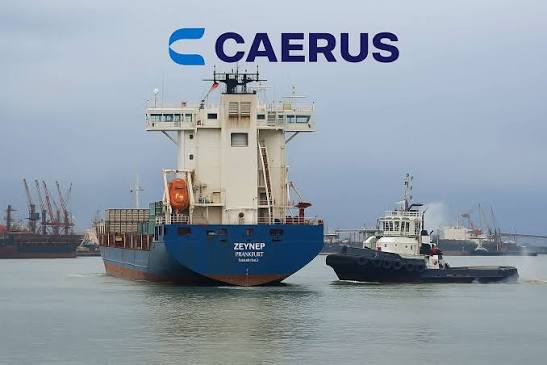

Caerus Shipping has introduced the Arab Sea Express (AXS), a direct container service connecting Sohar in Oman with Nhava Sheva and Mundra on India’s west coast. Operating every 14 days, the service adds a scheduled option for exporters, importers, freight forwarders and non-vessel-operating common carriers serving bilateral trade.
The company outlined the service in an announcement dated 16 November 2026. It also confirmed support for shipper-owned containers, allowing customers managing their own equipment to use the route, subject to booking and space confirmation.
What is the AXS port rotation?
The service follows the rotation:
Sohar → Nhava Sheva → Mundra → Sohar
Caerus Shipping’s published route information lists eastbound transit times of three days from Sohar to Nhava Sheva and seven days from Sohar to Mundra. Westbound transit times are six days from Nhava Sheva to Sohar and two days from Mundra to Sohar.
These are the carrier’s published port-to-port timings. They should be distinguished from the fortnightly sailing frequency and from the additional time required for inland transport, customs clearance and cargo delivery.
The launch information does not identify the inaugural voyage, deployed vessel capacity or a cargo-volume commitment.
Will the service carry refrigerated cargo?
Caerus Shipping is exploring refrigerated cargo opportunities, particularly fresh fruit and vegetable exports from India to Oman. It is also assessing other temperature-controlled commodities moving in either direction.
Reefer acceptance remains conditional on operational approval, equipment availability and vessel power connections. Customers therefore need shipment-specific confirmation of capacity, rates and monitoring arrangements.
The announcement presents refrigerated cargo as an area for development, rather than confirming a dedicated reefer allocation or guaranteed capacity on every sailing.
What logistics support is available?
The carrier’s local representatives in Oman provide assistance with port operations, documentation and container handling, alongside customs-clearance and inland-transport arrangements.
Teams at Mundra and Nhava Sheva support bookings, cargo coordination and operational enquiries. This gives customers contact points at both ends of the route for coordinating the ocean movement and associated landside requirements.
The service is available to freight forwarders and non-vessel-operating common carriers as well as cargo owners. Its acceptance of shipper-owned equipment provides an option for customers whose transport arrangements do not rely entirely on carrier-supplied containers.
What is the India–Oman trade backdrop?
According to the Embassy of India in Muscat, bilateral trade reached approximately US$11.19 billion in FY2025–26. India exported around US$4.02 billion of goods to Oman and imported approximately US$7.17 billion.
Oman ranked as India’s 27th-largest trading partner during that financial year. India was also among Oman’s leading commercial partners, ranking third among sources of Omani imports.
Indian imports from Oman include petroleum products, crude oil, fertilisers, inorganic chemicals and plastic raw materials. The broader trade relationship therefore encompasses substantial energy and industrial flows alongside cargo suitable for container transport. These aggregate trade figures should not be treated as the addressable volume for AXS or as a forecast of its utilisation.
How does Sohar support the connection?
Sohar combines a deep-sea port with an adjoining free zone and is managed by Sohar Industrial Port Company, a joint venture between the Port of Rotterdam and the Sultanate of Oman.
That port and industrial setting provides the Omani gateway for AXS, while the two Indian calls offer access through established west coast container ports. The new service’s commercial contribution will depend on confirmed bookings and the cargo flows developed around its fortnightly schedule.
 Join our WhatsApp channel for more updates:
 Subscribe to our YouTube channel for more updates: