
The Chennai Customs Brokers Association (CCBA) has threatened to boycott Mediterranean Shipping Company (MSC) export shipments from 15 November 2026 unless the carrier withdraws third-party collection of empty-container handling charges. Separately, Maersk has more than doubled its empty-container lift-on/lift-off rates at Mundra, adding to concerns over inland logistics costs.
The developments involve both the level of charges and the payment mechanism, with brokers challenging arrangements requiring customers to settle handling fees directly with nominated depots.
Why are Chennai customs brokers threatening a boycott?
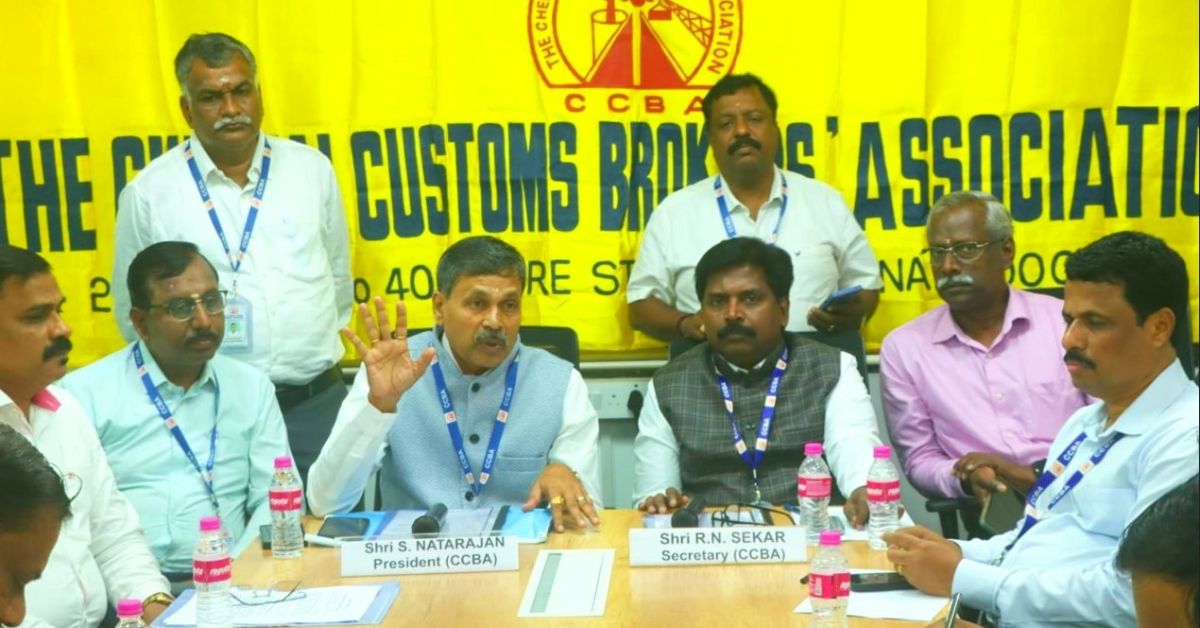
CCBA adopted its decision at an extraordinary general body meeting on 29 October. It also warned of extending the action to MSC import consignments from 15 December if the dispute remains unresolved.
Association president S. Natarajan said brokers accepted legitimate commercial charges but wanted shipping lines to collect them through their own invoices. CCBA argues that third-party collection creates uncertainty over tariff setting and accountability.
The association said exporters and importers sometimes refuse to reimburse these payments, leaving brokers to absorb the expense. Secretary R.N. Sekar also highlighted prolonged credit periods, which compound pressure on working capital.
CCBA has said its objections extend to other carriers adopting similar arrangements and that it remains open to discussions.
How much have Maersk’s Mundra charges increased?
Maersk’s revised Mundra rates took effect on 1 November. The lift-on/lift-off charge for a 20-foot empty container increased from US$23 to US$51, while the corresponding rate for a 40-foot container rose from US$31 to US$67. Local taxes are additional.
The changes represent increases of approximately 122% and 116%, respectively. In absolute terms, customers face an additional US$28 for a 20-foot container and US$36 for a 40-foot unit before tax.
These charges relate to handling empty equipment at depots. Maersk advised customers to make the necessary arrangements to support container collection and return operations. The Mundra tariff revision is separate from the threatened Chennai boycott, although both concern the cost and administration of empty-container movements.
What payment changes have other carriers introduced?
Published carrier advisories confirm that direct depot payment is being adopted elsewhere.
Hapag-Lloyd introduced a revised payment process at Chennai and Ennore empty-container yards from 1 November. Its advisory specifies charges of ₹725 for a 20-foot container and ₹975 for a 40-foot container, plus applicable Goods and Services Tax (GST).
Customers must pay the designated yard or depot operator when the container is handled. The operator issues the tax invoice after receiving the customer’s company name, billing address, GST identification number and invoice email address.
CMA CGM implemented a similar arrangement for export empty-container collections from Chennai yards on 15 October. Its published charges are ₹750 for a 20-foot container and ₹1,000 for a 40-foot container, plus GST.
The carrier explicitly states that it will no longer invoice these lift-on charges, with billing and collection undertaken by the respective depot.
What does this mean for container movements?
Both Hapag-Lloyd and CMA CGM require electronic payment through National Electronic Funds Transfer (NEFT) or the Unified Payments Interface (UPI), with cash payments excluded. Their instructions make payment and billing information part of the preparations for empty-container handling.
For Chennai, the immediate issue is whether discussions resolve the collection dispute before the proposed export boycott begins. The announced action remains conditional and should not be treated as an existing port-wide stoppage. The association’s demand centres on how legitimate charges are invoiced and recovered, alongside concerns about future increases
 Join our WhatsApp channel for more updates:
 Subscribe to our YouTube channel for more updates: