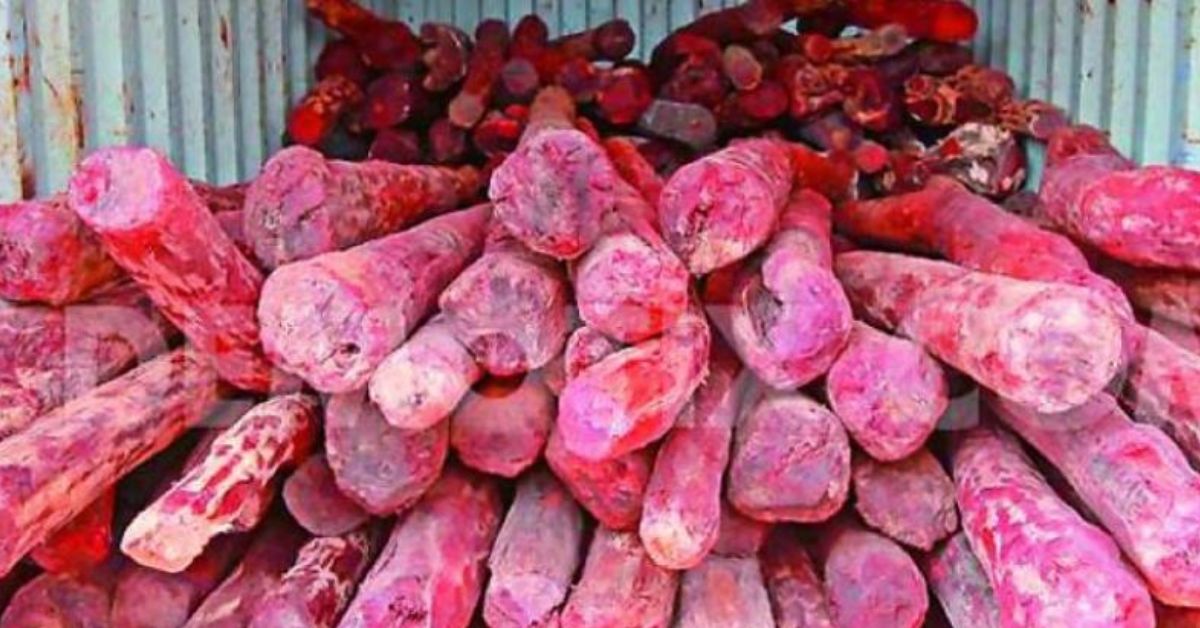

The Directorate of Revenue Intelligence (DRI) seized 12.87 tonnes of red sanders logs valued at about ₹7.72 crore from a Malaysia-bound container at Chennai Port and arrested three people in connection with the case. Officers intercepted the container before it was loaded onto a vessel during an operation from 9 to 11 November 2026, the Ministry of Finance said on 12 November. The consignment had been declared as paper laminate rolls.
What officers found in the Chennai Port container
Acting on intelligence about a suspected Chennai-based smuggling network, DRI officers examined the container on 9 and 10 November. They found the logs alongside a small quantity of paper laminate rolls and gravel. Officers seized the timber and the accompanying cargo under the Customs Act, 1962.
Investigators allege that the group used a consignment arranged through a manufacturer-exporter and took advantage of the exporter’s self-sealing facility. The DRI’s preliminary findings indicate that the container was diverted to a private warehouse, where the declared cargo was replaced with red sanders before the container was sent to the port.
Officers later searched the warehouse and recovered the original consignment of paper laminate rolls, an industrial weighing scale and traces of red sanders. The DRI said the findings supported its initial account of the cargo substitution. The three suspects were arrested under the Customs Act.
How India regulates red sanders exports
Red sanders (Pterocarpus santalinus) is protected under India’s Wildlife (Protection) Act, 1972, and is listed in Appendix II of the Convention on International Trade in Endangered Species of Wild Fauna and Flora (CITES). The listing subjects international trade in the species to controls. India’s export policy sets a zero export quota for wild specimens and allows limited exports of eligible cultivated material under authorisation.
Under a November 2025 notification from the Directorate General of Foreign Trade (DGFT), logs and roots sourced exclusively from cultivation on private land may be exported only under a Restricted Export Authorisation. Applicants must submit evidence of legal origin from the relevant state forest authority and a stock certificate issued after physical verification. These requirements establish the source and quantity of timber eligible for export.
The Chennai seizure illustrates the role of pre-loading checks in enforcing those controls. In this case, the shipping declaration identified a paper product, while the physical inspection established that the consignment contained protected timber. Intercepting the container at the port kept it off the outbound vessel.
FAQs
How much red sanders did the DRI seize at Chennai Port?
Officers seized 12,870 kilograms of red sanders logs, valued at approximately ₹7.72 crore. The container was bound for Malaysia.
What was the export container declared to contain?
The consignment was declared as paper laminate rolls. Officers found red sanders logs alongside a small quantity of the declared cargo and gravel.
Can cultivated red sanders be exported from India?
Eligible logs and roots grown on private land may be exported under a Restricted Export Authorisation, subject to proof of legal origin and verification of stocks. Wild specimens have a zero export quota.
 Join our WhatsApp channel for more updates:
 Subscribe to our YouTube channel for more updates: