



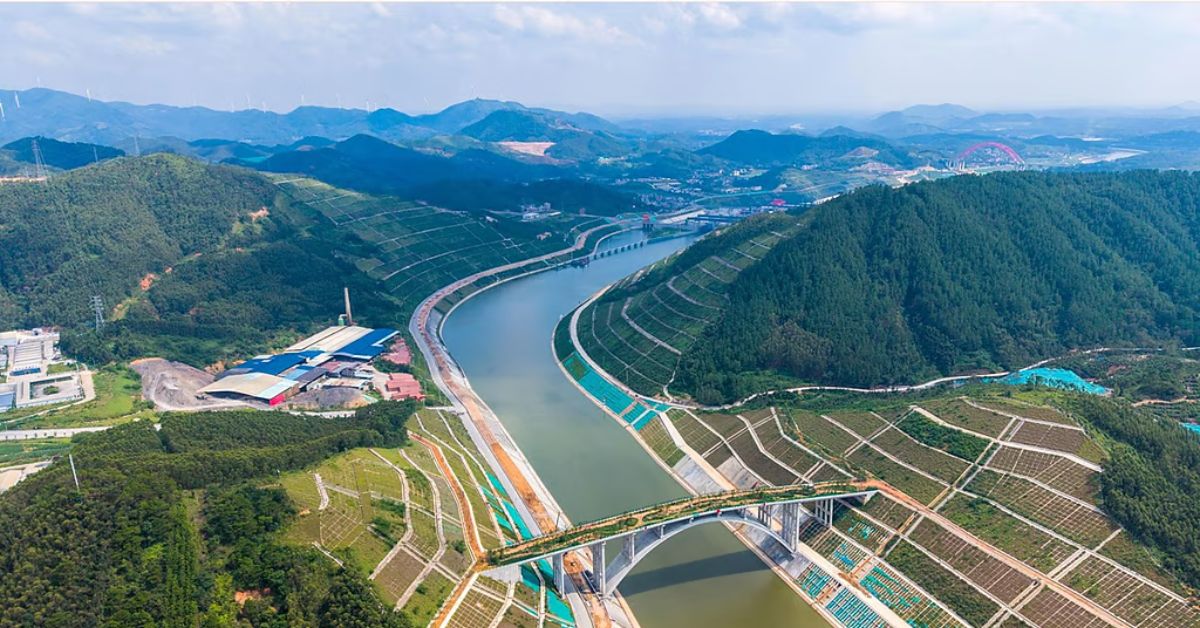

China opened the $10.75 billion Pinglu Canal, creating a new maritime gateway for the country’s southwestern hinterland and providing a shorter route to deepen trade with Southeast Asia, particularly the ASEAN region, state-run Xinhua news agency reported.
What role does the canal play in China’s broader trade infrastructure?
The canal forms part of the New International Land-Sea Trade Corridor, a strategic route linking China’s inland provinces with ASEAN and other global markets. It is the first river-to-sea canal project planned and coordinated at the national level since the founding of the People’s Republic of China in 1949, marking a significant infrastructure milestone for a region that has historically lagged behind China’s more prosperous eastern coastal provinces due to higher costs in transporting goods to seaports.
What are the canal’s key specifications and route?
Built for 72.7 billion yuan, about $10.75 billion, the 134.2 km canal connects Nanning, capital of the Guangxi Zhuang Autonomous Region, with the Beibu Gulf, the nearest maritime outlet for much of southwest China. Designed to accommodate vessels of up to 5,000 tonnes, the canal cuts more than 560 km from the inland waterway journey between southwest China and the sea compared with traditional routes through ports in Guangdong Province.
What cargo will benefit from the new route?
Coal, ore, grain, new-energy materials and automobile parts from the region will now have a more direct route to international markets, according to Xinhua. The canal is expected to reduce logistics costs by 18 to 30 percent and save more than 5 billion yuan, about $1.4 billion, in transportation expenses annually.
What did Guangxi officials say about the canal’s significance?
Lu Xinning, Vice Chairperson of the Guangxi regional government, said the canal establishes a new link between China’s 1.4 billion consumers and ASEAN’s nearly 700 million people. She said its significance could extend beyond the movement of goods, encouraging cross-border investment and promoting deeper integration of regional supply chains.
What engineering challenges did the project involve?
The canal took more than four years to build, with most of the waterway created by widening, deepening and straightening existing rivers, while some sections required excavation through dry land and mountainous terrain. A major engineering challenge involved overcoming a 65-metre difference in water levels, addressed through three navigation hubs equipped with twin-line ship locks to raise and lower vessels along the route.
What environmental measures were incorporated into the project?
More than 98 percent of the approximately 315 million cubic metres of excavated earth and rock was reused, according to Xinhua. The canal also features a more than 480-metre-long fish passage and a dedicated wildlife crossing for land animals, including leopard cats and squirrels.
How significant is China-ASEAN trade at present?
China’s trade with ASEAN surpassed $1 trillion for the first time last year. In the first seven months of 2026, bilateral trade reached $744.41 billion, up 24.7 percent year on year and accounting for 21.8 percent of China’s total foreign trade during the period.
What does the canal’s opening signal for China’s regional development strategy?
The canal opens in the first year of China’s 15th Five-Year Plan period, covering 2026-2030, as Beijing seeks to promote more balanced regional development and expand high-standard opening up, positioning the waterway as a key piece of infrastructure supporting deeper trade integration between China’s inland southwest and Southeast Asian markets.
 Join our WhatsApp channel for more updates:
 Subscribe to our YouTube channel for more updates: