



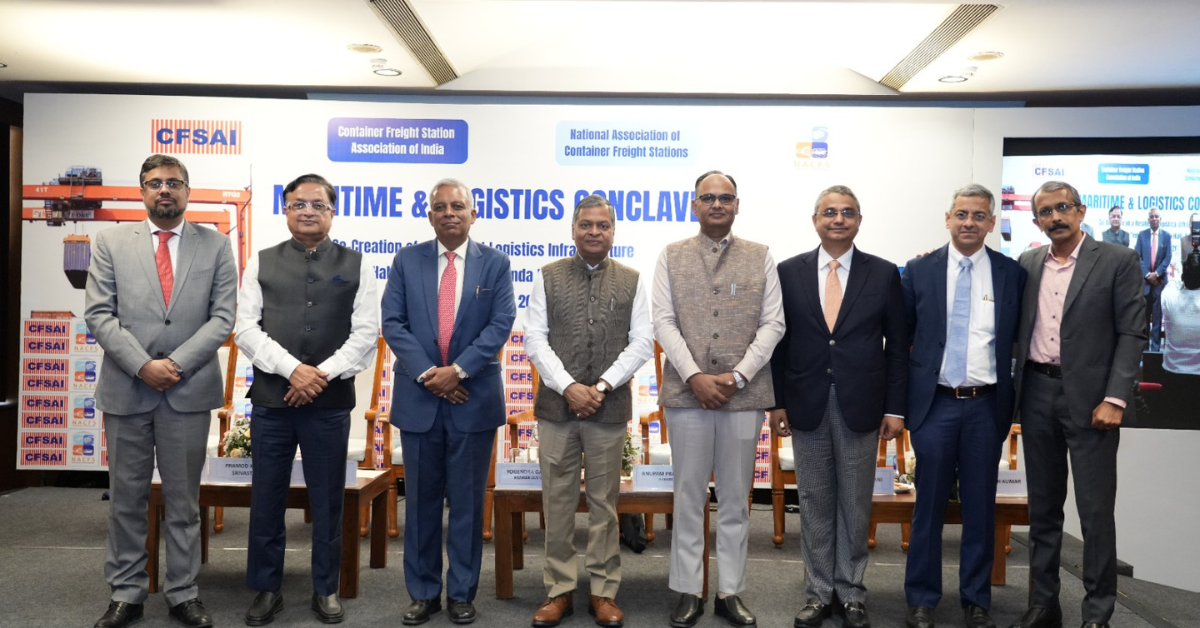

The National Association of Container Freight Stations (NACFS) and the Container Freight Stations Association of India (CFSAI) held a logistics conclave titled “Co-creation of a Resilient Logistics Infrastructure” in the capital yesterday. The conclave began with a welcome address, followed by two presentations.
In the welcome address, Pramod Kumar Srivastava, President, NACFS, stated that India was making rapid progress with the National Logistics Policy and Gati Shakti. There was rapid development, and a need to build resilience. He defined resilience as a system that does not stop under pressure, does not delay trade, is an infrastructure that adapts to change, and, most importantly, it means working together. India’s mission to become a global trade powerhouse will not depend merely on policy announcements; it will depend on the mission and on all the stakeholders. All partners in the chain needed to commit to collaboration and to building a logistics ecosystem. The commitment would achieve resilience and make India globally competitive.
Sameer Bhatnagar, Partner at KPMG, set the tone with a lucid presentation. He said that reliability in logistics movement was based on consistency, dependability, and predictability. When these factors are met, customers can expect to receive their cargo on time, every time. It was important that every mode in the link operated with the same efficiency and speed. The world was becoming increasingly interconnected across all modes of transport, making resilience and reliability less limited to a single mode.
Some countries are regarded as capable of high performance. In Germany, the focus was on traffic management, improving road transport, expanding rail transport, and identifying and removing choke points through regular analysis.
They look at the network as a whole. It was not just about developing resilience or reliability. They also look at interoperability through technology and process standardisation to enable a seamless, quick switch from one mode of transport to another, since different modes of transport were affected differently by factors such as the pilot shortage, the Red Sea crisis, and the trucking crisis during COVID.
In the second presentation of the day, Capt. Nishit Joshi, Sr V.P. – CFSAI & Vice President – NACFS, outlined how CFSs have evolved into a strategic backbone of India’s logistics ecosystem. He presented impressive statistical data. He stated that there were 125 functional CFSs. The network represented more than 20,000 crores of private investment and occupied about 4,000 acres of developed logistics land. CFSs provide a design capacity of about 12 million TEUs and currently handle 7.5 million TEUs per year, which was nearly 39% of the local port container volumes in India. The sector supported roughly 2.5 lakh direct and indirect jobs, making it a significant economic engine in addition to its logistics role. In FY2526, Indian ports handled 27 million. Of this, the local port volumes of cargo cleared via CFSs or directly at ports were about 19.2 million. CFSs processed 7.5 million, which was 39% of the total volume.
Joshi further elaborated on the role of CFSs. He stated that even at large private ports such as Mundra and Hazira, which have ample space, CFSs still handled about 22% and 37% of local cargo, respectively, indicating that CFSs were not peripheral but structurally embedded in the ports’ logistics ecosystems. CFSs play multiple interconnected roles in the EXIM supply chain. They are not just storage yards but integrated logistics hubs that extend ports and decongest marine terminals, enabling efficient, predictable cargo flows.
The CFS serves as an integrated logistics backbone. It provides end-to-end solutions for EXIM container handling, storage, stuffing and documentation, and connectivity to road and rail. This integration reduces handover points and improves reliability for shippers and consignees. The CFS functions as an extended gateway for container operations beyond the port boundary. It decentralises cargo handling, reduces pressure on marine terminal yards, and allows ports to focus on core marine operations. It also enables efficient cargo evacuation. Containers are quickly moved from the port container yard to the CFS, freeing yard space and speeding vessel turnaround. At the same time, CFSs ensure secure cargo storage and timely deliveries to importers and exporters, leveraging strong road and rail linkages to the end. CFSs are equipped to handle specialised cargoes such as reefer containers, hazardous materials, over-dimensional cargo, and project cargo. Doing this off-site reduces risks and enables more cost-effective, compliant handling of these sensitive loads. CFSs are a port decongestion tool. By shifting terminal clearance and storage activities, they significantly reduce yard occupancy, trucking, and overall dwell time within the port. They also directly support trade facilitation. They house customs and allied agencies, streamline documentation, and help deliver more predictable clearance timelines. This predictability is critical for exporters, importers, and global supply chain partners.
The keynote session featured an impressive array of speakers from the logistics industry. The panel comprised Suresh Kumar, President, CFSAI; Dushyant Mulani, Immediate Past Chairman, FFFAI; Anupam Prakash, IRS Joint Secretary (Customs), CBSE; and Sanjay Swarup, Chairman and Managing Director, Container Corporation of India (CONCOR). The Chief Guest was Yogendra Garg, an IRS Member at CBIC.
Prakash declared that India’s ambition to become a global logistics powerhouse was being built on the foundation of co-creation, where government policy, regulatory reform and industry capability reinforced each other at every step. Customs sat at the intersection of trade, technology and regulation. The reform introduced through the Union Budget 2026 reflected a fundamental shift in the role, from gatekeeping to enabling, from paper-driven processes to system-driven, trust-based processes, and from reactive compliance measures to proactive facilitation. CBIC is engineering the regulatory and digital architecture to support India’s growing logistics impact, thereby enabling faster, smarter and truly resilient trade flows. A few key initiatives taken by Indian Customs were.
A few key initiatives taken by the Indian Customs. CBIC has revamped a single digital gateway for all government exim interactions. One of the most transformative systemic reforms is the launch of Swift 2.0. Swift 2.0, CBIC’s single-window platform, provides a unified digital touchpoint for all regulatory approvals from any government department. Five key departments have been onboarded. It’s a revamped platform. Earlier, it was a PDF-driven ecosystem. Now it’s a digital, metadata-driven system where much of the targeted information and facilitation can take place simultaneously. We have completed our integration with the Food Safety and Standards Authority of India (FSSAI), the Animal Quarantine and Certification Service (AQCS), the Plant Quarantine Management System (PQMS), the Central Drugs Standard Control Organisation (CDSCO), and the World Customs Organisation (WCO).
Swarup, picking up on the conclave’s theme, said that resilient infrastructure and efficient logistics were in demand today, and that the Government of India was taking many initiatives to address them. The freight corridor has been connected to JNPA, a major landmark for the country, and very soon, trains will start regular operations by the end of May, which will be nothing short of a revolution in inland logistics. He assured the audience that transit times for exporters and importers would be reduced. A train starting from Dadri Terminal at 9 AM will reach JNPA by 9:00 the next morning, within 24 hours. CONCOR was in advanced talks with Indian Railways. The improved timing would reduce logistics costs and make Indian products more competitive in the international market.
CONCOR was involved in infrastructure development. They were conscious of Environmental, Social, and Governance (ESG) norms. About 95% of their transport was by Indian Railways, a green mode. In southern India, however, distances across the peninsula were very short, and roads became much more competitive than rail. As a multimodal company, CONCOR transported by road and also deployed LNG trailers, which were a green mode of transport. CONCOR, he stated, was working towards more and more Electric Vehicles (EVs). EVs were being used for inter-terminal movement. The battery technology currently gives them a lead of only 120-130 km for a 55-ton payload. However, with improvements in battery technology, he expects to move cargo over distances of 500 to 700 kilometres with a 55-ton payload. CONCOR would deploy EVs on a large scale for road transport. They had more than 250 LNG trucks, which were running mostly in South and Central India.
Garg did not doubt the resilience of India’s logistics infrastructure. The system had survived two major disruptions between 2020 and 2026, through COVID and the West Asia conflict. These instances were clear examples of the co-creation of this resilient infrastructure, with the government and service providers coming together to minimise disruption. But how could this be achieved, he asked. What was the challenge? In his opinion, the biggest challenge was a lack of trust. If mistrust between the government and the trade persisted, the gaps in the system would remain. There was a need to work together to ensure that import-export processes were efficient; otherwise, the entire logistics system would suffer. If inland logistics were inefficient, port or CFS logistics efficiency would not matter. Ultimately, it was most important for the end customer to receive the service as expected.
The entire activity centred on national growth. If India were to be among the top three, it was imperative to work towards that goal. Garg did not doubt that, at the core of the development dream, lay the maritime sector, because 90% of India’s trade by volume passed through it. So, unless the system is made competitive, India would not be able to compete globally.
Garg was aware of congestion at the CFS caused by uncleared cargo or cargo requiring disposal. They were seeking an efficient mechanism for disposing of these goods.
In another panel discussion, Atul Singh, Addl. Commissioner, CBIC, said that the way globalisation unfolded marked the time when things started to change. He said that the defragmentation had started across the country. Major changes were in the offing, such as dedollarisation. The government was prepared to handle any kind of disruption. Thus, resilience came from two parts, first from across the border over which we had no control. However, those events happening within our borders had to be in sync and resilient.
 Join our WhatsApp channel for more updates:
 Subscribe to our YouTube channel for more updates: