




Summary
Cochin Shipyard has begun steel cutting for three battery-electric harbour tugs being built for Denmark-based Svitzer. The 70-tonne bollard-pull vessels form part of a four-tug order for the TRAnsverse 2600e design, advancing the Indian yard’s capabilities in electric propulsion and supporting the international shift towards cleaner port operations.
Three vessels enter construction
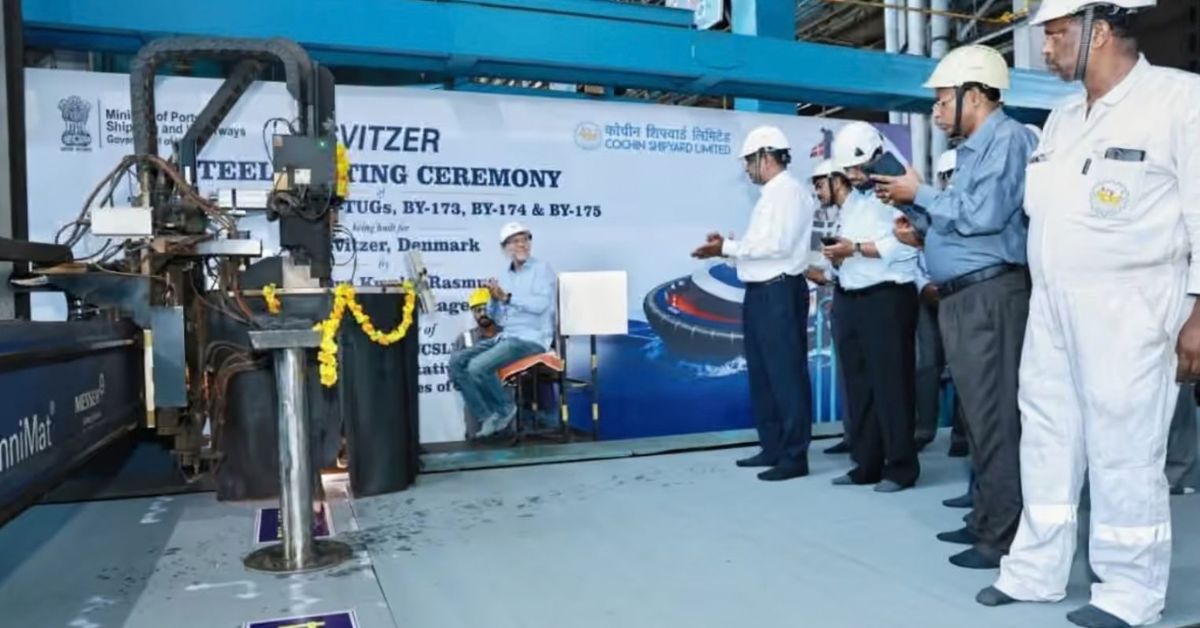
The Cochin Shipyard electric tugs programme has reached another construction milestone with steel cutting commencing for three TRAnsverse 2600e vessels commissioned by global towage operator Svitzer. The tugs, identified as BY-173, BY-174 and BY-175, are being built at the company’s Kochi facilities.
The ceremony was led by Jens Ove Kymler Rasmussen, Svitzer’s newbuilding site manager. It marks the start of steel fabrication for these vessels and the progression of the contracted programme into physical construction.
Each tug is designed for a bollard pull of 70 tonnes, providing substantial towing capability within a compact harbour vessel. Bollard pull measures a tug’s pulling force at zero forward speed and is a key specification for ship-assistance duties.
The vessels are intended for demanding port and terminal operations, including manoeuvring ships in confined waters and working under challenging weather and tidal conditions.
Four-tug contract provides the framework
The latest milestone concerns three vessels within a broader agreement signed on 8 December 2025. That contract covers a minimum of four 26-metre battery-electric TRAnsverse 2600e tugs, with options for up to four additional vessels.
The agreement followed a Letter of Intent signed during India Maritime Week in October 2025. It established Cochin Shipyard as a construction partner for Svitzer’s global fleet renewal programme, with the vessels built to the operator’s specifications.
The original contract announcement indicated that the first delivery was targeted no earlier than late 2027 or early 2028, subject to design completion, yard scheduling and regulatory approvals. This remains the earlier delivery guidance rather than a newly confirmed handover date.
The programme had already recorded a September 2026 construction ceremony. Cochin Shipyard’s announcement at that stage identified steel cutting for the first vessel in the four-tug series. The latest activity therefore extends construction across the remaining three identified hulls.
Electric propulsion supports cleaner harbour services
The TRAnsverse 2600e is the battery-electric version of Svitzer’s specialised harbour tug design. It combines propulsion and manoeuvring capabilities intended to give operators greater flexibility when assisting different ship types in restricted operating areas.
Svitzer has positioned the design around more predictable vessel movements and improved use of existing port infrastructure. At the September ceremony, the company said the wider TRAnsverse class had completed more than 3,000 commercial towage jobs. That operating experience relates to the design family, rather than these newly started electric vessels.
The electric tugs are designed to provide zero direct emissions during battery-powered harbour operations. Using renewable electricity for charging supports their wider decarbonisation benefits; emissions associated with electricity generation remain distinct from emissions produced aboard the vessel.
The project’s relevance consequently extends beyond hull construction to the integration of electric propulsion, vessel systems and the shore-side arrangements required for practical deployment.
Indian manufacturing gains specialist experience
Svitzer selected Cochin Shipyard after evaluating shipyards internationally. The collaboration builds Indian experience in constructing advanced electric harbour vessels for an established overseas customer.
At the earlier construction ceremony, the companies highlighted opportunities to strengthen domestic expertise in electric propulsion and high-specification shipbuilding. The work also connects Indian manufacturing with Svitzer’s international fleet requirements, although specific deployment ports for these vessels have not been confirmed in the announcements reviewed.
Domestic green tug policy provides background
The order progresses alongside India’s Green Tug Transition Programme, whose operating procedures were launched in August 2024. Its first phase runs from October 2024 to December 2027.
Jawaharlal Nehru, Deendayal, Paradip and V.O. Chidambaranar port authorities are each expected to procure or charter at least two green tugs during this phase. The initial vessels are envisaged as battery-electric, with provision for other emerging technologies.
The programme requires participating tugs to be built in Indian shipyards and envisages a transition to green tugs across major ports by the end of 2040. The Svitzer order is a separate commercial programme, but develops manufacturing capabilities relevant to that domestic transition.
FAQs
How many tugs are covered by the latest steel cutting?
Three vessels: BY-173, BY-174 and BY-175.
How many vessels has Svitzer ordered?
The contract covers four battery-electric tugs, with options for up to four more.
What are their main specifications?
They are 26-metre TRAnsverse 2600e battery-electric tugs with a stated bollard pull of 70 tonnes.
When is the first delivery expected?
The original contract announcement targeted first delivery no earlier than late 2027 or early 2028, subject to project conditions.
 Join our WhatsApp channel for more updates:
 Subscribe to our YouTube channel for more updates: