



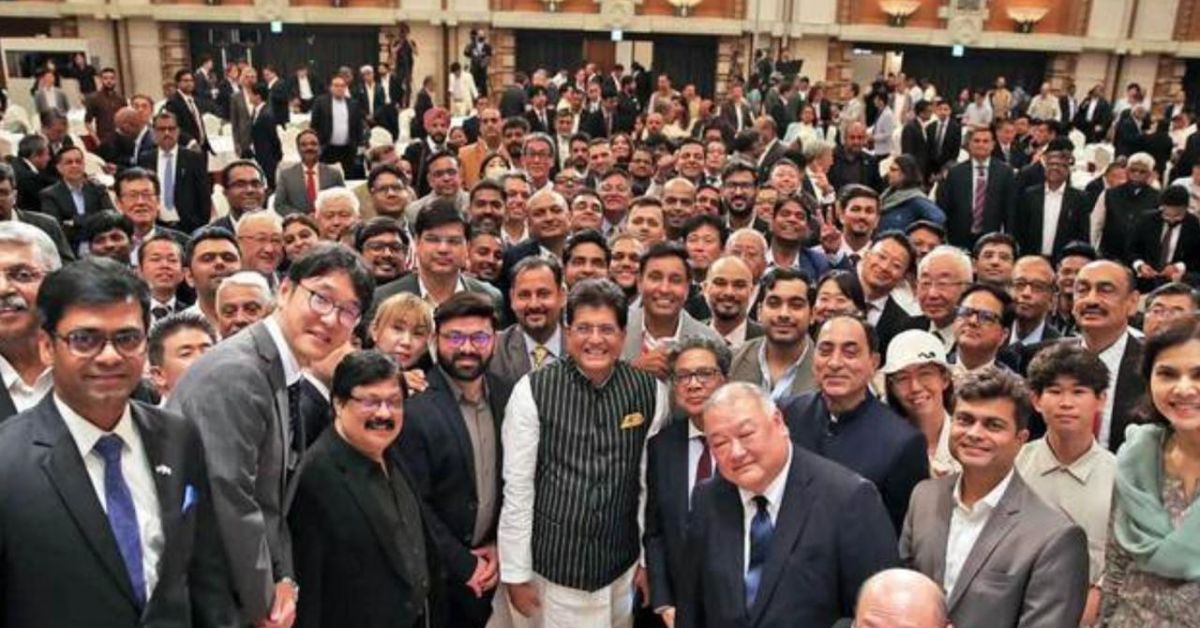

Union Minister of Commerce and Industry Piyush Goyal concluded his official visit to Japan on Wednesday, following a series of high-level engagements in Tokyo, Nagoya and Osaka aimed at accelerating Japanese investment in India, strengthening industrial partnerships and expanding bilateral economic cooperation across emerging and strategic sectors.
During the visit, Goyal held extensive discussions with senior Japanese government leaders, financial institutions and business executives, including the leadership of more than 30 major Japanese companies and financial institutions with significant or growing interests in India. The engagements focused on expanding investment, strengthening resilient supply chains, advancing technology partnerships and creating new avenues for business-to-business collaboration between the two countries.
A key focus of the visit was mobilising long-term Japanese institutional capital for India. Goyal engaged with leading Japanese financial institutions, including MUFG, Mizuho, Nomura, Nippon Life, Development Bank of Japan and Morgan Stanley MUFG Securities, besides other major investment and financial institutions, exploring opportunities to deepen capital flows into India’s expanding infrastructure, manufacturing, technology and financial ecosystem.
The Minister also chaired sector-specific roundtables on Capital Goods, Machinery and Automotive; Semiconductors and Artificial Intelligence; Startups; and Foreign Institutional Investors, bringing together Japanese and Indian businesses to identify concrete investment, technology and commercial partnerships, particularly involving India’s Tier-II and Tier-III supplier ecosystem and MSMEs.
At the Semiconductor and AI Roundtable, Goyal highlighted India’s ambition to build a globally competitive semiconductor ecosystem, with semiconductor demand projected to reach USD 150 billion by 2032, outlining the government’s six-pillar strategy covering chip design, semiconductor machinery and materials, fabrication, ATMP/OSAT, research and development, and talent development. He said India’s large pool of skilled and young talent, combined with Japan’s cutting-edge technology, engineering expertise and manufacturing capabilities, can catalyse a world-class semiconductor and technology revolution in India, also highlighting India’s expanding renewable energy capacity and robust national power grid as key enablers for energy-intensive industries such as semiconductor manufacturing, AI and data centres.
Japanese companies participating in the discussions expressed interest in expanding their presence in India across semiconductor materials and equipment, power semiconductors, electronics, AI, logistics and related advanced technologies, with discussions also covering supporting infrastructure including reliable power, ultra-pure water, skilled manpower and social infrastructure in emerging semiconductor clusters such as Dholera and Sanand.
The Minister held discussions with Japan’s Minister of Economy, Trade and Industry, H.E. Akazawa Ryosei, as well as senior representatives of JETRO, JBIC and JICA, covering trade and investment, resilient supply chains, manufacturing cooperation, technology, infrastructure and greater participation of Japanese companies in India’s growth story.
In his interaction with Keidanren, representing more than 1,500 leading Japanese companies, Goyal underlined the widening scope of the India-Japan economic partnership, encompassing traditional trade as well as economic security, resilient supply chains, advanced technology, clean energy, defence-related manufacturing and people-to-people linkages, inviting Japanese companies to scale up investments and expand their presence in India. Japanese business leaders warmly welcomed the Minister and reaffirmed their strong confidence in India’s growth story, expressing commitment to expanding strategic engagements and diversifying investments across India.
Goyal also addressed the “India-Japan Next Generation Economic Partnership” roadshow in Nagoya, organised in collaboration with Chukeiren and other leading business organisations, with more than 80 Japanese companies from the Chubu region participating in discussions covering automobiles, aerospace, machine tools, semiconductors, electronics, auto components and SMEs.
Highlighting India’s strong economic fundamentals, Goyal noted that the Indian economy recorded 7.7% growth despite global headwinds and is progressing towards the ambition of becoming a USD 30 trillion economy by 2047, underlining that India’s large and increasingly aspirational middle class, expanding digital economy, robust banking sector, renewable energy capacity and improving business environment are creating significant opportunities for long-term investors.
The visit also advanced efforts towards the target of JPY 10 trillion in Japanese private investment in India over the next decade, agreed upon during Prime Minister Narendra Modi’s visit to Japan in 2025, with Goyal calling for greater participation of Japanese institutional investors and companies in India’s next phase of growth, particularly in manufacturing, infrastructure, financial services, semiconductors, AI and clean energy.
The Minister also participated in a fireside chat moderated by Nikkei Asia, engaging with the Japanese and Indian business and media communities on the evolving contours of the bilateral economic relationship. The visit reaffirmed the strong momentum in the India-Japan Special Strategic and Global Partnership and provided fresh impetus to efforts to deepen trade, investment, technology and industrial cooperation.
 Join our WhatsApp channel for more updates:
 Subscribe to our YouTube channel for more updates: