



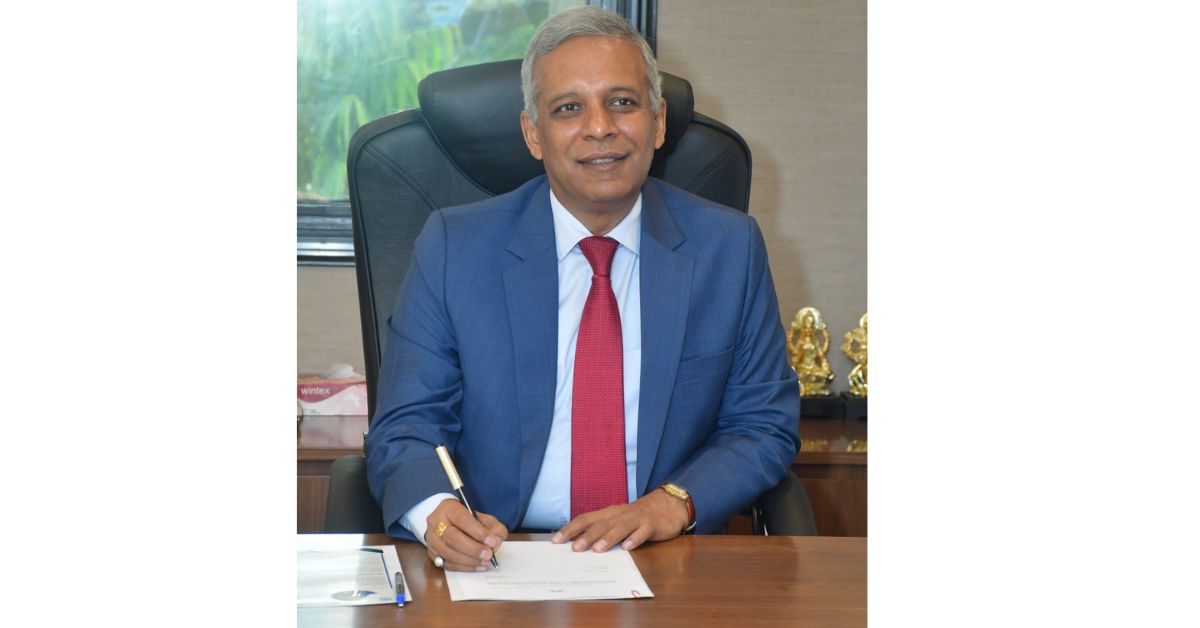

Sanjay Swarup took charge as CMD of Container Corporation of India (CONCOR) on October 1, 2023. Just a week before he demits office, Maritime Gateway Editor-in-Chief Ramprasad caught up with him to sum up his three-year journey at CONCOR.
An expert in dry ports and multimodal logistics parks (MMLPs), with rich experience in railway operations, commercial functions, and IT, Swarup commissioned and operationalised 15 greenfield MMLPs at around INR 3 billion each. He drove IT initiatives like KYCL, the Logistics App, a digital workplace solution, and an AI-based TMS, alongside marketing strategies that cemented CONCOR’s market leadership.
He streamlined Time Tabled and Double Stack container trains, saving 48 percent on empty flat wagon costs, led the INSTC MoU with JSC Russian Railways (RZDL), and strengthened rail links to Nepal and Bangladesh. He organised multimodal cargo exports to Iran, introduced Japanese passive cooling technology, launched a chat-based grievance system, and led CONCOR’s restructuring from a three-tier to two-tier structure.
In this candid conversation, he reflects on the milestones that reshaped CONCOR, the challenges that tested him, and the road ahead for the country’s largest container logistics company.
Q: Over your tenure as CMD, CONCOR has moved several initiatives — timetabled trains, double-stack container trains, greenfield MMLPs. Looking back, which of these changes do you see as the ones that most fundamentally reshaped how CONCOR does business?
We could bring in a lot of new initiatives during this period. The one I would single out first is our entry into shipping — a forward integration of our services to customers, extending even to foreign shores, which was very well received by trade.
The second big initiative was the transportation of bulk cement in tank containers on the domestic circuit, which has also been very well received. Right now we have a shortage of tank containers because it’s a new product still being manufactured in the country, but our fleet is gaining strength. We have ordered 2,000 more tank containers, and by the end of this calendar year, we should have a very good fleet in place — one that fulfils demand and brings a real revolution to cement logistics in India.
Another interesting development is the connection of the Western Dedicated Freight Corridor to Nhava Sheva, which happened just last month. We are now running double-stack trains from the NCR to Nhava Sheva — another big milestone. All in all, a lot of good things are happening in logistics right now. It’s a challenging time, but a very interesting one too.
Q: Of everything you drove during your term, which single decision or change gives you the most satisfaction today, and why?
At the start of my tenure, I placed a lot of emphasis on three things. The first was customer centricity — building strong relationships with our customers, which we already have. Whenever I travel, I make it a point to meet customers directly.
The second was giving customers a total logistics solution — end-to-end logistics, covering first mile and last mile. We’ve made real progress here: around 45 percent of our total volume is now handled end-to-end by us, with the remaining 55 percent still managed by the customer. That’s a big achievement, because three years ago we were in the range of just 10 to 12 percent.
The third was green logistics, because I strongly believe in ESG norms and environmental preservation. We’ve done very well on this front too — 95 percent of our transportation runs through rail, which is a green mode. We’ve also procured 230 LNG trucks, which are already running, and LNG is a much greener fuel compared to diesel. We’ve introduced electric vehicles for internal terminal use — ITVs — at a few terminals on an experimental basis, and they’ve been successful; we’re now procuring them in larger numbers. We’ve also deployed RTGs on electric power. I’m quite satisfied on all three fronts. When I leave this office, I will leave satisfied.
Q: Every tenure has its toughest stretch — a market disruption, an internal resistance to change, or a policy hurdle. What was the most challenging period or task you had to navigate?
That’s a good question. We are currently present at 68 locations, and we want to move quickly to 100. That’s the target set by the Honourable Minister of Railways — 100 terminals by 2028. But for that, we need land availability, and land acquisition has been the single biggest challenge I’ve faced.
Land acquisition is very difficult in our country. We’re trying through the DFC, through the Railways, through our own sources, and through state governments — but I’m not fully satisfied with the progress we’ve made. It remains a very big challenge. If land is made available to us, we can construct multimodal parks quickly. We keep trying, but progress has been slow.
Q: Is there something you had set out to achieve for CONCOR that you weren’t able to complete within your term?
Yes — there is one unfinished task: the Bharat Container Shipping Line, which has been conceived, and where we are a 30 percent partner. Its current status is that it’s headed to the Union Cabinet for approval. Once that comes through, it will be operationalised, and procurement — of vessels and containers — will begin in parallel. Once it’s operational and the management structure is in place, I expect it to start working within six months to a year. That is the one task I’ll be handing over unfinished.
Q: As you hand over charge, how do you see CONCOR’s next phase — on rail-linked logistics parks, EXIM growth, competition from private players, and India’s broader logistics ambitions? What should the industry watch for in CONCOR’s future?
CONCOR has got a very bright future. We are present at four locations on the Western DFC, which is going to be crucial going forward — a fifth is already under construction and should be ready within a year. That will give us five locations on the Western DFC, and with Nhava Sheva now connected to the DFC, these are genuinely interesting times. We already have huge pendencies at ports, and running double-stack trains is bringing a lot of satisfaction to customers. Add to that our domestic bulk cement business.
There’s one more very big contract we’re going to sign soon. Cargo is currently moving from western India to south India, but the containers need to come back — so we’re finalising a major contract in south India from which loaded cargo will move north and west. That will address the empty running problem and multiply our domestic loading. Our initial estimate is that it should add around one million tonnes of domestic loading a year — a huge number, considering our current domestic volume is only around 14 to 15 million tonnes. That’s a significant incremental jump, on top of what bulk cement will add. Trade is very positive about us right now, and they’re appreciating our services despite various constraints. CONCOR has got a very bright future — it should do very well.
Q: On a scale of ten, what’s your satisfaction level about your time as CMD? Ten on ten. I am very satisfied.
 Join our WhatsApp channel for more updates:
 Subscribe to our YouTube channel for more updates: