





Summary
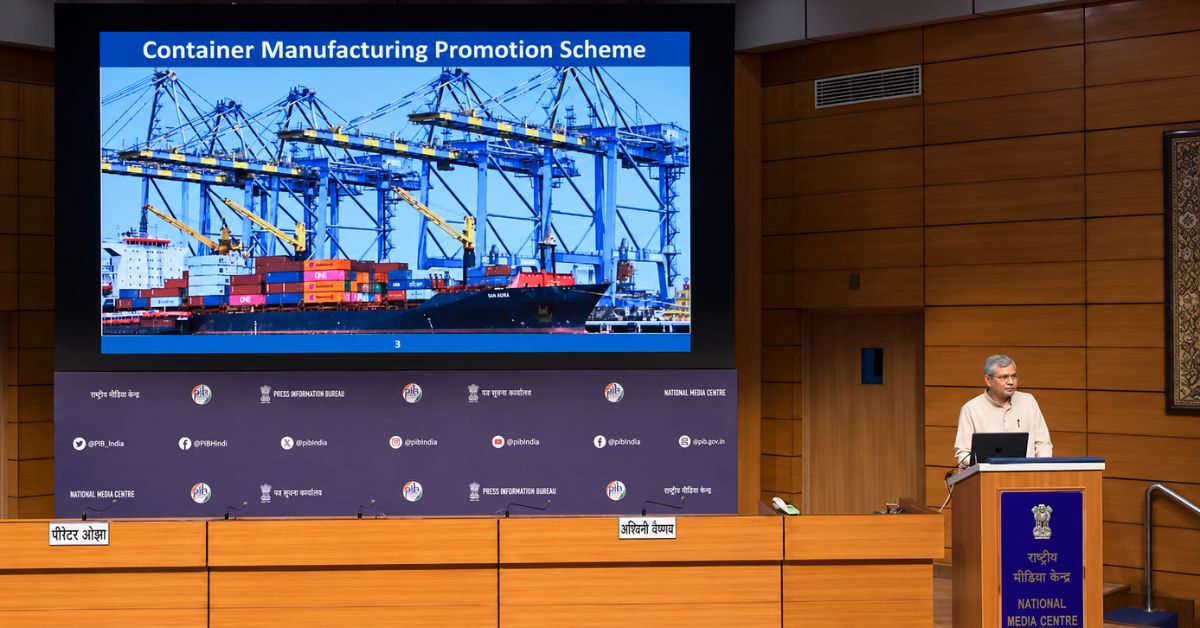
The Union Cabinet has approved the ₹10,000 crore Container Manufacturing Promotion Scheme to expand domestic production and reduce dependence on overseas suppliers. Running from FY2027–28 to FY2039–40, the programme combines financing support, production assistance, testing infrastructure and concessional port land, targeting annual manufacturing capacity of 750,000 TEUs.
Support targets new factories and expansion
The Container Manufacturing Promotion Scheme, approved on 28 October 2026, aims to increase India’s annual capacity from approximately 70,000 TEUs to 750,000 TEUs.
The programme provides three years for establishing facilities and ten years of production support.
Its largest component is ₹8,891 crore in operational expenditure assistance for eligible containers manufactured to international shipping standards and sold. Domestic content must progressively increase from 70% to 90%.
A further ₹859 crore supports annual interest subvention of 3% on eligible term loans. Minimum capacity thresholds are 100,000 TEUs for greenfield plants and 25,000 TEUs for brownfield expansion.
Testing and certification receive ₹150 crore, while ₹100 crore covers management, monitoring and capacity building. Major-port land leasing support is proposed at 25% of the notified rate.
An inter-ministerial steering committee chaired by the shipping ministry secretary will approve guidelines and sanction assistance.
Production support addresses commercial competitiveness
The structure places substantial emphasis on the recurring cost of making containers, alongside assistance for factory investment.
For prospective manufacturers, that combination addresses two separate requirements: financing production capacity and selling containers competitively once facilities begin operating.
The capacity thresholds also indicate an emphasis on scale. Smaller component suppliers could participate through the manufacturing chain even where they do not establish eligible container assembly facilities themselves.
Actual investment decisions will depend on detailed guidelines, assistance calculations, financing availability and customer contracts. Cabinet approval establishes the programme; individual factories and production volumes will follow through implementation.
Earlier orders provide a commercial starting point
The approval follows initial efforts to establish Indian-made containers in international shipping networks.
In July 2026, an India-manufactured EXIM container for A.P. Moller–Maersk was unveiled at the Maersk–CONCOR inland container depot in Dadri, Uttar Pradesh.
An August government backgrounder also recorded Maersk’s order for 1,000 additional Indian-made containers from the DCM Shriram Group. These developments provided early commercial references for domestic manufacturing before the latest Cabinet decision.
Such orders matter because a manufacturing programme ultimately needs repeat purchasing from shipping lines, leasing companies and other equipment users. Installed capacity alone does not establish customer acceptance or sustained factory utilisation.
The next stage will require manufacturers to demonstrate consistent quality, dependable delivery and competitive lifetime costs.
Domestic production and container availability are different challenges
India’s reliance on overseas manufacturing is one part of a wider equipment-management problem.
The August backgrounder noted that nearly two million empty containers enter India annually for domestic requirements and repositioning. That movement should not be interpreted as an equivalent number of newly purchased containers.
Containers already in circulation must be positioned where exporters need them. Local manufacturing can diversify procurement, but equipment availability also depends on shipping networks, trade imbalances and the movement of empty boxes.
For exporters, the practical benefits will therefore depend on how new production connects with buyers and distribution networks. More domestic factories will not automatically eliminate shortages at individual gateways or inland locations.
Testing is essential for international acceptance
The programme’s testing allocation addresses a requirement extending beyond manufacturing volume.
The International Convention for Safe Containers establishes international procedures for testing, inspection, approval and maintenance. Its purpose includes protecting people handling containers and facilitating their movement through consistent safety requirements.
Approved containers carry a safety approval plate. Recognition between contracting states allows compliant equipment to move internationally with fewer repeated safety formalities.
Owners remain responsible for maintenance and periodic examination after initial approval.
Domestic testing capability could make qualification more accessible, while manufacturers will still need to meet applicable specifications and approval requirements.
For steelmakers, component businesses and logistics providers, the scheme creates an opportunity to develop a broader industrial supply chain. Its success will be measured through commissioned plants, compliant containers sold, repeat orders and sustained competitiveness as production assistance progresses.
FAQs
What is the scheme’s budget?
The approved outlay is ₹10,000 crore.
How long will it run?
From FY2027–28 to FY2039–40, including facility establishment and production support.
What capacity is targeted?
Annual domestic manufacturing capacity of 750,000 TEUs.
Can existing manufacturers participate?
Yes. The programme supports eligible brownfield expansion as well as new facilities.
Will it automatically resolve container shortages?
No. Manufacturing expands equipment supply, while availability also depends on purchasing, shipping networks and empty-container repositioning.
 Join our WhatsApp channel for more updates:
 Subscribe to our YouTube channel for more updates:




