




Freight movement on the dedicated freight corridors (DFCs) has increased nearly 15% over the past year, with combined traffic reaching 438 trains a day in August. This means the two corridors are now operating at over 91% of their stated capacity of 480 trains a day.
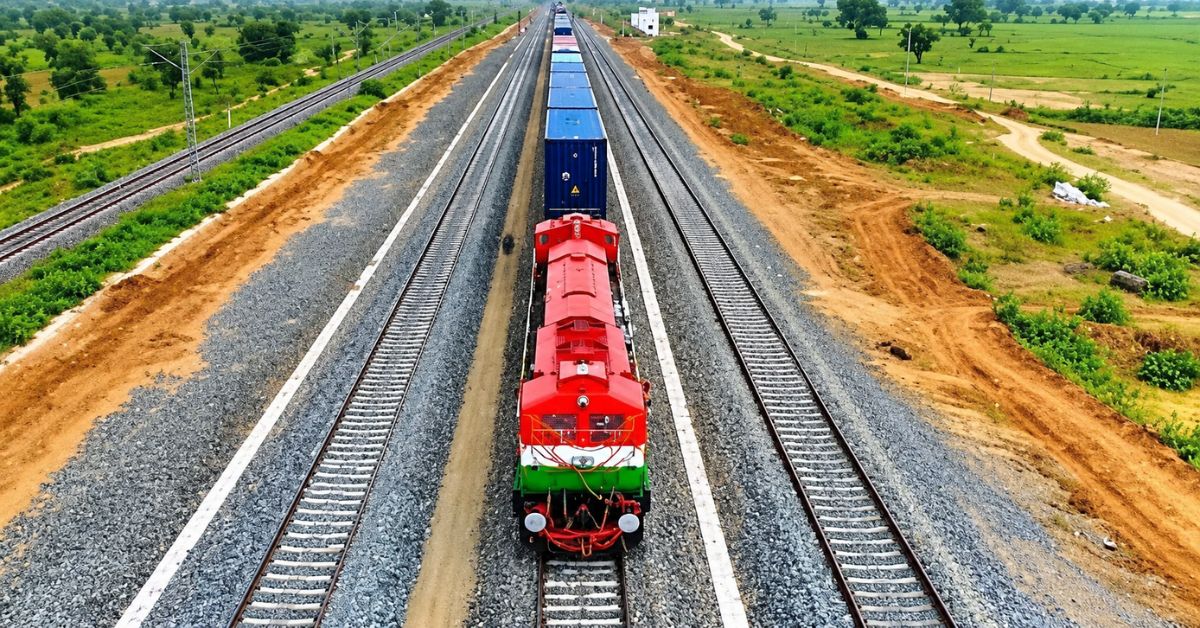
Official data shows that the Western Dedicated Freight Corridor (WDFC), which was inaugurated by Prime Minister Narendra Modi on Tuesday, alone recorded a monthly record of 210.4 trains a day, or nearly 88% of its stated 240-train daily capacity, even before its full commissioning.
The opening of the New Saphale-Jawaharlal Nehru Port Authority (JNPA) section by the PM will allow freight to move directly between Dadri and JNPA, instead of being transferred to the Western Railway network for the final leg. This is expected to reduce transit time and improve the reliability of freight movement on the corridor.
Earlier, freight moving on the WDFC had to be offloaded at terminals such as New Sanjali and Palanpur and then carried by the conventional railway network to JNPT. With the final leg now operational, freight movement on the corridor is expected to become faster, with fewer handling points and lower transit time, which is expected to improve the efficiency of container movement and allow the corridor to handle even higher freight volumes.
Despite the recent rise in traffic, the corridors are already operating close to their stated capacity. WDFC handled 210.4 trains a day in August, 87.7% of stated capacity, while EDFC recorded 227.6 trains a day, 94.8% of stated capacity.
The capacity constraint does not necessarily mean freight volumes cannot rise further, since the use of long-haul and double-stack trains, particularly on WDFC, can increase the amount of cargo moved per train without requiring a proportional increase in train movements.
Train movement on the two corridors rose nearly 13% year-on-year to an average 435.5 trains a day during April-August 2026, from around 385.5 trains a day in the corresponding period last year. DFC accounts for just 4% of the railway network but carries more than 14% of the rail freight.
The WDFC has a different cargo profile from the eastern DFC. The western corridor largely carries containers and other high-value freight, which tends to be lower in volume than high-density commodities such as coal. The corridor’s advantage is therefore not just the number of trains it carries, but the faster and more reliable movement of high-value cargo over long distances.
The two corridors cover 2,843 km, the 1,337-km EDFC from Ludhiana to Sonnagar and the 1,506-km WDFC. The projects were conceived more than two decades ago and were initially targeted for completion around 2016-17. Delays in land acquisition, clearances, financing and contracting pushed back execution, with construction gaining pace in the last 10-odd years.
With the completion of the DFCs, the government has now moved towards expanding the DFC network. The Union Budget 2026 announced a new 2,052-km East-West DFC connecting Dankuni in West Bengal with Surat in Gujarat, with the detailed project report submitted to the Railway Board for approval.
 Join our WhatsApp channel for more updates:
 Subscribe to our YouTube channel for more updates: