




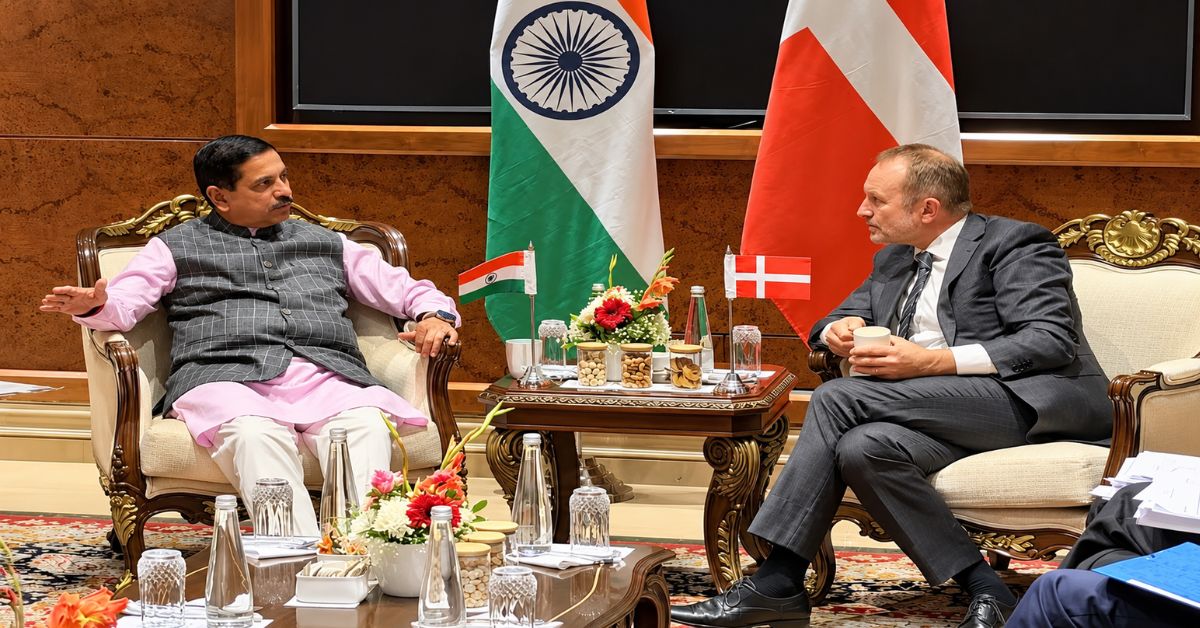

Denmark’s Minister for Business and Competitiveness, Martin Lidegaard, met Maharashtra Governor Jishnu Dev Varma in Mumbai on 2 November to explore closer cooperation in energy, technology, education and investment. The engagement formed part of a wider India visit focused on renewable energy, green shipping and artificial intelligence.
During the meeting at Lok Bhavan, Lidegaard highlighted the presence of 63 Danish companies in Maharashtra, including shipping and logistics group Maersk. He identified energy as a significant area for further bilateral cooperation.
What did the Maharashtra discussions cover?
Lidegaard outlined opportunities under the India–Denmark Green Strategic Partnership, including wind and solar energy, green hydrogen and life sciences. He also expressed interest in collaboration in education and artificial intelligence.
The minister said Maharashtra could benefit from the proposed India–European Union Free Trade Agreement. Governor Dev Varma briefed the delegation on India’s progress in education, skills, digital transactions and artificial intelligence.
Danish Ambassador Rasmus Abildgaard Kristensen and Deputy Permanent Secretary for International Business Tine Nielsen Hertz were among the delegation members. The official account described discussions on cooperation without announcing a specific investment commitment or project agreement.
Why is green shipping part of the visit?
Denmark’s Ministry of Business said the minister’s programme in Mumbai and New Delhi was designed to strengthen cooperation in renewable energy, emerging technologies and green shipping. It also sought to expand commercial opportunities and collaboration between government authorities.
According to the Danish ministry, nearly 200 Danish subsidiaries operate in India, employing approximately 100,000 people. Danish companies exported goods and services worth DKK 21.2 billion to India in 2025.
The ministry framed the visit as an opportunity to connect Denmark’s capabilities in green technologies with India’s investment in energy and infrastructure, while learning from the scale and pace of Indian development. Maritime cooperation is therefore part of a broader commercial and technology agenda.
What maritime cooperation is already in place?
The two countries’ maritime relationship sits within the Green Strategic Partnership launched in 2020. In September 2024, they extended their memorandum of understanding on maritime issues for another three years.
The cooperation framework covers shipping standards, port state control, maritime education, research, shipbuilding and green maritime technologies. A joint work programme has also addressed green and digital initiatives through cooperation between Indian maritime authorities and the Danish Maritime Authority.
In 2025, the countries established the Indo-Danish Centre of Excellence on Green Shipping. Denmark’s official account identifies alternative fuels, sustainable shipbuilding, port electrification, digitalisation, seafarer training and environmentally sound ship recycling among the partnership’s areas of work.
How far has work on green shipping corridors progressed?
Green shipping corridors have become a practical focus of the partnership. During ministerial discussions in Copenhagen in June 2025, the two sides agreed that the Centre of Excellence would support a pre-feasibility study to assess potential corridors in India.
The study was assigned to the Mærsk Mc-Kinney Møller Center for Zero Carbon Shipping, working with Indian and Danish institutions. Its purpose was to assess the components required for potential routes and identify promising opportunities.
Findings were presented at a consortium-building workshop in New Delhi on 28 May 2026. The assessment examined alternative fuel availability, port and bunkering readiness, cargo flows, vessel deployment and supporting policies.
The workshop brought together representatives from government, ports, shipping, energy, logistics and industry. This ongoing technical work provides a concrete foundation for the wider maritime discussions accompanying Lidegaard’s visit, with corridor development still requiring coordination across fuel suppliers, ports and vessel operators.
 Join our WhatsApp channel for more updates:
 Subscribe to our YouTube channel for more updates:




