


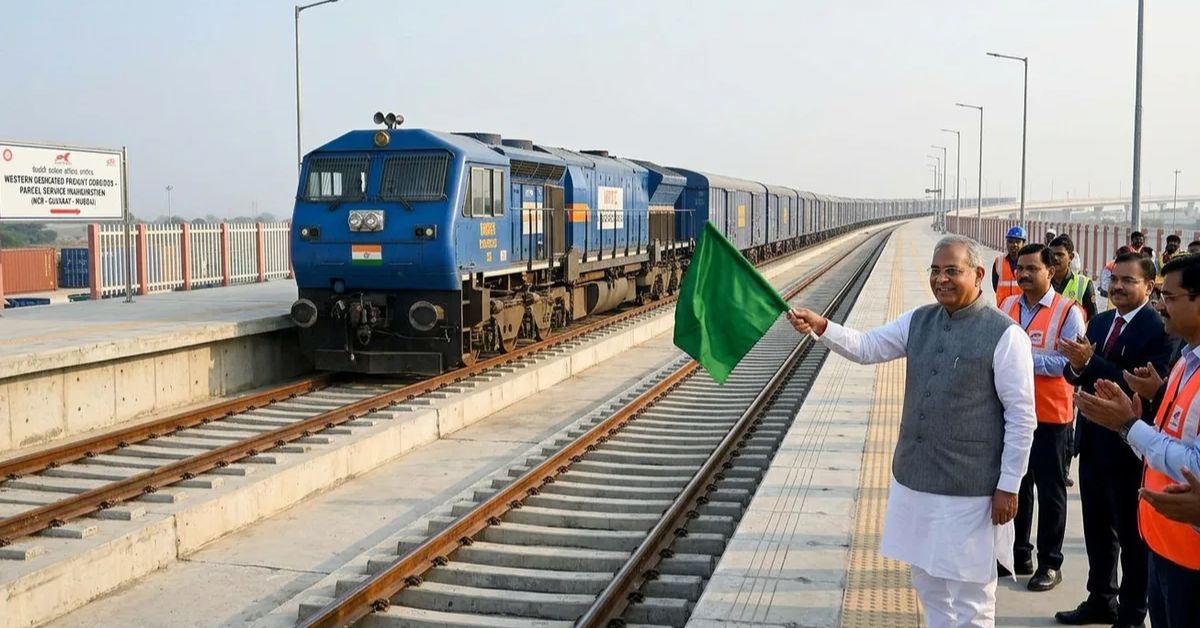

Dedicated Freight Corridor Corporation of India Limited launched a rapid cargo parcel service on the Western Dedicated Freight Corridor, connecting major logistics hubs across the NCR and Northern India with industrial centres in Gujarat.
Who launched the service and how does it improve on existing connectivity?
Dr Manoj Singh, Member (Operations and Business Development) at the Railway Board, flagged off the train in the presence of senior officials from DFCCIL and the Railway Ministry. Officials said the existing parcel service through NMGHS (New Modified Goods High Speed) wagons had primarily catered to destinations up to Ahmedabad. With the introduction of the Joint Parcel Product-Rapid Cargo Service on the DFC, parcel traffic can now extend beyond the Ahmedabad region, enabling Surat and Mumbai-bound parcels to be transported and further connected to their destinations.
What route and schedule will the service follow?
The service commenced from New Dadri station on August 18, 2026, with the return down-direction service from New Ancheli station beginning August 20, 2026. It covers an approximate distance of 1,200 km one way between New Dadri in Uttar Pradesh and New Ancheli in Gujarat, with intermediate loading and unloading at New Motidau station. The scheduled transit time is approximately 23 hours, providing a rail-based logistics solution between northern and western India.
What does DFCCIL say this milestone represents?
DFCCIL described the launch as an important step toward strengthening rail-based logistics and providing faster, reliable and efficient transportation solutions for parcel movement, calling it a significant milestone in developing time-sensitive, customer-oriented rail logistics, particularly for the e-commerce and FMCG sectors.
How does the JPP-RCS model work end to end?
DFCCIL said JPP-RCS provides an integrated rail-and-road logistics solution covering the complete movement of goods from origin to destination. This includes collection of goods from customers by aggregators, loading and unloading, rail transportation on a fixed timetable, delivery to end customers by aggregators, and seamless integration of rail and road transport.
What revenue potential does the service offer?
The service is expected to generate approximately Rs 21 lakh per round trip, translating into an annual revenue potential of around Rs 76 crore with regular operations. Parcel space booking is facilitated through the Virtual Aggregation Platform on DFCCIL’s Freight Business Development portal, offering a transparent digital interface with bookings possible up to 180 days in advance, alongside integration with aggregator websites, digital tracking and improved logistics planning.
What environmental benefits does the shift to rail offer?
DFCCIL said JPP-RCS provides a more sustainable alternative for long-distance parcel movement by shifting suitable traffic from road to rail. Officials noted that while trucks account for only around 3 percent of India’s vehicle fleet, they contribute nearly 34 percent of transport-related CO2 emissions and 53 percent of particulate matter emissions, underscoring the environmental case for expanding rail-based parcel logistics.
 Join our WhatsApp channel for more updates:
 Subscribe to our YouTube channel for more updates: