
Summary
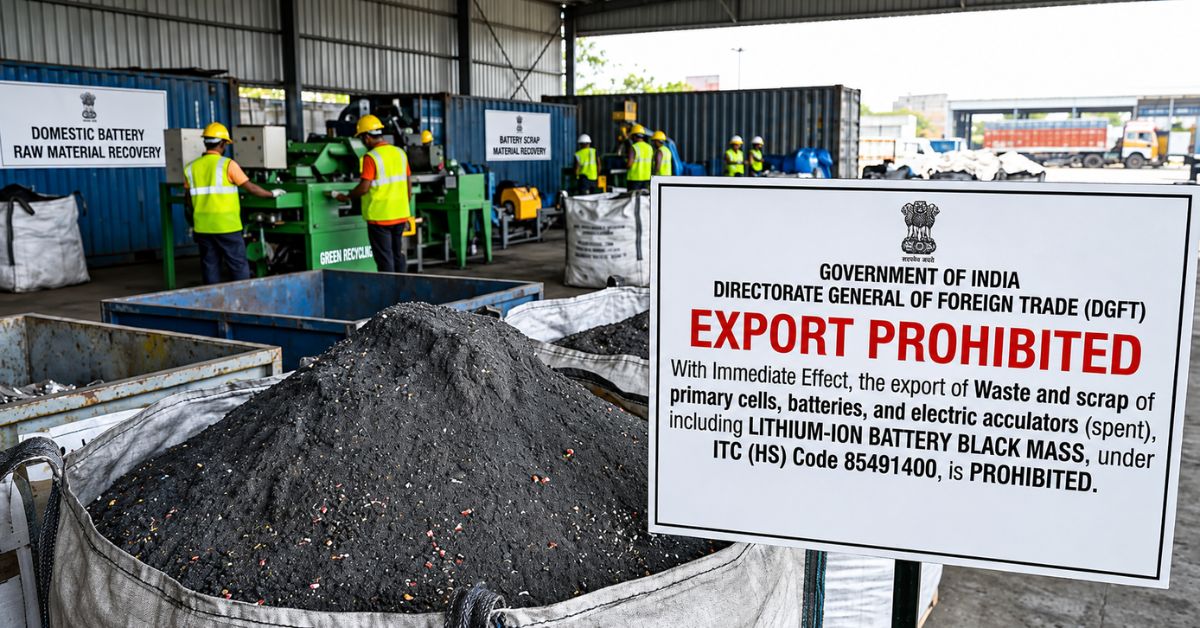
The Directorate General of Foreign Trade (DGFT) has prohibited the export of lithium-ion battery black mass under ITC(HS) Code 85491400 with immediate effect. The restriction, notified on 10 November 2026, aims to retain battery waste within India, improve feedstock availability for domestic recyclers and increase the recovery of critical minerals such as lithium, cobalt, nickel and manganese.
Article
DGFT changes export policy from ‘Free’ to ‘Prohibited’
The Directorate General of Foreign Trade (DGFT), under the Department of Commerce, has prohibited the export of lithium-ion battery black mass through Notification No. 49/2026-27, dated 10 November 2026.
Under the notification, the export policy for the material covered by ITC(HS) Code 85491400 has been changed from ‘Free’ to ‘Prohibited’ with immediate effect and until further orders. The transitional arrangements under Para 1.05 of the Foreign Trade Policy (FTP), 2023, will apply.
The specified ITC(HS) code covers waste and scrap of primary cells, primary batteries and electric accumulators, including spent cells and batteries that are unsorted and do not contain lead, cadmium or mercury. The notification specifically identifies lithium-ion battery black mass under this classification.
Export restriction aims to secure domestic recycling feedstock
Black mass is the powder-like material produced by shredding end-of-life lithium-ion batteries and battery manufacturing waste. It contains recoverable critical minerals, including lithium, cobalt, nickel and manganese, which are used in battery manufacturing, electric mobility, energy storage, electronics and renewable energy technologies.
India relies significantly on imports for several of these minerals. Although the country’s battery recycling and critical mineral refining capacity has expanded, domestic facilities are not operating at their full potential due to insufficient feedstock availability.
The export of locally generated black mass has diverted recyclable material to overseas markets, while some Indian recyclers have had to import similar material to meet their processing requirements.
By restricting exports, the government intends to ensure that black mass generated in India is processed domestically. The move is expected to improve feedstock availability, increase capacity utilisation at recycling and refining facilities, and encourage investment and employment in the sector.
Policy targets higher recovery of critical minerals
Retaining black mass within the country is expected to increase the domestic recovery of lithium, cobalt, nickel and other critical minerals, potentially reducing India’s dependence on imports and the associated foreign exchange expenditure.
The measure is also intended to strengthen supply chains for battery manufacturing, electric vehicles, energy storage and clean-energy technologies. It supports the government’s Aatmanirbhar Bharat initiative by promoting domestic access to materials required for these industries.
In addition, domestic processing of black mass is expected to support the circular economy and the concept of urban mining, which involves recovering valuable materials from discarded products and waste. It could also reduce dependence on primary mineral extraction while enabling the environmentally sound treatment of hazardous battery waste under applicable regulations.
Export ban complements National Critical Mineral Mission
The restriction complements the government’s National Critical Mineral Mission (NCMM), which includes measures to expand domestic recycling and mineral recovery capacity.
In September 2025, the Union Cabinet approved a ₹1,500-crore incentive scheme to support the separation and production of critical minerals from secondary sources, including battery waste and electronic waste.
Ensuring domestic availability of black mass is expected to provide feedstock to recycling facilities being developed under the scheme and support the country’s efforts to establish a domestic critical mineral supply chain.
The policy also follows a broader approach adopted by several major economies to retain critical mineral-bearing battery waste and black mass for processing within their own borders.
FAQs
What has DGFT prohibited under Notification No. 49/2026-27?
DGFT has prohibited the export of lithium-ion battery black mass classified under ITC(HS) Code 85491400, changing its export status from ‘Free’ to ‘Prohibited’.
When did the export prohibition come into effect?
The restriction took effect immediately following the issuance of Notification No. 49/2026-27 on 10 November 2026 and will remain in force until further orders.
What is lithium-ion battery black mass?
Black mass is the powder-like material obtained by shredding end-of-life lithium-ion batteries and battery manufacturing waste. It contains recoverable minerals such as lithium, cobalt, nickel and manganese.
Why has India prohibited black mass exports?
The restriction aims to retain domestically generated black mass for processing in India, address feedstock shortages at recycling facilities, increase critical mineral recovery and reduce dependence on imported minerals.
How does the export ban support the National Critical Mineral Mission?
The measure is expected to improve domestic feedstock availability for recycling facilities supported by the ₹1,500-crore incentive scheme approved under the National Critical Mineral Mission in September 2025.
 Join our WhatsApp channel for more updates:
 Subscribe to our YouTube channel for more updates: