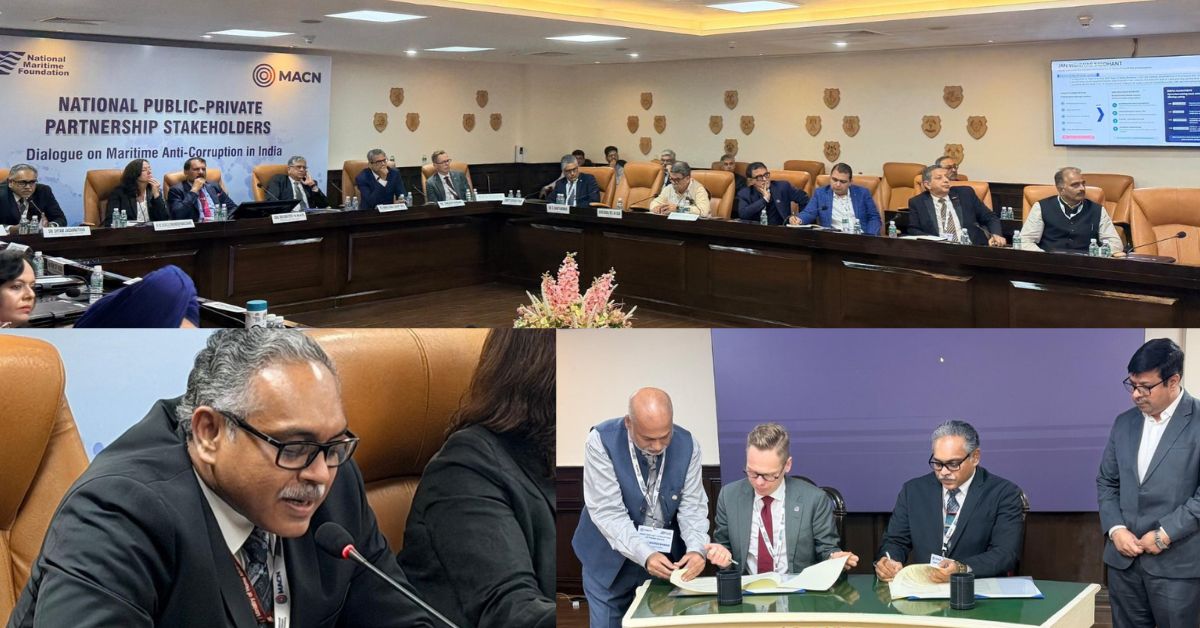

The Directorate General of Maritime Administration (DGMA) and the Maritime Anti-Corruption Network (MACN) signed a Memorandum of Understanding (MoU) in New Delhi on 19 November 2026 to strengthen cooperation on transparency, institutional capacity and corruption prevention across India’s maritime sector.
The agreement was concluded during the National Public-Private Partnership Stakeholders Dialogue on Maritime Anti-Corruption in India at the Manekshaw Centre. Jointly organised by the National Maritime Foundation (NMF) and MACN–India, the event brought government and industry stakeholders together to discuss maritime governance and operational integrity.
What will the DGMA–MACN agreement cover?
The MoU establishes cooperation across capacity building, systemic corruption risks, port-level initiatives, stakeholder engagement and the exchange of international best practices.
These areas connect institutional reform with the practical challenges faced by shipping companies, seafarers and other port users. The partnership is intended to support coordinated action between public authorities and industry, including efforts to identify and address recurring risks in maritime operations.
The announcement outlines the areas of cooperation but does not specify a budget, implementation timetable or an initial list of participating ports.
How will digital reform support transparency?
Shyam Jagannathan, Director General of Maritime Administration and Additional Secretary in the Ministry of Ports, Shipping and Waterways, led DGMA’s participation and delivered the keynote address.
He highlighted regulatory reform, ease of doing business and digital transformation as priorities for transparent and accountable maritime administration. His address referred to platforms including e-Samudra and e-Navik, alongside institutional measures intended to reduce discretionary interactions and prevent fraudulent practices.
The emphasis was on combining technology with stronger governance mechanisms. Digital platforms formed part of a broader approach that also included administrative accountability, stakeholder participation and trust in regulatory processes.
DGMA’s delegation included Deputy Director General Sudhir Kohakade, Sankalp Abhishek of SEEED PMC and Devarshi Datta of SEEED–Engineering.
What corruption risks affect port operations?
MACN’s India programme identifies demands for small payments in kind, including cigarettes, alcohol and soft drinks, among incidents reported by vessels calling at Indian ports. According to the network, refusing such demands can lead to threats of delays or fines for alleged non-compliance.
The organisation also records concerns over burdensome documentation and instances in which crew shore passes have reportedly been denied. These are reported experiences compiled by MACN, rather than findings applicable to every Indian port.
Such incidents explain why the network’s work combines engagement with authorities, practical guidance for operators and mechanisms for reporting demands. Addressing the circumstances behind repeated incidents is a central part of its collective-action approach.
How does the agreement build on existing initiatives?
MACN launched its Indian port integrity campaign in 2019, initially bringing together government, member companies and local stakeholders at Mumbai Port and Jawaharlal Nehru Port. The initiative was tested over six months before the network refined its wider India strategy in 2021.
That strategy prioritised cooperation among private operators, capacity building across public and private organisations, and partnerships to address integrity challenges throughout the maritime supply chain.
The network subsequently extended its HelpDesk service to India in July 2022. It provides members with guidance before port calls and support when unethical demands arise, including escalation to the appropriate authorities.
In its three-year assessment, MACN reported more than 50 successfully escalated cases and estimated savings of approximately US$750,000 from avoided departure delays and recovered payments. These are the network’s reported results from its existing programme, separate from the newly signed MoU.
The November agreement adds a formal cooperation framework with DGMA to this established programme, with capacity building and port-level engagement among its stated priorities.
 Join our WhatsApp channel for more updates:
 Subscribe to our YouTube channel for more updates: