



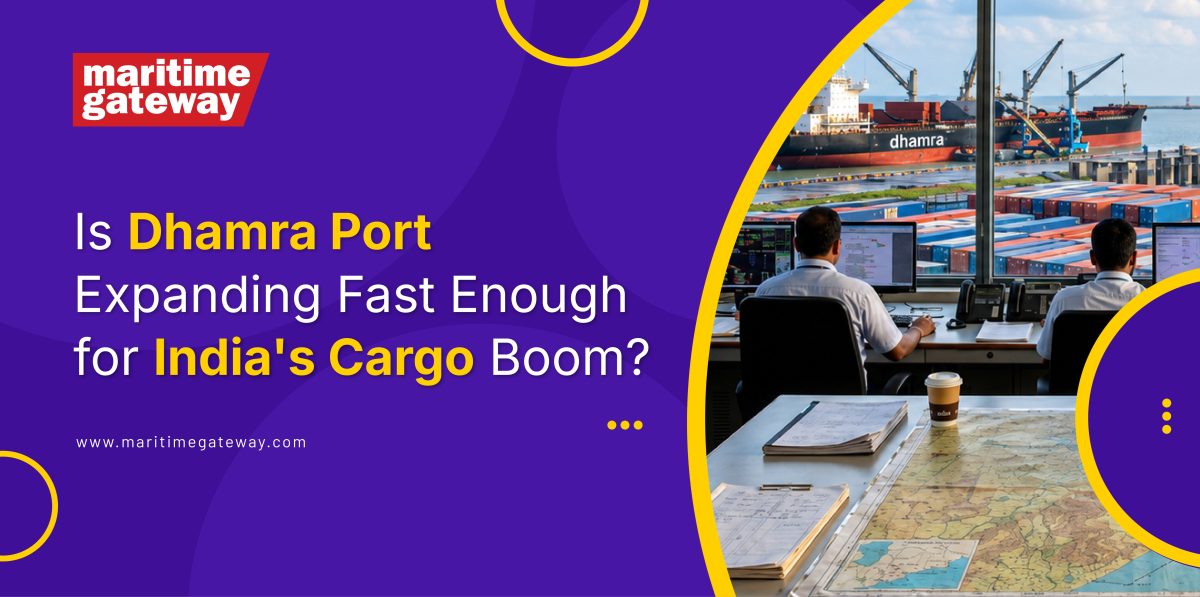

On the Odisha coastline, in Bhadrak district, Dhamra Port has quietly become one of the most closely watched growth stories in Indian port infrastructure. Once a single-berth mineral gateway, it now sits at the centre of Adani Ports and Special Economic Zone’s (APSEZ) eastern expansion strategy, backed by record-setting cargo operations, an aggressive capex pipeline, and a rail-road-waterway network designed to turn the port into a true multimodal logistics hub. Here’s a look at where the expansion stands, and why it matters for India’s east coast trade corridor.
Why Dhamra’s Location Sets It Apart
Geography does a lot of the work in explaining why Dhamra matters. The port sits at the mouth of the Dhamra river on Odisha’s coast, in a natural deep-water zone that requires minimal capital dredging, a rarity on India’s east coast and a structural advantage over ports that must dredge continuously to maintain draft. That depth allows Dhamra to berth large Capesize bulk carriers directly, rather than relying on lighterage or transshipment, cutting freight costs for the heavy dry-bulk cargo that dominates its trade.
Positionally, it sits almost midway between Kolkata/Haldia to the north and Paradip and Visakhapatnam to the south, giving it direct access to the mineral and industrial belt of Odisha, Jharkhand, Chhattisgarh and West Bengal without competing head-on for the same catchment as its larger neighbors. This hinterland happens to be one of the densest concentrations of coal, iron ore, limestone and steel-making capacity in the country, which is precisely the cargo mix Dhamra has built its business around.
Maritime-wise, its location also puts it on a natural sea lane for coal imports from Australia and Indonesia and for exports moving toward Bangladesh, Myanmar, Nepal and the broader ASEAN market, effectively making it a bridgehead between the Bay of Bengal’s east-west trade and India’s landlocked eastern industrial states. Few ports on this stretch of coast combine deep, dredge-free water with such direct rail access to a resource-rich hinterland, and that combination is what has allowed Dhamra to scale from a single-berth facility to a near-100 MMT ambition in under two decades, and why it continues to draw fresh capital even as larger, more established ports compete for the same cargo.

A Port Built for Scale
Dhamra Port, operated by Dhamra Port Company Limited (DPCL), a wholly owned subsidiary of APSEZ, sits between Haldia and Paradip on India’s eastern seaboard, roughly 62 km from Bhadrak railway station on the Howrah-Chennai mainline. Its deep drafts and mechanised berths have made it a natural gateway for the mineral-rich hinterland of eastern India, serving steel, power and mining industries in Odisha, Jharkhand and Chhattisgarh, while also positioning itself as a trade corridor to Bangladesh, Nepal, Myanmar and the wider ASEAN region.
The port’s growth has come in distinct phases. Its Phase II expansion, commissioned in 2018, was a step-change moment, lifting capacity roughly fourfold from 25 million tonnes per annum (MTPA) to over 100 MTPA of rated infrastructure, and cementing Dhamra’s status as one of India’s largest ports by design capacity. Since then, the story has shifted from headline capacity numbers to actual throughput, mechanisation, and the connectivity needed to move that cargo inland efficiently.
Mechanisation Drives the Current Phase
The most recent phase of expansion has been about sweating existing infrastructure harder rather than simply adding berths. APSEZ has mechanised Berth BB4 and commissioned the new Berth BB5, together lifting Dhamra’s effective bulk handling capacity to approximately 60 MMTPA. Complementing this, the port has deployed a next-generation ZPMC ship loader, a high-capacity piece of equipment designed to accelerate bulk material transfer onto vessels and squeeze more productivity out of every berth hour.
That investment in mechanisation is already showing up in performance data. Early July 2026 brought a landmark moment: Dhamra Port set a new national record, discharging 132,365 metric tonnes of dry bulk cargo in a single 24-hour period. The cargo came off the Cape-size vessel MV ASL OTSL2, which arrived from Queensland, Australia, carrying 165,283 MT of coking coal for Tata Steel.
What made the achievement notable wasn’t just the tonnage. During the same berthing at Berth-2, the port’s operations team set two national records simultaneously: the highest-ever 24-hour discharge, eclipsing the previous mark of 127,867 MT set while handling single-grade steam coal aboard MV Patragas, and the fastest multi-grade turnaround on record, with the vessel’s full cargo discharged in just 38 hours.
The complexity here is worth flagging for anyone who tracks bulk terminal operations. Coking coal, unlike steam coal, is a non-free-flowing commodity that resists rapid mechanical extraction. MV ASL OTSL2 was carrying two distinct grades, Goonyella and PCI, which had to be discharged and segregated without cross-contamination, a task that demands precise yard planning and disciplined execution rather than just raw equipment power.
Speaking on the milestone, DPCL CEO Devendra Thakar said the achievement reinforces Dhamra’s position as the preferred maritime gateway on India’s east coast, adding that “backed by highly mechanized infrastructure and deep drafts, the port is rapidly expanding its capabilities and is on a firm trajectory to achieve a mammoth 100 MMT handling capacity by 2030.”
The Capex Story: Where the Money Is Going
Dhamra’s expansion is being financed as part of a much larger APSEZ investment cycle. The group has earmarked close to ₹30,000 crore for domestic port expansion over the next two years, with Mundra, Vizhinjam and Dhamra identified as the three anchor sites for this next wave of growth. For FY26 alone, APSEZ’s capital allocation plan sets aside roughly ₹6,500-7,000 crore for port expansion, alongside further allocations of about ₹2,300 crore for logistics, ₹1,500 crore for renewables, and ₹700-800 crore for marine services.
Within that envelope, Dhamra has been earmarked for an additional 49 MTPA of capacity, a build-out the company has explicitly linked to rising rail-sea-rail cargo movement through the port. That phrase is worth unpacking, because it points to where Dhamra’s real competitive edge is being built: not just bigger berths, but a tighter, faster loop between ship, port and hinterland rail network.
Building the Multimodal Backbone
If Phase II was about port-side capacity, the current phase is about connectivity, and this is where Dhamra’s multimodal logistics story gets interesting. The original rail link, a 62 km line connecting the port to the Bhadrak/Ranital Link Cabin on the Howrah-Chennai mainline, was commissioned back in 2011 under a revenue-sharing arrangement between Indian Railways and DPCL, among the first projects under the Railways’ Infrastructure for Industry initiative. That line has operated on a “merry-go-round” rake system, cycling loaded and empty rakes continuously to maximize turnaround efficiency, and is now undergoing doubling to handle higher rake volumes.
A more ambitious rail project is also on the table. A proposed 101.26 km broad-gauge line from Jajpur-Keonjhar Road to the port via Aradi has been under evaluation by the Network Planning Group, with a Detailed Project Report already prepared. If sanctioned, this line would directly connect Odisha’s mineral and industrial belt, including coalfields, to the port, cutting out transshipment friction and aligning with the government’s PM GatiShakti approach to integrated infrastructure planning.
On the road side, the port currently connects to National Highway 16 via a two-lane carriageway that is slated for an upgrade to four lanes, a corridor originally planned to service the port’s container and general cargo terminal traffic as it scales up beyond bulk commodities.
Water connectivity adds a third layer to the picture. The ongoing National Waterway 5 project is designed to link Dhamra to Paradip via inland waterways, opening a coastal and riverine option for cargo movement that could ease pressure on rail and road corridors during peak periods.
Supporting all of this is a substantial on-port storage footprint: a 113,024 sq m mechanised coal storage yard, 184,083 sq m of semi-mechanised space for limestone and coal, 75,606 sq m allocated to thermal coal and iron ore, 8,000 sq m for steel, and a 33,750 sq m covered warehouse. Together, these facilities let the port stage and blend cargo before it moves onward, a critical function for a hub that handles multiple grades of bulk commodities for different end-industries.
Why This Matters Beyond Dhamra
It’s worth placing Dhamra’s build-out in the context of India’s broader multimodal logistics push. Under the National Highways Logistics Management Limited (NHLML), a wholly owned NHAI subsidiary, the government has approved 35 locations nationwide for dedicated Multi-Modal Logistics Parks under a hub-and-spoke model, aimed at lowering freight costs, cutting warehousing overheads, reducing road congestion, and improving cargo traceability. Projects at locations like Nagpur, Indore and Assam are moving forward under this dedicated MMLP framework.
Dhamra’s model is a little different. Rather than a standalone, government-anchored logistics park bolted onto the port, what’s emerging is a port-led multimodal ecosystem, where DPCL itself is investing in rail doubling, new broad-gauge connectivity, road upgrades and warehousing infrastructure to function as a de facto logistics park integrated with the terminal. For cargo owners and third-party logistics players, the practical effect is similar either way: less time and cost lost in the handoff between sea, rail and road.
That integration is increasingly the differentiator for east coast ports competing for coal, coking coal, limestone, iron ore and steel traffic. Speed of discharge matters, but so does how quickly that cargo clears the port and reaches a steel plant in Jharkhand or a power station further inland. Dhamra’s rail-sea-rail emphasis in its own capex commentary suggests the company understands this: a 60 MMTPA berth capacity is only as useful as the rail and road network that can absorb the resulting cargo flow without creating a bottleneck a few kilometres inland.
What to Watch Next
A few markers will indicate whether Dhamra’s ambitions convert into sustained performance. First, whether the Jajpur-Keonjhar Road broad-gauge line clears its planning stage and moves to construction, since that single project could unlock direct connectivity to Odisha’s coalfields. Second, how quickly the additional 49 MTPA of announced capacity gets commissioned, and whether it comes with matching investment in evacuation infrastructure rather than berths alone. Third, whether the National Waterway 5 linkage to Paradip becomes operationally significant or remains a secondary option behind rail.
For now, the signals are positive. A national record in dry bulk discharge, a clear capex commitment running into thousands of crores, and a rail-road-waterway network under active expansion together paint a picture of a port moving deliberately toward its 100 MMT ambition. Whether Dhamra reaches that milestone by 2030, as its CEO has stated, will depend as much on how well the surrounding multimodal network keeps pace as it will on how many more berths get mechanized at the water’s edge.
 Join our WhatsApp channel for more updates:
 Subscribe to our YouTube channel for more updates: