




Summary
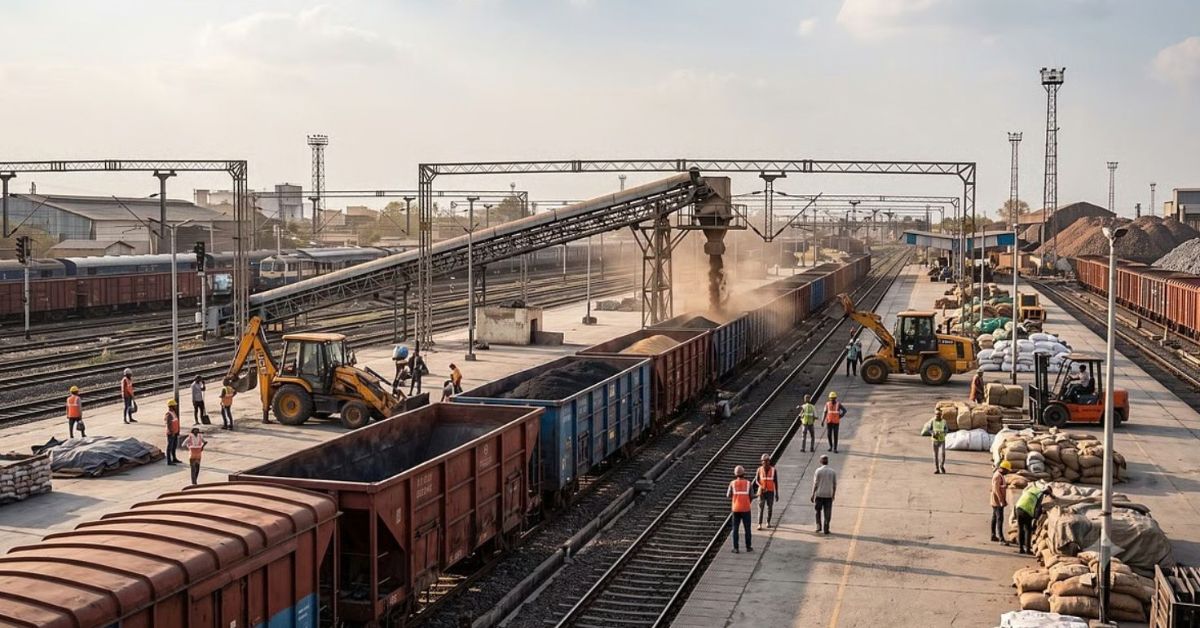
East Coast Railway loaded 120.76 million tonnes of freight in April-September 2026, up 3.4% year on year, with coal leading volumes and iron ore growing 14%. Unloading rose nearly 10% to 109.66 MT. The figures are the zone’s first half-year results since its reorganisation and the creation of the Rayagada division.
Article
Bhubaneswar: East Coast Railway freight loading rose 3.4% to 120.76 million tonnes (MT) in the first half of 2026-27, compared with 116.78 MT in the same period last year, according to an official statement released on October 8.
The Bhubaneswar-headquartered zone credited the growth to coordinated planning, closer engagement with freight customers and efficient operations across its three divisions.
Which commodities drove the growth?
Coal remained the backbone of the zone’s freight business. Coal loading increased 3.7% to 71.01 MT from 68.46 MT, accounting for nearly 59% of total volumes.
Iron ore delivered the strongest growth among major commodities, rising 14% to 19.60 MT from 17.19 MT. Container loading grew 7.8% to 2.10 MT, while iron and steel loading was broadly flat, edging up 0.3%.
How did the divisions perform?
Khurda Road remained the zone’s largest freight division, loading 87.64 MT, up 1.7% on the previous year. The newly created Rayagada division loaded 19.97 MT, an increase of 8.8%, while Sambalpur division recorded 13.15 MT, up 7.3%.
Growth was sharper on the unloading side. Total unloading rose to 109.66 MT from 100.11 MT, an increase of about 10%. Khurda Road led with 78.33 MT, up 11%, followed by Sambalpur at 22.84 MT, up 6%, and Rayagada at 8.49 MT, up 3%.
Why is the Rayagada division new?
The first-half figures reflect a significantly redrawn zone. Under a Ministry of Railways gazette notification issued on May 4, 2026, the new South Coast Railway zone, headquartered at Visakhapatnam, took effect from June 1, 2026. The former Waltair division of ECoR was split in two: one part stayed with East Coast Railway as the new Rayagada division, and the rest moved to South Coast Railway as the Visakhapatnam division.
The Rayagada division covers about 680 km, including the Kottavalasa-Bacheli/Kirandul, Kuneru-Theruvali, Singapur Road-Koraput and Paralakhemundi-Gunupur sections. The Kirandul line serves the iron ore belt of Chhattisgarh’s Bastar region. After the restructuring, ECoR comprises the Sambalpur, reorganised Khurda Road and Rayagada divisions.
How does this compare with earlier performance?
Earlier results were reported under the zone’s previous structure, so they are not directly comparable. ECoR reported loading of 137.6 MT for April-September 2025, up 11.33% at the time, under its earlier jurisdiction, which included the full Waltair division. The 116.78 MT base used in the latest statement is lower, which suggests last year’s figures have been restated for the zone’s current boundaries.
ECoR has led Indian Railways in freight loading for several years. In 2024-25 it retained the top position for the eighth consecutive year, loading 259.25 MT against 256.22 MT the previous year. Up to December 2025, it remained the top-loading zone with 209.97 MT, an 11.31% year-on-year increase.
Why does it matter for industry and logistics?
ECoR serves Odisha’s mineral-rich hinterland, and its traffic is dominated by bulk commodities that feed power plants, steel mills and east coast ports. The 14% rise in iron ore loading points to sustained demand from steelmakers, while steady coal growth reflects continued thermal power requirements.
The 7.8% rise in container loading, though small in absolute terms, indicates gradual diversification of the zone’s traffic beyond bulk minerals. Stronger unloading volumes, especially in Khurda Road, also point to rising inbound cargo movement into the region.
With the reorganisation now in place, the second-half figures will offer a cleaner view of how the restructured zone performs on a like-for-like basis.
FAQs
How much freight did East Coast Railway load in H1 FY27?
ECoR loaded 120.76 MT of freight during April-September 2026, up 3.4% from 116.78 MT in the corresponding period last year.
Which commodity contributed the most?
Coal was the largest contributor at 71.01 MT, up 3.7%. Iron ore posted the fastest growth among major commodities, rising 14% to 19.60 MT.
Which division handled the most freight?
Khurda Road division led with 87.64 MT of loading and 78.33 MT of unloading.
What is the Rayagada division?
It is a new ECoR division formed from part of the former Waltair division. It became effective on June 1, 2026, when the South Coast Railway zone began operations, with the rest of Waltair becoming the Visakhapatnam division under SCoR.
Why are this year’s figures lower than last year’s 137.6 MT?
The 137.6 MT reported for April-September 2025 covered the zone’s earlier jurisdiction, including the full Waltair division. The current figures reflect the reorganised zone, which no longer includes the portion that moved to South Coast Railway.
 Join our WhatsApp channel for more updates:
 Subscribe to our YouTube channel for more updates: