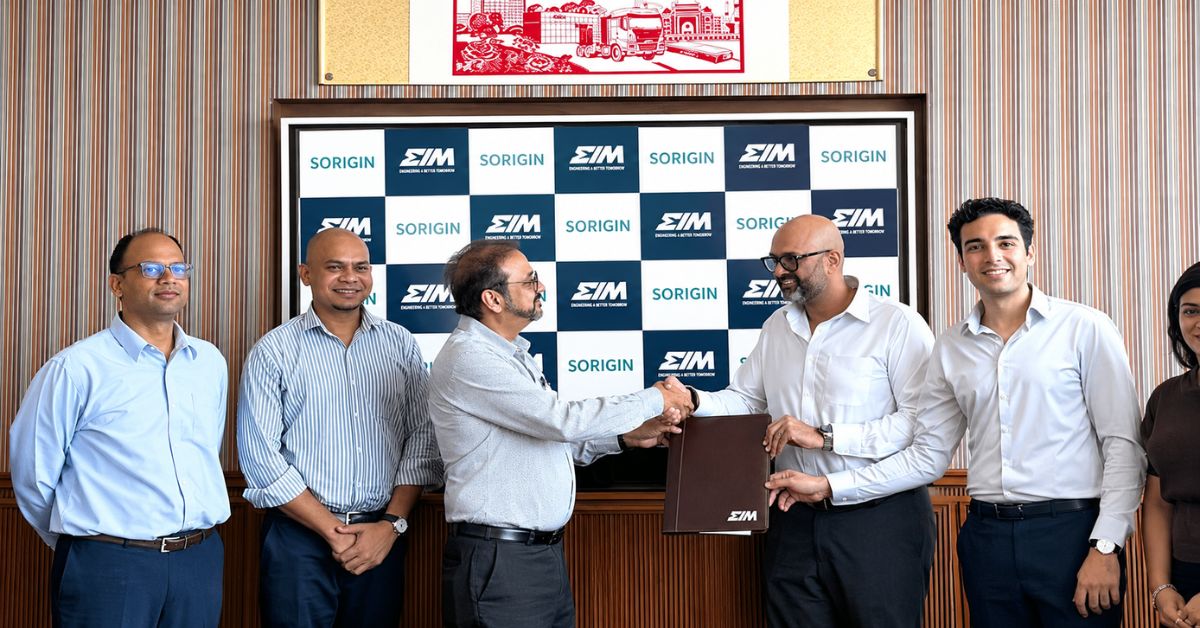

Energy In Motion Limited (EIM) and Sorigin Green Mobility Private Limited have signed a memorandum of understanding (MoU) to deploy 500 electric heavy commercial vehicles across India over two years, beginning with 18 vehicles in the Jawaharlal Nehru Port Authority (JNPA) ecosystem.
Announced on 3 November, the programme will prioritise freight corridors with substantial cargo movement. EIM will supply Ashwa 55-tonne electric tractors alongside charging infrastructure, battery-swapping facilities and energy-management services. The companies expect implementation to begin immediately.
How will the fleet deployment work?
Sorigin will finance, deploy, operate and maintain the vehicles under a service model in which customers pay for freight movement without purchasing the trucks upfront.
Sorigin director Gautam Rekhi and co-founder Aarav Tanti said the company already operates EIM tractors at Jawaharlal Nehru Port and Tuticorin Container Terminal. Its managed offering includes trailers, drivers, on-site supervision, maintenance, charging arrangements, vehicle tracking and emissions reporting.
EIM managing director Narendra Murkumbi said the partnership would combine vehicles and energy infrastructure to address utilisation, turnaround times and operating costs. The 500-vehicle figure is a deployment target under the MoU, with the initial rollout focused on JNPA.
What charging infrastructure is available at JNPA?
The agreement follows EIM’s expansion of battery-swapping infrastructure around the port. In September 2026, the company announced the opening of its second heavy-duty swapping station at Nhava Sheva Distribution Terminal.
At that time, EIM said nearly 150 of its electric trucks were operating within the JNPA ecosystem. These were existing operations across its customer base, rather than vehicles delivered under the newly announced Sorigin programme.
The company also outlined plans for an electric vehicle complex incorporating three battery-swapping and charging stations, a service station, a driver training centre and a heavy-vehicle simulator.
Together with an existing swapping facility, the proposed infrastructure is intended eventually to support more than 700 heavy trucks across port terminal corridors. That figure represents planned support capability, rather than the number of vehicles currently deployed.
How does battery swapping support fleet operations?
EIM’s business model separates battery ownership from vehicle ownership through a battery subscription service. The company presents this approach as a way to reduce the initial investment required from truck owners.
Its operating model combines battery exchange, charging and fleet scheduling. Instead of relying exclusively on charging a battery while it remains on the vehicle, compatible trucks can exchange a depleted pack for a charged one.
EIM also provides maintenance support through service teams, mobile vans and workshops. These arrangements form part of its wider offering to operators managing vehicle availability and energy requirements across freight routes.
What manufacturing capacity supports the rollout?
On 14 October 2026, EIM inaugurated an electric heavy commercial vehicle complex at Ambi village in Talegaon, Pune. The company described the ₹500-crore development as the first phase of its ₹1,000-crore investment programme in Maharashtra.
The complex combines vehicle assembly, lithium-ion battery-pack assembly and an independent battery-testing laboratory. Its stated initial vehicle assembly capacity is 5,000 units annually on a single-shift basis.
EIM’s technology partnerships include BAIC Foton Motor for heavy electric vehicles, Contemporary Amperex Technology Co. Limited for battery technology and Shanghai Enneagon Energy Technology for robotic battery-swapping systems.
Alongside manufacturing, the company is developing charging and swapping infrastructure at highways, ports and industrial locations. The Sorigin agreement adds a fleet-operation partner to that programme, with the first 18-vehicle deployment providing the initial implementation milestone for the two-year plan.
 Join our WhatsApp channel for more updates:
 Subscribe to our YouTube channel for more updates: