



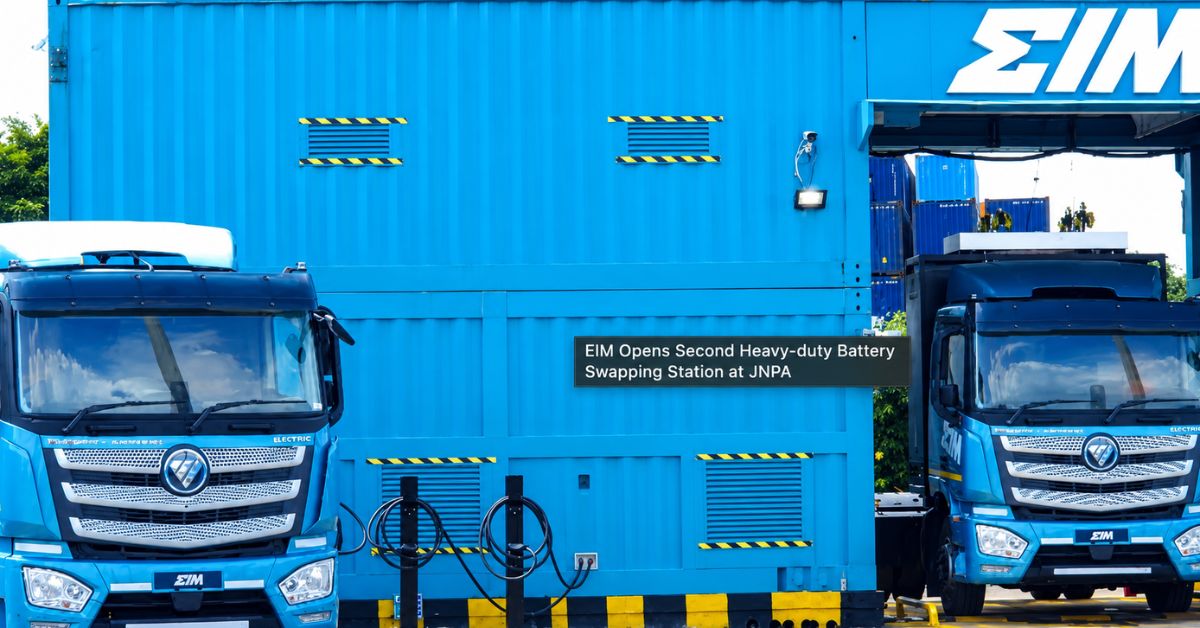

Energy In Motion (EIM) has inaugurated its second heavy-duty battery swapping-cum-charging station at the Nhava Sheva Distribution Terminal (NSDT) under the Jawaharlal Nehru Port Authority (JNPA), as the port works toward a planned EV Megaplex supporting electric freight operations.
Why is EIM adding a second station?
The new facility follows EIM’s existing E5 battery swapping station at JNPA. According to the company, nearly 150 of its electric trucks are currently operating within the port, and the first swapping station has reached its stated operational capacity, prompting the expansion.
What does the planned EV Megaplex include?
The EV Megaplex at JNPT is planned to comprise three battery swap-cum-charging stations, a dedicated service station, a driver training centre and a heavy-vehicle simulator, with the existing swapping facility forming part of the wider infrastructure. EIM said the setup is designed to combine battery swapping with vehicle servicing and driver training, aimed at reducing turnaround time, supporting vehicle uptime, and preparing drivers for electric heavy-vehicle operations. The company said the infrastructure will eventually support more than 700 heavy trucks operating across key terminal corridors at JNPT.
How is EIM scaling beyond port movements?
EIM Managing Director Narendra Murkumbi said the company’s electric freight operations at JNPT are being extended beyond dedicated port movements to include container freight station (CFS) movements, involving coordination between EIM, JNPA, terminal operators and logistics service providers. The company is also deploying slot-booking and slot-optimisation systems to integrate electric vehicles into high-throughput freight operations. EIM said the EV Megaplex is intended to bring together energy infrastructure, electric vehicles and freight operations as JNPA works toward its December 2027 energy-transition target.
 Join our WhatsApp channel for more updates:
 Subscribe to our YouTube channel for more updates: