





Summary
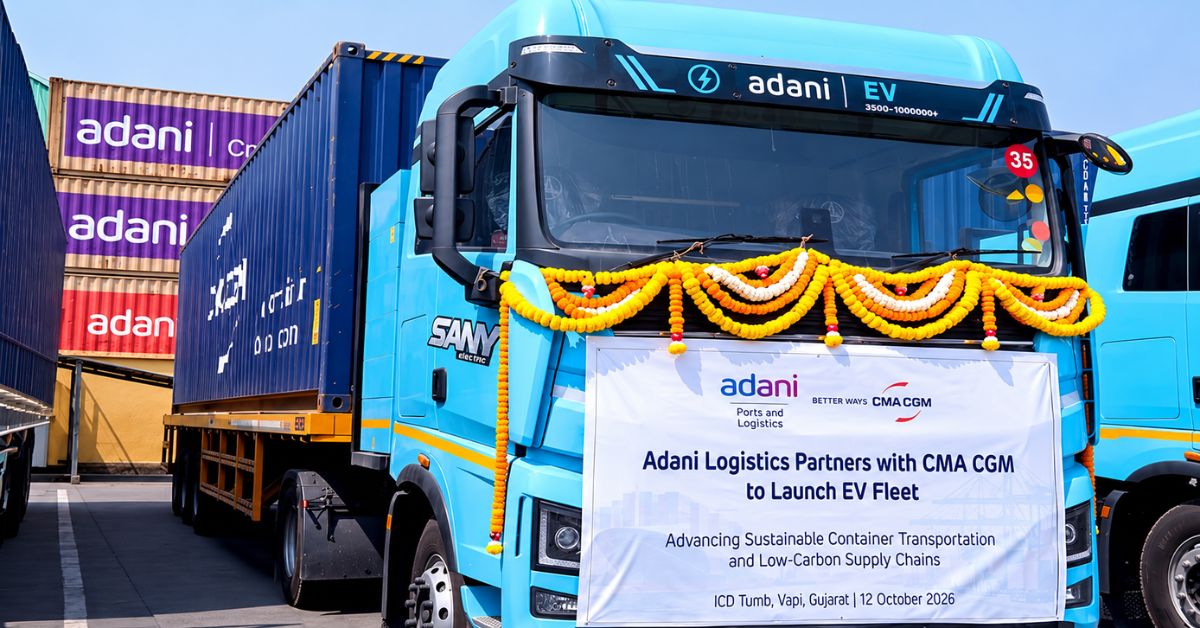
Adani Logistics and CMA CGM have flagged off an electric truck fleet for container movement at ICD Tumb near Vapi. The deployment extends electric mobility into inland freight operations, adding a road transport component to the depot’s existing rail and port connections serving industrial cargo in Gujarat and Maharashtra.
Electric mobility enters container transport.
Electric container trucks have been introduced at ICD Tumb through a partnership between Adani Logistics and CMA CGM, expanding the use of electric vehicles in India’s inland logistics network.
The announcement describes the deployment as the country’s largest electric truck fleet for container movement. However, it does not specify the number of vehicles or provide comparative fleet data supporting that description.
The initiative focuses on the inland transport segment linking cargo gateways with depots, warehouses and factories. It brings together a logistics infrastructure operator and an international shipping line around container delivery requirements.
Details of truck manufacturers, battery capacity, operating range, charging infrastructure, investment and individual routes were not included in the announcement. These particulars will be important for assessing the deployment’s scale and operating performance.
ICD Tumb serves a major industrial catchment
Tumb’s location provides the commercial backdrop to the deployment. When Adani Logistics announced an agreement to acquire the facility from Navkar Corporation in August 2022, it described the depot as a strategic connection between industrial customers and western Indian ports.
The transaction carried an enterprise value of ₹835 crore and covered an operational ICD with capacity to handle 500,000 TEUs. The announcement also identified 129 acres of associated land as providing scope for expansion.
Tumb lies approximately 160 kilometres from Hazira port and 230 kilometres from Nhava Sheva. Its catchment includes industrial estates administered by the Gujarat Industrial Development Corporation and Maharashtra Industrial Development Corporation.
The acquisition announcement described a private freight terminal with four rail handling lines, customs-notified land and bonded warehousing facilities. This infrastructure places the electric truck deployment within an established cargo-processing and distribution hub.
Road deployment complements earlier rail development
The electric fleet follows previous efforts to strengthen Tumb’s rail connections. APSEZ’s 2025–26 annual report records the first double-stacked container rake between ICD Tumb and ICD Patli in June 2025.
That service strengthened connectivity between the Jawaharlal Nehru port gateway and the Delhi-NCR hinterland. It represents an earlier development, separate from the latest electric truck launch.
Across its logistics business, APSEZ reported 695,517 TEUs of container rail volumes during 2025–26. Its operating model combines multimodal logistics parks, rail services, trucking and warehousing with freight management platforms.
Within such a network, road transport provides connections to customer premises and locations beyond the rail terminal. The new deployment adds electric vehicles to that part of the container journey, while existing rail services continue to provide longer-distance links.
CMA CGM already includes Tumb in its inland network
CMA CGM’s Indian subcontinent intermodal programme provides another relevant connection. The company introduced four additional Indian rail corridors in 2025, including Tumb via Nhava Sheva.
The other additions covered Loni through Mundra and Pipavav, and Borkhedi through Nhava Sheva. Together, these developments expanded inland transport options across Gujarat, Uttar Pradesh and Maharashtra.
CMA CGM reports 428,000 TEUs in its Indian subcontinent intermodal programme in 2025, with 92% transported by rail. Its services combine rail and truck movements with maritime connections.
The Tumb electric fleet therefore builds on an existing inland service relationship. It extends the partners’ collaboration into road transport technology at a depot already included in CMA CGM’s rail network.
National policy supports heavy vehicle electrification
The deployment also comes against a wider policy push for electric freight vehicles. In July 2025, the Ministry of Heavy Industries launched electric truck incentives under PM E-DRIVE.
The framework covers eligible medium and heavy trucks, including articulated tractor units. Incentives vary with gross vehicle weight and can reach ₹9.6 lakh per vehicle, subject to scheme conditions.
The programme also requires manufacturer-backed battery, vehicle and motor warranties, alongside the scrapping of an older truck to qualify for support. Ports and logistics were identified among the sectors expected to benefit.
There is no information confirming that the Tumb fleet received these incentives. The scheme provides policy context for the deployment, while fleet utilisation, charging arrangements and measured operating results will determine its practical contribution to container logistics.
FAQs
Who launched the electric truck fleet?
Adani Logistics, in partnership with CMA CGM.
Where was the fleet flagged off?
At ICD Tumb near Vapi, serving the Gujarat–Maharashtra industrial region.
How many electric trucks were deployed?
The supplied announcement does not state the fleet size.
Is the “country’s largest” description independently verified?
No comparative fleet data was provided to substantiate the claim.
Does Tumb have existing rail connections?
Yes. Earlier developments include a double-stacked rake connection to ICD Patli and CMA CGM’s Tumb–Nhava Sheva rail corridor.
 Join our WhatsApp channel for more updates:
 Subscribe to our YouTube channel for more updates:



