



Pelagus started as a side project for one shipping company and has since grown into a manufacturing network spanning more than 25 OEM partners worldwide. VP Engineering Scott Harding talks to Ramprasad Ravi about how the company made a decisive pivot, why trust is harder to build than technology, and what geopolitical disruption is doing for the on-demand parts business.
When Wilhelmsen set out to solve its spare parts problem through additive manufacturing, it began with a single site in Singapore. The logic was sound: 3D printing could produce components on demand, close to where ships actually operated, eliminating the delays and costs of a traditional supply chain. But a single site could not serve a global fleet, and replicating the model across multiple owned locations would have required enormous capital investment in machinery and facilities.
The answer, it turned out, was not to build more sites. It was to stop building them altogether. Instead of investing in owned capacity, Wilhelmsen recognised that manufacturing infrastructure already existed around the world, much of it sitting underutilised in the additive and conventional manufacturing sector. The result was Pelagus: a platform-based manufacturing network that connects engineering data to available capacity wherever it is needed.
Scott Harding, VP Engineering at Pelagus, spoke to Maritime Gateway on the sidelines of Singapore Maritime Week about the journey from that first site to a global operation, and the strategic decisions that shaped the company along the way.
The Pivot That Changed Everything
For Pelagus, the most consequential moment was not a technology breakthrough. It was a customer rethink. For its first period of operation, the company was focused on serving Wilhelmsen directly: identifying parts, digitising them, manufacturing on demand, and delivering to the fleet. The model worked, but the scale was bounded by one company’s requirements.
About eighteen months ago, Pelagus made what Harding describes as a critical shift. Wilhelmsen, despite having the pain point and the commercial appetite to solve it, was not the right primary customer. The reason was intellectual property.
The original equipment manufacturers hold the design drawings, the CAD files and the genuine engineering understanding of the parts they produce. Working with OEMs rather than operators meant Pelagus could access that knowledge directly, rather than reverse-engineering specifications from physical components case by case. It also meant that solving the problem for one OEM unlocked access to every asset in the world carrying that equipment.
Today, Pelagus works with more than 25 OEM partners, including Kawasaki Heavy Industries as an early anchor customer. The company sells manufactured parts to the OEM, who in turn sells to ship owners and operators through their existing commercial relationships. Pelagus does not disrupt the OEM’s route to market. It enables them to serve customers they would otherwise have stopped supporting.
The Legacy Portfolio Opportunity
The part of the market Pelagus has deliberately targeted is one that most OEMs have quietly walked away from: the legacy portfolio. Once a product line passes the fifteen to twenty-year mark, OEMs typically redirect their engineering resource and manufacturing capacity towards new product introductions. Demand for older parts becomes sporadic and harder to forecast. Support becomes commercially marginal. The grey market fills the gap.
Harding is direct about the opportunity this creates. For the OEM, Pelagus provides a way to continue honouring commitments to customers without diverting attention from the new products that drive growth. For the end user, it means access to properly specified, quality-assured parts instead of grey market alternatives of uncertain provenance.
Not a 3D Printing Company
Despite its origins in additive manufacturing, Pelagus is deliberate about not defining itself as a 3D printing business. The company takes what Harding calls an application-led approach: the manufacturing technology is selected based on the geometry, material requirements, location and specific needs of each part. By his estimate, 3D printing accounts for thirty to fifty percent of output. Conventional CNC machining and casting make up the rest.
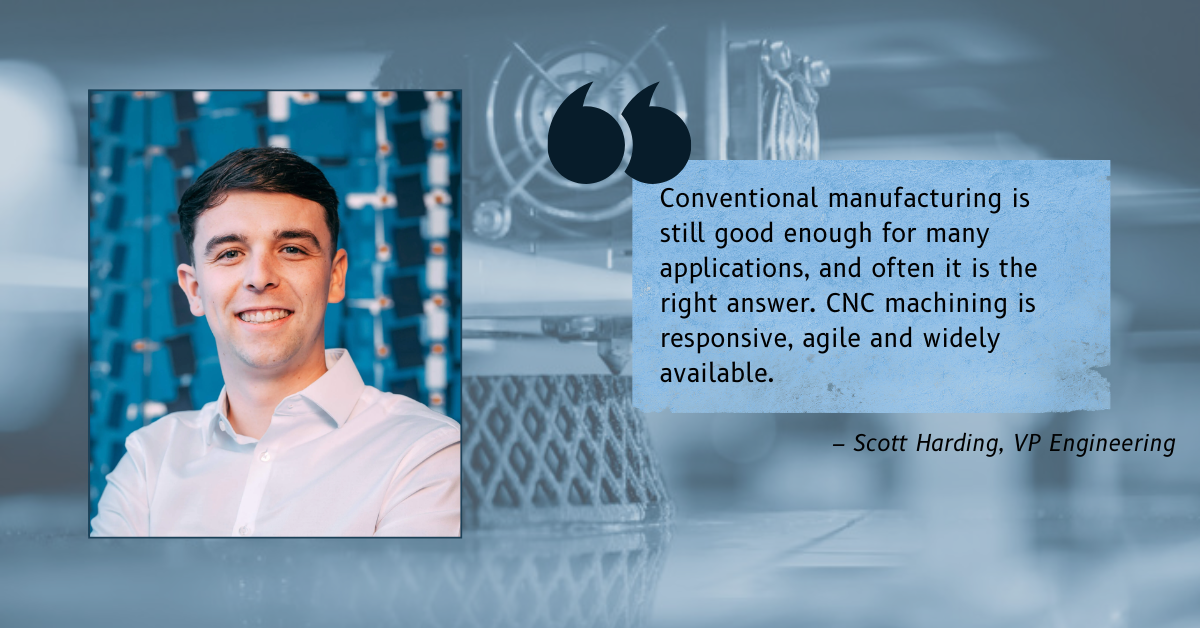
“We are not trying to shove 3D printing down everyone’s throats,” Harding says. “Conventional manufacturing is still good enough for many applications, and often it is the right answer. CNC machining is responsive, agile and widely available.”
Where additive does offer a clear advantage is in low-volume casting applications. By 3D printing the sand mould rather than investing in traditional tooling, Pelagus can reduce the minimum order quantity to a single part. For legacy portfolios where demand arrives unpredictably, this flexibility is precisely what both OEMs and end users need. A tooling investment sitting on a shelf waiting for a sporadic order is, as Harding puts it, simply wasteful.
The Trust Barrier
If the technology is increasingly mature, what is holding broader adoption back? For Harding, the answer is straightforward: trust, and the organisational processes that govern it.
“A lot of our OEM partners are the biggest name brands in the industry, with reputations built over tens, sometimes hundreds of years,” he says. “For them to build trust in Pelagus, in our manufacturing quality controls and our assurance processes, that is probably our biggest challenge. They have internal change control procedures, their own supplier quality assurance frameworks. Qualifying Pelagus, and sometimes our manufacturing partners, takes time.”
On the question of whether additive manufacturing meets classification and regulatory standards, Harding pushes back on the premise. The technology has been qualified for use in nuclear submarines, commercial aircraft and space applications. In the marine sector, DNV and ABS both publish guidelines for additive manufacturing, including the B203 and ABSAM standards, which specify material testing, non-destructive evaluation and process controls. The standards exist. The question is whether organisations have the internal will to go through the qualification process to use them.
Geopolitics as Accelerant
The disruption to shipping routes through the Strait of Hormuz has brought the resilience argument for localised manufacturing into sharp relief. Pelagus has suppliers and customers in the Middle East, and Harding is clear that supply chain shocks of this kind strengthen the case for distributed, on-demand production.
“When these routes are held up, it only increases the voice for localised manufacturing,” he says. “It is not always the answer. But in these geopolitical conditions, you need to have the availability so that when those situations arise, you can call on an alternative supply chain.”
On lead times, the company promises four weeks for any repeat order, covering a wide range of parts and technologies. Cast parts can be delivered in as little as two weeks. CNC machined components from a local shop can be ready within days.
Looking further ahead, Harding identifies India as a market with significant untapped potential, both as a manufacturing base and as an end-user market. Current OEM customers are concentrated in Europe, Japan and Korea, but the country’s dry docks, ship repair facilities and growing shipyard sector represent a natural fit for on-demand parts supply. “There is great manufacturing competence available in India,” he says. “And from a customer perspective, the demand is clearly there.”
 Join our WhatsApp channel for more updates:
 Subscribe to our YouTube channel for more updates: