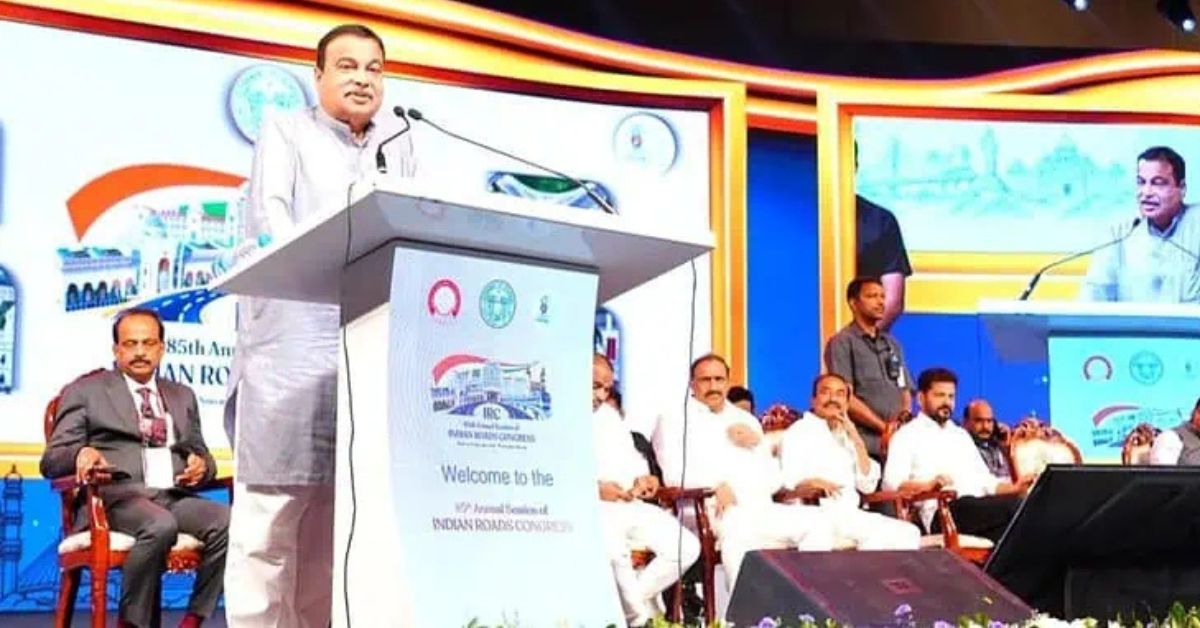

Union Minister for Road Transport and Highways Nitin Gadkari has called for greater emphasis on road safety, construction quality and sustainable technologies, linking stronger infrastructure with lower logistics costs and improved economic connectivity.
Addressing the 85th annual session of the Indian Roads Congress (IRC) in Hyderabad on 19 November 2026, Gadkari urged engineers, contractors, consultants and policymakers to improve the durability and performance of India’s road network. Telangana Chief Minister A. Revanth Reddy and state Roads and Buildings Minister Komatireddy Venkat Reddy attended the event.
What priorities did Gadkari identify?
Gadkari called for better detailed project reports, stronger technical supervision and effective road-safety audits. He urged engineers to address accident-prone locations through improved junction layouts and, where required, flyovers and underpasses.
He also sought greater accountability for construction quality and transparent, time-bound project implementation.
On sustainable construction, the minister highlighted technically suitable uses for plastic waste, used tyres, steel slag and agricultural residue. He referred to rice-straw-based bio-bitumen and encouraged greater use of treated wastewater.
Gadkari also advocated cleaner fuels and electric technologies for construction equipment, alongside financing through public-private partnerships and monetisation of existing highway assets.
How does the programme relate to freight movement?
The Hyderabad gathering provides a forum for examining the engineering and operational issues that affect road transport. The IRC’s official programme includes sustainable construction, road safety, intelligent transport systems, pavement design, bridges and tunnels.
These subjects address both the physical condition of roads and the systems used to manage traffic. For freight operators, the relevance extends from pavement performance under heavy traffic to maintenance planning and the reliability of transport routes.
The annual session is being held at HITEX from 19 to 22 November, following the technical exhibition’s inauguration on 18 November. It brings together engineers, researchers, government officials, contractors and infrastructure companies.
Which Telangana road projects are in focus?
Ahead of the conference, Komatireddy Venkat Reddy said Telangana had allocated ₹5,677 crore for roads and bridges in its 2026–27 budget.
The state’s stated priorities include the Regional Ring Road, expansion of the Hyderabad–Vijayawada Highway, the Hyderabad Elevated Corridor and a proposed greenfield highway connecting Future City with Machilipatnam Port.
Other projects identified by the minister included development of National Highway 167, the Karimnagar–Warangal Highway and rural roads through the hybrid annuity model.
The proposed port highway gives the programme a direct relevance to maritime logistics. However, its inclusion among state priorities does not establish a construction award or completion timetable.
The state minister said improved roads would support industrial movement, agricultural market access and investment. A Telangana pavilion at the conference is showcasing ongoing and proposed road, bridge and infrastructure projects.
What technical issues will delegates examine?
The conference programme includes sessions on highway maintenance, pavement investigation, infrastructure durability and digital transport systems.
Listed presentations cover maintenance decision-support tools, traffic-speed pavement assessment and the implications of automated navigation for highway networks. The agenda also provides for discussions involving senior public works officials and presentations from central infrastructure agencies.
These exchanges provide a mechanism for reviewing practical engineering approaches alongside the minister’s call for stronger implementation of road standards.
How is Telangana linking connectivity with investment?
Speaking at the event, Revanth Reddy announced the Invest Telangana Global Summit 2026, scheduled for 7–9 December at Bharat Future City.
The investment programme accompanies the state’s infrastructure push, placing industrial development and transport connectivity within its broader economic agenda.
 Join our WhatsApp channel for more updates:
 Subscribe to our YouTube channel for more updates: