



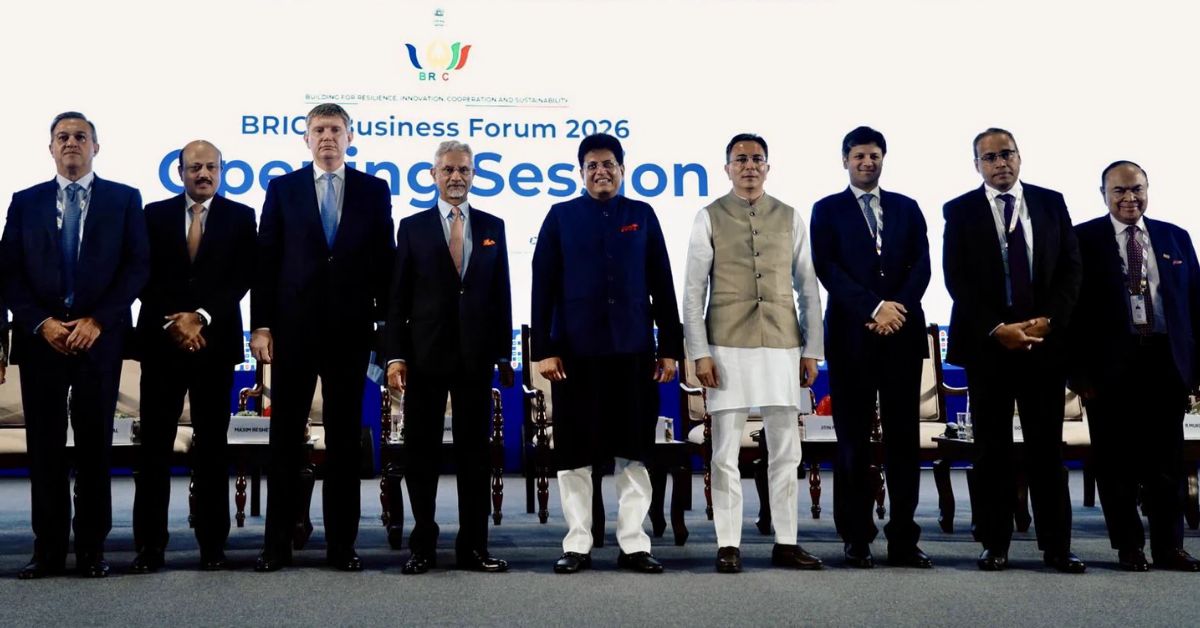

With BRICS accounting for nearly one-fourth of global trade, Union Minister of Commerce and Industry Piyush Goyal underlined the need for member and partner countries to build deeper, more resilient and balanced trade partnerships. Addressing the Opening Session of the BRICS Business Forum in New Delhi, Goyal emphasised greater market access, diversified supply chains and simpler regulatory procedures to unlock the full potential of economic cooperation, expressing hope that the Forum would deliver significant outcomes and take economic dialogue and business partnerships among BRICS countries to the next level.
The Opening Session was also addressed by H.E. Maxim Reshetnikov, Minister of Economic Development of the Russian Federation; Union Minister of External Affairs Dr. S. Jaishankar; Minister of State for Commerce & Industry and Electronics & IT Jitin Prasada; and Commerce Secretary Rajesh Agrawal.
Goyal said India is an important pillar of intra-BRICS trade, highlighting the country’s strong capabilities in engineering goods and electronics, its largest manufactured export segment, and its position as the “pharmacy of the world.” He said India sees BRICS as an important market for these and other products it seeks to take to the world as a trusted partner. He called for supply chains to run both ways, noting that non-tariff measures impose higher export costs than tariffs themselves for 88% of countries, and urged BRICS members to open their markets, including for raw materials and critical minerals, while working together to simplify regulatory procedures and speed up clearance of consignments.
Goyal called for greater cooperation in agriculture through joint agri-tech startup development for food security, and urged countries to open their services markets, ease cross-border movement of professionals, and simplify recognition of professional qualifications. Highlighting women’s participation in India’s startup ecosystem, he noted more than 45% of India’s 250,000 recognised startups have at least one woman partner or director, and that two-thirds of small loans issued over the past decade have gone to women entrepreneurs. He referenced this week’s BRICS Women’s Business Alliance meeting in New Delhi, where he had urged greater participation of women-led enterprises across BRICS exhibitions and trade fairs.
On digital infrastructure, Goyal pointed to India’s Unified Payments Interface, now processing over 250 billion transactions a year and accepted in 11 countries, urging BRICS countries to link payment systems, promote trade in local currencies, and build jointly on emerging technologies. He said India’s strengths across agriculture, pharmaceuticals, engineering, electronics, automobiles and services offer scope for joint innovation and technology partnerships, and expressed hope that the Forum’s thematic sessions would produce actionable recommendations to strengthen intra-BRICS cooperation as India works toward its Viksit Bharat 2047 goal.
Dr. S. Jaishankar, marking 20 years of institutionalised BRICS cooperation, said India’s Chairship has carried the grouping’s evolution forward through the theme of resilience, innovation, cooperation and sustainability, particularly relevant amid growing global volatility and geopolitical churn. He said the BRICS Business Council and Women’s Business Alliance have played a key role in bringing industry and entrepreneurs into the BRICS process, and stressed the need for self-reliance alongside competitiveness through dependable logistics, diversified commercial relationships and transparent trade. He highlighted digital public infrastructure, AI, fintech and advanced manufacturing as major opportunities, alongside questions of access, standards and trust, and pointed to India’s BRICS incubator network and Startup Innovation Fund as efforts to widen the benefits of innovation across the business community.
Jitin Prasada said the Forum offers an opportunity to convert BRICS economic strength into concrete commercial outcomes, highlighting AI and digital services as key collaboration areas for improving productivity and MSME outcomes, particularly ensuring compute access across the Global South. He also cited India’s Semiconductor Mission 2.0, with an outlay of about USD 13 billion in incentives, as an area for collaborative ecosystem development, alongside digital public infrastructure and data centres.
Commerce Secretary Rajesh Agrawal noted that trade among BRICS countries has risen from USD 84 billion in 2003 to nearly USD 1.2 trillion in 2024, and called for preserving the WTO-centred multilateral trading system, supporting MSMEs through affordable working capital under the Jaipur Consensus, and strengthening global value chains through BRICS Connect, B2B partnerships, an annual BRICS Trade and Investment Expo, and digital trade documentation, in line with the BRICS Economic Partnership Strategy 2030.
 Join our WhatsApp channel for more updates:
 Subscribe to our YouTube channel for more updates: