




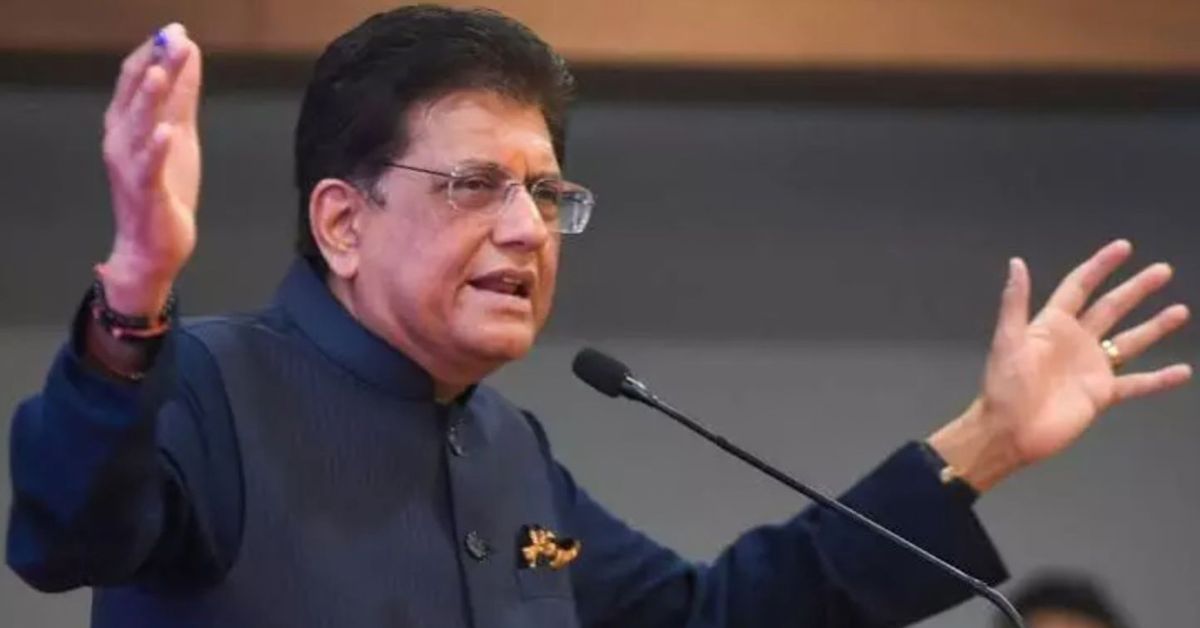

Commerce and Industry Minister Piyush Goyal has said India could consider a China-style trade engagement at some stage, and that he expects the country to emerge as a major exporter of goods and services to both China and the ASEAN region. Speaking after India-Netherlands trade negotiations in The Hague, he framed the pitch around fair, open markets and the removal of non-tariff barriers rather than tariff bargaining alone.
Coming from the minister steering India’s busiest FTA calendar, the remarks land squarely on the maritime and logistics trade — the sectors that will have to physically move any export growth, and the financiers who will have to fund it.
The Hague Remarks: Fair Access, Not Just Tariffs
Goyal’s comments followed a round of ministerial-level talks with the Netherlands as part of a wider Europe visit, during which he also addressed the India-Netherlands Business Forum. His core message: India is open to imports, including from China, but wants reciprocal access for its own goods and services.
The sectors he named as FTA-driven opportunities were notably cargo-heavy — technology, textiles, footwear, agriculture, marine products and precision engineering. He also flagged Global Capability Centres (GCCs) as a job-creation engine, a services line that sits alongside merchandise exports rather than competing with them.
The mention of non-tariff barriers is the operative phrase for exporters. For Indian seafood shippers, spice and agri exporters, and engineering goods suppliers, market access problems usually surface as certification, labelling, traceability and port-of-entry inspection hurdles — not headline duty rates. Those are exactly the frictions that delay vessel clearances and pile up demurrage.
China: Export Momentum, but a Wide Gap to Close
The ambition is easy to state and hard to deliver. India’s exports to China rose 36.62% to $19.47 billion in 2025-26 from $14.25 billion a year earlier, while imports climbed 16% to $131.62 billion. The goods deficit widened to $99.19 billion from $85 billion in 2024-25.
Read that through a shipping lens and the structure of the trade becomes clear. India’s inbound container volumes from China are dominated by machinery, electronics, chemicals and inputs for domestic manufacturing — cargo that fills east-to-west capacity. The outbound leg carries a narrower basket of commodities and agri goods, which is why return-leg utilisation and equipment repositioning remain structural costs for carriers on the India-China lane. Any shift toward higher-value Indian exports would improve that imbalance, but it will not happen through rhetoric; it needs buyer acceptance, standards alignment and predictable clearance times at both ends.
Export controls are the other constraint Goyal addressed. India’s own controls on sensitive goods and technology cut both ways in negotiations — they are a bargaining chip and a compliance burden for shippers who must classify cargo correctly before booking.
Rotterdam and the EU Route
The Netherlands leg of the tour matters more to Indian shippers than its size suggests. The Netherlands is India’s third-largest export destination globally and its largest in Europe, and the Port of Rotterdam functions as a strategic gateway into the European hinterland for Indian cargo.
Two things are converging. First, the India-EU free trade agreement was concluded in January 2026 and is in the legal-review and ratification phase, with the EU side set to eliminate or reduce tariffs on 99.5% of Indian goods by line — a list that explicitly includes marine products, textiles, leather and footwear. Second, India and the Netherlands have institutionalised the relationship through a Joint Trade and Investment Committee and a strategic partnership roadmap running to 2030.
For a Cochin or Visakhapatnam seafood exporter, the practical read is straightforward: duty savings on the European leg plus a Rotterdam-first routing strategy could improve landed cost competitiveness against Ecuadorian and Vietnamese suppliers. The catch is that tariff benefits arrive only after ratification, and European buyers are already enforcing sustainability and traceability documentation that Indian processors must be able to produce at the container level.
What It Means for Logistics and Trade Finance
Three operational implications stand out for the sector:
- Reefer and cold-chain capacity. A larger marine products push into Europe and ASEAN raises demand for reefer containers and temperature-controlled transhipment, tightening equipment availability during peak shrimp and fish harvest cycles.
- Documentation discipline. Preference claims under an FTA depend on rules of origin, which means bills of lading, invoices and certificates must align exactly. Mismatches are the single most common reason consignments lose preferential treatment at destination.
- Working capital and FX. Longer voyages and new markets stretch the receivables cycle. Trade finance structures — packing credit, bill discounting, ECGC-backed cover — will need to scale alongside order books, particularly for mid-sized exporters moving from one large buyer to several smaller ones.
On GCCs, the services story is more immediately bankable than the goods story. Global Capability Centres serving shipping lines, freight forwarders, insurers and charterers already anchor India’s maritime services employment in cities like Mumbai, Pune, Chennai and Gurugram — and they are insulated from the cargo cycle in ways that port operations are not.
Frequently Asked Questions
1. Is India negotiating a free trade agreement with China?
Not currently. Goyal said India “may consider a similar trade exercise with China at some stage” — a forward-looking signal, not an announced negotiation. Existing engagements include the India-EU FTA, an India-US trade pact in final stages, and talks with Chile and Canada.
2. What is India’s trade position with China right now?
Exports to China grew 36.62% to $19.47 billion in 2025-26, but imports of $131.62 billion left a goods deficit of $99.19 billion, up from $85 billion the previous year.
3. Which export sectors did Goyal identify as FTA beneficiaries?
Technology, textiles, footwear, agriculture, marine products and precision engineering, along with Global Capability Centres on the services side.
4. Why does the Netherlands matter for Indian exporters?
It is India’s largest export market in Europe and third-largest globally, with the Port of Rotterdam acting as the main gateway for Indian cargo moving into the EU hinterland. The India-EU FTA, once ratified, would cut or eliminate EU duties on 99.5% of Indian goods lines.
5. When would EU tariff benefits on Indian marine products actually apply?
Only after the India-EU FTA completes legal review and ratification on both sides. Until then, exporters continue to pay prevailing duties, though documentation and buyer-qualification work can begin now.
 Join our WhatsApp channel for more updates:
 Subscribe to our YouTube channel for more updates:



