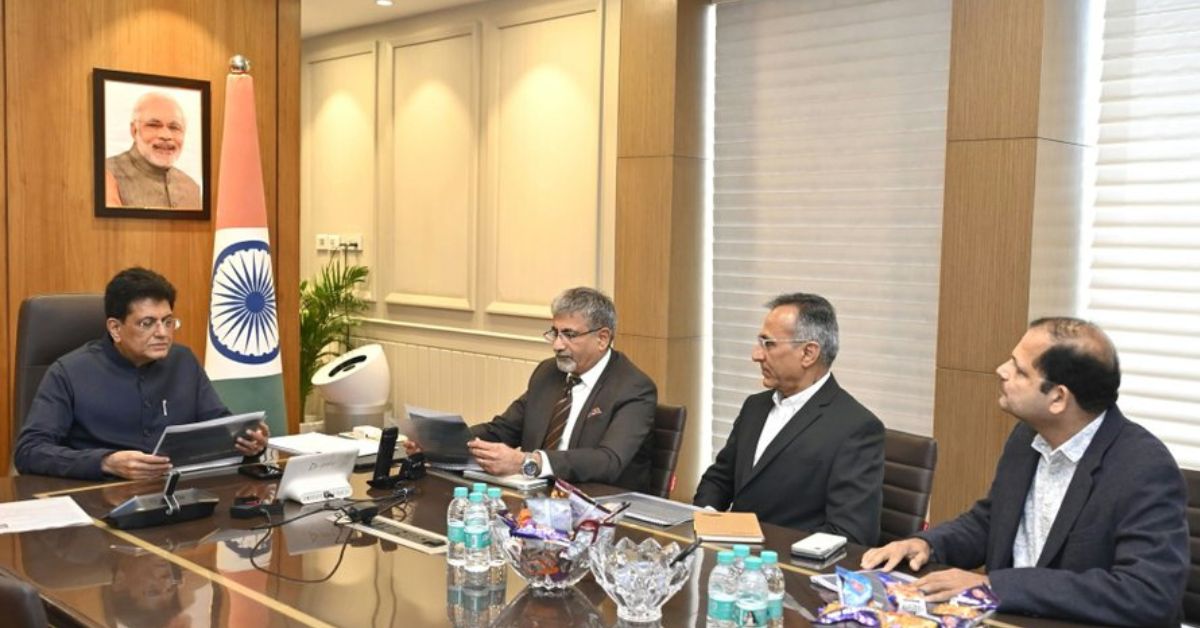

Union Commerce and Industry Minister Piyush Goyal met Škoda Auto Volkswagen India Private Limited (SAVWIPL) Managing Director and Chief Executive Officer Piyush Arora in New Delhi on 9 November 2026 to discuss electric vehicle (EV) manufacturing, automobile exports and greater localisation.
The discussions focused on strengthening domestic production and India’s participation in global automotive supply chains. Arora led a corporate delegation that also discussed innovation and increased sourcing of locally manufactured components.
The engagement comes as the Volkswagen Group’s Indian operations support both finished-vehicle exports and overseas assembly through component shipments, creating established links between manufacturing facilities, logistics centres and maritime gateways.
What did the meeting cover?
According to the Commerce Minister’s office, the talks examined opportunities to expand vehicle exports, develop EV production and strengthen India’s automotive manufacturing ecosystem.
Localisation formed a central part of the discussion, alongside improving the country’s position within international production networks.
The published account did not announce a new investment commitment, an EV manufacturing location, additional production capacity or a commissioning timetable. The meeting therefore represents discussions on industrial and export development, rather than confirmation of a specific new manufacturing project.
How significant is India to the group’s export operations?
SAVWIPL reported in June 2026 that it had exported more than 40,000 vehicles through Mumbai Port during financial year 2025–26. Mumbai Port Authority recognised the company as its leading automobile exporter for that period.
At the time, the company said cumulative exports had exceeded 725,000 Indian-made vehicles, reaching more than 40 countries. Its overseas markets include destinations across Asia, Africa, the Middle East and North America.
The export portfolio includes fully built Volkswagen Taigun and Virtus vehicles and Škoda Kushaq and Slavia models. The company has also expanded shipments of parts and components to support assembly in overseas markets.
SAVWIPL operates manufacturing plants at Chakan, near Pune, and Chhatrapati Sambhajinagar in Maharashtra, with combined annual capacity of 315,000 vehicles. The group crossed two million locally produced vehicles in 2025.
How does the India–Vietnam supply chain work?
Vietnam provides an example of India’s role beyond exports of completed vehicles.
Škoda Auto and its regional partner, Thanh Cong Group, opened an assembly plant in Vietnam’s Quang Ninh province on 26 March 2025. The facility uses completely knocked-down (CKD) kits prepared in Pune, linking Indian production and logistics operations with final assembly overseas.
The Vietnamese plant is close to Haiphong port, which Škoda identified as an advantage for receiving kits from India. The facility includes welding, painting and final assembly operations.
Supporting this trade is Škoda’s approximately 16,000-square-metre Parts Expedition Centre in Pune, opened in 2023 to package Kushaq and Slavia kits for the Vietnamese market. It established a dedicated logistics facility for the company’s component export programme.
What does recent production show?
Škoda’s Indian vehicle production increased to 73,800 units in 2025 from 32,800 in 2024, supported by demand for the locally manufactured Kylaq. More than 85,000 other Volkswagen Group vehicles were also produced in India during the year.
Pune manufactures the Škoda Slavia, Kushaq and Kylaq, while the Kodiaq is built at Chhatrapati Sambhajinagar. In Vietnam, production of the Kushaq and Slavia began during 2025, with 2,500 vehicles assembled by year-end.
These existing operations provide the manufacturing and logistics context for the latest discussions. Any additional cargo demand arising from EV production or expanded exports will depend on subsequent project decisions, production programmes and market allocations, none of which were specified in the meeting announcement.
 Join our WhatsApp channel for more updates:
 Subscribe to our YouTube channel for more updates: