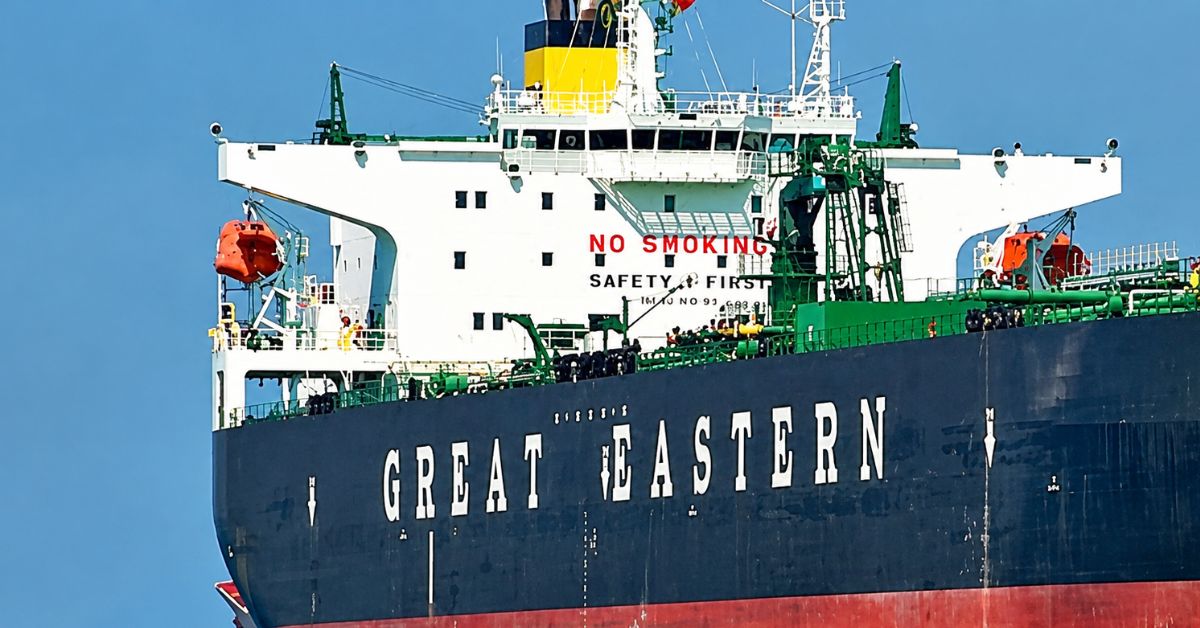

The Great Eastern Shipping Company reported a 46.9% year-on-year increase in consolidated revenue from operations to ₹1,824.42 crore for the quarter ended 30 September 2026, as the Mumbai-based shipowner continued renewing and expanding its fleet. The board approved the unaudited results on 6 November.
How did quarterly earnings perform?
Consolidated net profit rose 118.3% to ₹1,269.23 crore, compared with ₹581.41 crore a year earlier. However, revenue declined 9% and net profit fell 3% against the June quarter.
Earnings included ₹307.90 crore in net gains from selling ships and other assets, compared with ₹0.12 crore a year earlier. These gains were reported separately from revenue from operations.
For April–September, consolidated revenue increased 56.8% to ₹3,829.78 crore, while net profit rose 137.4% to ₹2,578.07 crore.
The board declared a second interim dividend of ₹14.40 per share for financial year 2026–27. The record date is 13 November, with payment scheduled on or after 1 December.
Which vessels have joined the fleet?
After the reporting quarter, Great Eastern Shipping took delivery of Jag Amit, a 2015-built Kamsarmax dry bulk carrier, on 4 November. The vessel has a capacity of approximately 81,886 tonnes deadweight (dwt), and its purchase was funded entirely through internal accruals.
The acquisition contract was signed during the September quarter, but delivery occurred in the third quarter. The distinction separates the purchase commitment from the vessel’s addition to the operating fleet.
Following delivery, the company reported an owned fleet of 41 vessels with aggregate capacity of approximately 3.33 million dwt. This comprised 25 tankers and 16 dry bulk carriers.
The tanker fleet included five crude carriers, 16 product tankers and four liquefied petroleum gas (LPG) carriers. The dry bulk fleet comprised two Capesize vessels, 11 Kamsarmax vessels, one Ultramax and two Supramax carriers. Capacity utilisation was close to 100%, according to the company’s 4 November update.
How is the tanker fleet being renewed?
Earlier in the September quarter, Great Eastern Shipping added Jag Laxman, a 2015-built Long Range 2 (LR2) tanker of approximately 109,990 dwt. Delivery took place on 9 July, following a purchase agreement signed in the preceding quarter.
The company financed that acquisition through internal accruals. On 21 July, it delivered the 2009-built LR2 product tanker Jag Lokesh to its buyers.
These transactions changed the composition of the product tanker fleet, with a younger vessel entering service and an older ship leaving. They also show why individual acquisitions do not necessarily translate into an equivalent net increase in fleet size.
What further acquisitions are planned?
In its 4 November fleet update, the company said it had contracted to acquire another secondhand Kamsarmax dry bulk carrier and a secondhand Very Large Gas Carrier. Both transactions were expected to be completed during the third quarter of financial year 2026–27.
The longer-term investment programme includes a newbuilding Suezmax tanker of approximately 157,000 dwt. Great Eastern Shipping signed the acquisition contract on 28 September, with delivery scheduled for the second half of financial year 2028–29.
The vessel is to be constructed in the Far East. The company identified fleet expansion as the purpose of the acquisition and said it proposed to finance the purchase through internal accruals. The order extends its investment programme beyond the nearer-term secondhand vessel deliveries.
 Join our WhatsApp channel for more updates:
 Subscribe to our YouTube channel for more updates: