





Summary
India’s maritime administration has launched two analytical tools to help assess vessel carbon emissions, indicative carbon costs and the potential benefits of shore power. Developed by the National Centre of Excellence in Green Ports and Shipping at TERI, the tools were unveiled at INMARCO 2026 in Mumbai.
Launch targets practical decarbonisation decisions
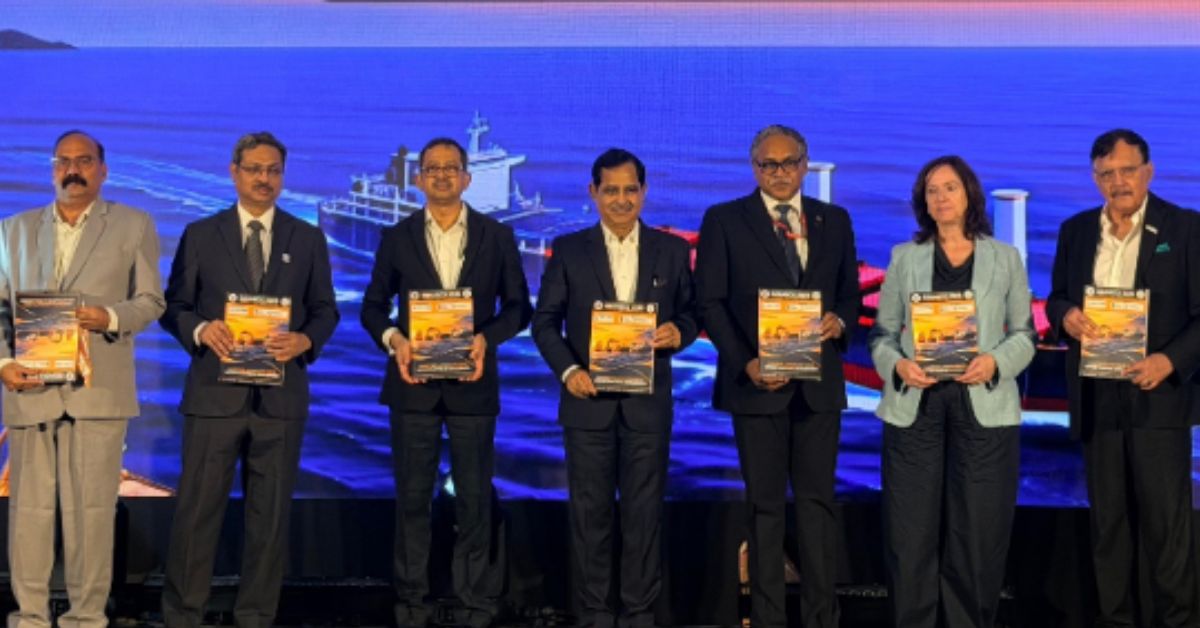
The green maritime digital tools were launched by Shyam Jagannathan, Director General of Maritime Administration, during INMARCO’s Blue Economy session on 27 October 2026.
The two applications are the Maritime CO₂ Emission & Implied Carbon Tax Calculator and the Shore to Ship Power Estimator PRO Tool.
They are intended to support operational assessments and investment decisions by making the emissions and cost implications of shipping activities easier to examine.
The launch formed part of discussions connecting maritime infrastructure, technology and decarbonisation with India’s longer-term maritime development plans.
Calculator examines emissions and indicative carbon costs
The Maritime CO₂ Emission & Implied Carbon Tax Calculator estimates vessel carbon dioxide emissions and examines their financial implications under different reference scenarios.
Its purpose is analytical: an implied carbon-cost estimate is not, by itself, a statutory tax assessment or a determination of a company’s compliance liability.
For operators, the practical value lies in understanding how emissions can affect operating economics. Comparing scenarios can help frame decisions about fuel consumption, efficiency measures and future investment.
Any commercial interpretation must remain tied to the assumptions used and the regulatory requirements applicable to the vessel’s activities.
Shore-power estimator supports port-stay assessments
The second tool evaluates potential fuel savings, emissions reductions and operating-cost implications when vessels use shore electricity during port stays.
Such estimates can help ports and shipowners examine whether a proposed connection warrants more detailed technical and financial study.
Shore power allows a berthed ship to draw electricity from land rather than generate the same power using its onboard auxiliary engines. Its economics depend on the circumstances of the call, including electricity demand, connection time and energy prices.
The estimator’s results describe potential outcomes. They should be distinguished from savings measured after equipment has been installed and used.
Earlier research provides the commercial background
TERI’s shore-to-ship power business-model project, published in December 2025, examined the conditions needed for financially viable deployment at Indian ports.
The work used administrative and vessel-survey data from V.O. Chidambaranar Port Authority. Its methodology included capital recovery and discounted cash-flow analysis, with payback periods and internal rates of return among the indicators considered.
The assessment compared diesel-generation costs with shore-electricity tariffs and examined emissions benefits, possible carbon revenues and incentive mechanisms.
This earlier research illustrates why shore-power decisions require both technical and commercial analysis. An available electricity connection does not alone establish a viable business case; utilisation, pricing and the allocation of infrastructure costs also matter.
The business-model project is relevant background, rather than confirmation that every assumption or feature has been incorporated into the newly launched estimator.
Centre connects research with maritime implementation
The National Centre of Excellence in Green Ports and Shipping was established jointly by the Ministry of Ports, Shipping and Waterways and TERI.
Operating from TERI’s Gurugram research campus, it supports research, policy development, technical assessments and skills development across green ports, vessels and shipping.
Its founding partners include V.O. Chidambaranar, Paradip and Deendayal port authorities, alongside Cochin Shipyard.
The centre’s remit covers identifying technology gaps, developing practical solutions and supporting investment through studies, pilot projects and demonstration platforms.
That role places digital assessment tools within a broader programme intended to connect research with decisions made by ports, shipowners and public authorities.
Data quality will determine practical value
For users, the immediate opportunity is to examine options before committing capital or changing operating practices.
The usefulness of any calculation depends on reliable inputs and a clear understanding of what the result represents. Vessel fuel records, port-stay patterns and applicable energy prices can materially influence an assessment.
Comparable assumptions are equally important when evaluating alternatives. A favourable result under one operating scenario may change under another.
The launch adds analytical support to India’s maritime transition. Its practical contribution will emerge through informed assessments, better project preparation and subsequent investments whose performance can be measured against the original estimates.
FAQs
Who developed the tools?
The National Centre of Excellence in Green Ports and Shipping at TERI.
When were they launched?
During INMARCO’s Blue Economy session on 27 October 2026.
What does the carbon calculator assess?
Vessel CO₂ emissions and indicative carbon costs under reference scenarios.
What does the shore-power estimator assess?
Potential fuel savings, emissions reductions and operating-cost implications during port stays.
Do the tools establish actual regulatory liabilities or guaranteed savings?
No. They support scenario-based assessment; actual obligations and operating outcomes require separate evaluation.
 Join our WhatsApp channel for more updates:
 Subscribe to our YouTube channel for more updates:




