
Summary
GRSE has laid the keel of its fifth multipurpose cargo vessel for Germany’s Carsten Rehder, advancing a 12-ship export programme. The milestone begins assembly of the first vessel under the second contract and supports the Kolkata shipyard’s expansion into international commercial shipbuilding.
Fifth vessel reaches assembly milestone
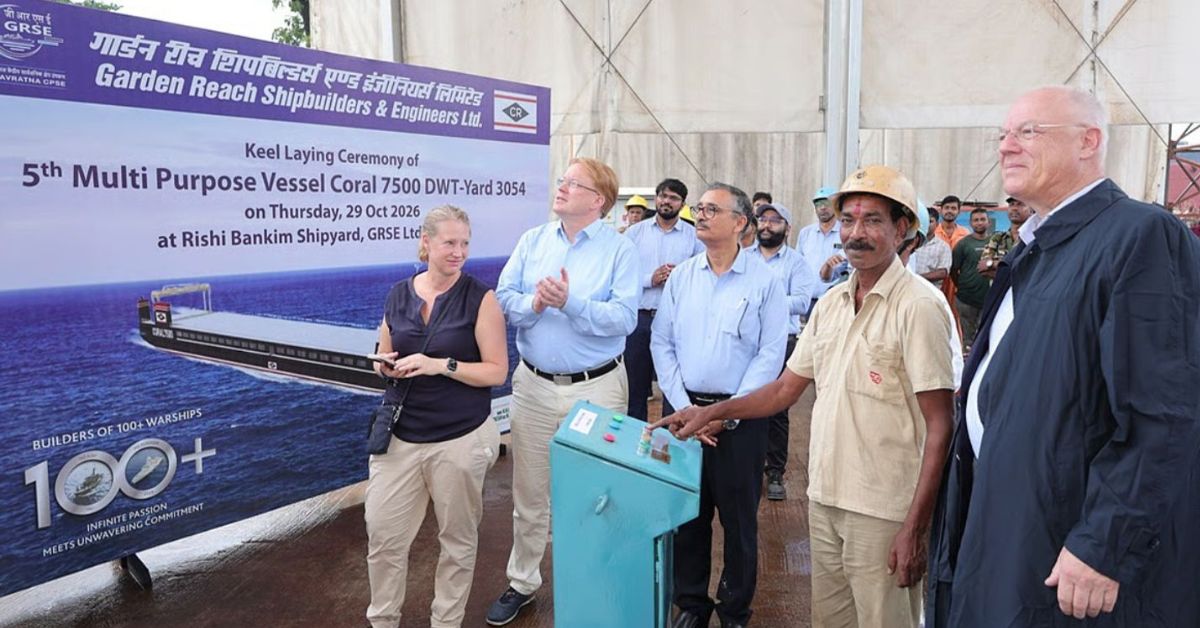
The GRSE German export project advanced on 29 October 2026 with the keel laying of the fifth multipurpose vessel being built for Carsten Rehder Schiffsmakler und Reederei GmbH & Co. KG.
Representatives of the shipbuilder, the German customer and classification society DNV attended the ceremony.
The vessel belongs to the CORAL 7500 series and is the first of four ships covered by the programme’s second contract.
Keel laying marks a stage in hull assembly. Further construction, outfitting, testing and acceptance remain before a vessel can be delivered for commercial employment.
Design accommodates varied cargo
The multipurpose vessels are designed to handle bulk, general and project cargo, with arrangements allowing containers on hatch covers and oversized consignments, including wind-turbine blades, on deck.
Published dimensions are 120 metres in length, 17 metres in beam and 5.85 metres in draught, with a deadweight capacity of 7,500 tonnes.
That combination provides flexibility across different cargo markets. However, the load carried on an individual voyage will depend on the consignment, stowage arrangements and applicable operating limits.
DNV is providing classification and certification for the programme.
Successive contracts expanded the programme
The construction milestone follows a series of agreements that established GRSE’s commercial relationship with the German owner.
The first contract, signed in June 2024, covered four vessels. Subsequent agreements expanded the programme to 12 ships.
Steel cutting for the CORAL series began in April 2025, followed by keel laying for the first vessel in October 2025. The second vessel reached that milestone in December.
These earlier developments show the progression from contract award and steel processing to assembly across successive hulls. The latest event concerns the fifth vessel’s construction status, rather than completion of five ships.
For a yard executing a series, repeat construction creates opportunities to carry production experience from one hull into the next. Delivering that benefit requires consistent design control, equipment supply and coordination between production teams.
Hybrid ships form a separate later batch
The programme also includes a distinct hybrid-propulsion component.
In September 2025, GRSE signed a contract for four hybrid multipurpose vessels, taking the firm programme to 12. The agreement also provided for two additional hybrid vessels.
Those additional ships were provisions beyond the contracted series and should not automatically be counted as firm orders.
The distinction between batches is equally important: the hybrid specification associated with the ninth to twelfth vessels should not be attributed to the fifth vessel solely because it belongs to the same customer’s programme.
The later agreement demonstrates how an established commercial relationship can extend into different propulsion requirements while retaining a common focus on multipurpose cargo transport.
Commercial work broadens GRSE’s business
The German programme forms part of a wider shift in GRSE’s order mix.
During a September 2026 briefing, Chairman and Managing Director Commodore P. R. Hari said non-defence business accounted for approximately 20–25% of orders. Around five years earlier, warship construction represented nearly 95% of the orderbook.
The shipyard reported revenue from operations of ₹7,002 crore for FY2025–26 and received Navratna status in June 2026.
Its capacity-development plans include increasing concurrent construction capability from 28 vessels to 32 and developing a major facility at Raichak in West Bengal.
These are broader corporate developments, separate from the fifth vessel’s construction milestone. Together, they provide the context for GRSE’s effort to serve commercial customers alongside naval and coast guard requirements.
For India’s shipbuilding industry, the programme offers experience in executing a repeat commercial series for an overseas owner. The practical test will be consistent construction quality, timely equipment integration and dependable delivery.
The fifth keel laying demonstrates continued progress through that production sequence. Its commercial significance will ultimately rest on completed ships entering service and meeting the customer’s operating requirements.
FAQs
Who is the customer?
German shipowner Carsten Rehder.
When was the fifth vessel’s keel laid?
On 29 October 2026.
How large is the contracted programme?
It comprises 12 multipurpose vessels.
What cargo can the vessels carry?
The design accommodates bulk, general and project cargo, containers and oversized consignments.
Has the fifth ship been delivered?
No. Keel laying is a construction milestone preceding outfitting, testing and delivery.
 Join our WhatsApp channel for more updates:
 Subscribe to our YouTube channel for more updates: