





Summary
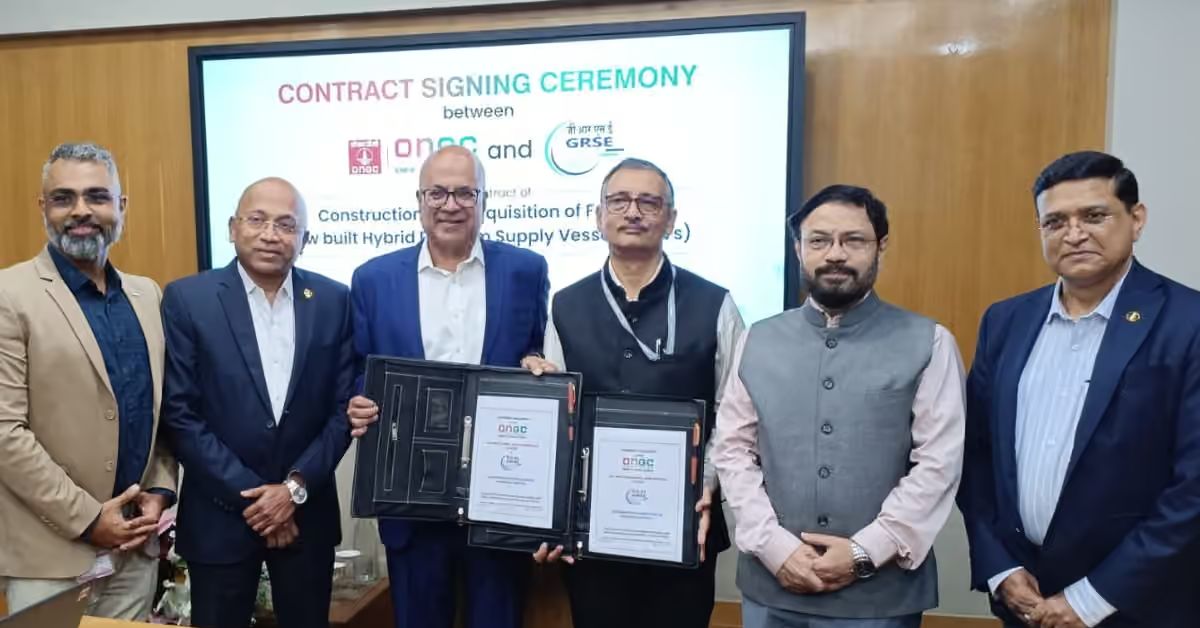
Garden Reach Shipbuilders & Engineers has signed a contract with ONGC to construct four hybrid platform supply vessels, advancing an order awarded in July 2026. The ₹1,032.07-crore programme expands GRSE’s commercial offshore portfolio and will introduce battery-supported propulsion for vessels serving offshore exploration and production operations.
Article
Contract signing follows July award
The GRSE–ONGC vessel contract covers four platform supply vessels designed to support offshore installations, adding specialised commercial ships to the Kolkata shipbuilder’s portfolio.
The signing was reported on October 15. Commander Shantanu Bose, Director (Shipbuilding) at GRSE, and Ratnesh Kumar, Executive Director (Strategy) at ONGC, signed the agreement.
The development follows GRSE’s receipt of the Notification of Award on July 30, 2026. Its exchange disclosure valued the order at ₹1,032.07 crore, including GST, and specified completion within 48 months from the award date.
The latest signing therefore advances an existing procurement programme rather than representing an additional four-vessel order.
Ships designed for offshore supply duties
The vessels will be approximately 80 metres long and 20 metres wide, with about 650 square metres of clear deck space.
They will be designed and constructed to Indian Register of Shipping rules and will support the logistical requirements of offshore exploration and production.
For this vessel category, deck space and dependable power are important operational considerations. Offshore supply work requires ships to transport equipment and supplies while operating around installations where manoeuvrability and position control matter.
The programme consequently involves more than hull construction. Propulsion, electrical systems, cargo arrangements and control equipment must function together across different operating conditions.
Successful integration will be central to translating the vessel specifications into reliable service.
Battery system supports several operating functions
The propulsion architecture combines electrically driven azimuth thrusters with lithium-ion battery energy storage.
GRSE has identified peak-load management, spinning reserve, dynamic positioning support and emergency response among the battery system’s intended functions.
These applications address different demands on the electrical plant. Batteries can respond to changing power requirements, while dynamic positioning requires coordinated propulsion and control to maintain a vessel’s location.
The commercial objective is to manage energy more effectively across the operating cycle. Actual savings will depend on the final system configuration, machinery operation and the proportion of time spent undertaking different duties.
The available announcement does not quantify fuel savings or emissions reductions. Those outcomes will require assessment against operating conditions and an appropriate comparison vessel.
Offshore diversification has earlier foundations
GRSE’s move into specialised offshore construction follows earlier efforts to develop engineering partnerships and pursue commercial opportunities.
At Nor-Shipping in June 2025, the shipbuilder signed an agreement with Dubai-based Aries Marine covering offshore platform and vessel design.
That arrangement envisaged identifying and developing offshore orders involving Aries designs and construction by GRSE. It established a framework for market development, although it should not be assumed to determine the design arrangements for the ONGC vessels.
During the same event, GRSE also announced a memorandum of intent with Germany’s Carsten Rehder for four additional 7,500-DWT multipurpose vessels, featuring hybrid propulsion.
Together, these earlier initiatives show that commercial vessels and advanced propulsion were already part of the yard’s diversification agenda before the ONGC award.
September partnerships broaden technical capabilities
Further cooperation agreements followed at SMM Hamburg in September 2026.
GRSE’s agreement with DNV covered areas including specialised vessels, sustainable technologies, digital shipbuilding and skills development.
A separate arrangement with Damen Technical Cooperation established a framework to explore dredger design and construction for Indian customers, including trailing suction hopper and water injection dredgers.
These partnerships address different markets from platform supply vessels. Their relevance lies in the broader effort to develop engineering capabilities and compete across more specialised ship categories.
They remain cooperation frameworks and should be distinguished from firm construction orders such as the ONGC programme.
Execution becomes the next commercial test
For GRSE, the four-ship series offers an opportunity to demonstrate repeatable construction and integration of hybrid offshore vessels.
For ONGC, the programme is an investment in the maritime support infrastructure required for offshore activity.
The next substantive milestones will involve detailed engineering, procurement, construction and trials. Delivery discipline and operational reliability will determine the programme’s longer-term significance, including its value as a reference for future commercial offshore orders.
FAQs
What does the contract cover?
Construction of four hybrid platform supply vessels for ONGC.
What is the order value?
₹1,032.07 crore, including GST, according to the July award disclosure.
When is completion required?
Within 48 months of the July 30, 2026 Notification of Award.
What makes the propulsion system hybrid?
It combines electrically driven azimuth thrusters with lithium-ion battery energy storage.
Have fuel-saving figures been announced?
The available announcements do not specify quantified fuel or emissions savings.
 Join our WhatsApp channel for more updates:
 Subscribe to our YouTube channel for more updates:



