

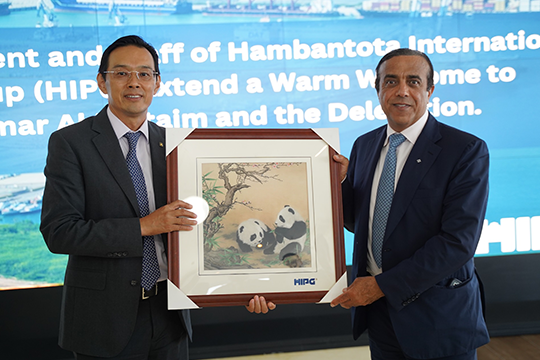
Hambantota International Port Group (HIPG) and Al-Futtaim Logistics are exploring expanded commercial cooperation and potential investment opportunities at the Sri Lankan port, building on its role in alternative vehicle supply routes to Gulf markets. HIPG disclosed the discussions on 6 November 2026, following a visit by a delegation led by Al-Futtaim Group’s vice chairman.
The talks covered existing business relationships, regional vehicle shipping connections and opportunities across port operations and the adjoining industrial park. No investment agreement, project value or implementation timetable was announced.
The engagement follows the use of Hambantota as a transhipment gateway during shipping disruption around the Strait of Hormuz earlier this year.
How has Hambantota supported Gulf vehicle supplies?
Al-Futtaim’s white paper, Resilience in Motion, published on 1 October, identifies Hambantota as one of three alternative gateways deployed following disruption in March 2026. The other two were Port Sultan Qaboos in Muscat, Oman, and Khor Fakkan in the United Arab Emirates (UAE).
According to Al-Futtaim, the three corridors collectively moved more than 25,000 finished vehicles into the UAE, Qatar, Bahrain, Kuwait and Saudi Arabia. The company said these arrangements helped maintain dealer inventories and supported vehicle manufacturers in restoring production.
The 25,000-vehicle figure covers the combined contribution of all three routes. It does not represent Hambantota’s individual throughput, for which a separate figure was not disclosed.
What role does the CASCADIA feeder service play?
The CASCADIA roll-on/roll-off (RoRo) feeder service formed part of the discussions on strengthening Hambantota’s connections with Gulf vehicle distribution networks.
Launched on 9 June 2026, the service supports onward vehicle movements through the port. Its operator, CASCADIA, is a Canada-headquartered maritime logistics specialist with regional operations in trade centres including Dubai.
Al-Futtaim Logistics, part of the Dubai-headquartered Al-Futtaim Group, provides services across finished vehicles, aerospace, retail, and food and beverage supply chains.
What vehicle-handling infrastructure does Hambantota offer?
The discussions build on Hambantota’s established automotive cargo business. The port handled 726,153 vehicles in 2025 and has been expanding its RoRo infrastructure to accommodate further growth.
In March 2026, HIPG announced the commissioning of a six-hectare vehicle yard under the first stage of its Phase II expansion programme. The additional space was intended to ease storage pressure, improve traffic circulation and support more efficient vessel operations.
The port has outlined plans to increase annual RoRo handling capacity towards one million vehicles through subsequent development phases. That figure is a capacity objective, rather than an achieved annual throughput.
Located approximately 10 nautical miles from the principal East–West shipping lane, Hambantota serves vehicle movements between Asia, West Asia and Africa. Its deep-water berths and dedicated RoRo facilities can accommodate large pure car and truck carriers.
What lessons emerge for automotive supply chains?
Al-Futtaim’s white paper places advance planning, shipment visibility and local operational capability at the centre of its response to disruption.
The company said it deployed a logistics visibility platform within 72 hours, linking each vehicle identification number to information including the driver, model, destination and distributor. The paper also highlights the need to coordinate different customs regimes and develop local teams capable of sustaining operations after the initial emergency response.
For Hambantota, the immediate outcome is an opportunity to deepen an existing commercial relationship. Any wider investment programme will depend on the parties converting their discussions into defined projects, funding commitments and implementation arrangements.
 Join our WhatsApp channel for more updates:
 Subscribe to our YouTube channel for more updates: