
Summary
Hambantota International Port delivered 167,569 vehicles across March–December 2025 and January–September 2026. Used vehicles accounted for roughly two-thirds of deliveries, while the port introduced financial concessions and storage-cost measures to help importers manage restrictions, changing demand and disruptions affecting Gulf-region transhipment.
Used vehicles dominate delivery figures
Hambantota vehicle deliveries totalled 86,389 during March–December 2025, followed by 81,180 in the first nine months of 2026, according to an operational update issued on 15 October.
| Reporting period | New vehicles | Used vehicles | Total |
|---|---|---|---|
| March–December 2025 | 30,809 | 55,580 | 86,389 |
| January–September 2026 | 25,018 | 56,162 | 81,180 |
| Combined | 55,827 | 111,742 | 167,569 |
Calculated from these figures, used vehicles represented approximately 66.7% of combined deliveries. Their share increased from around 64.3% in the 2025 reporting period to 69.2% in January–September 2026.
The periods cover different numbers of months, so the totals do not provide a like-for-like annual growth comparison.
Importer support addresses disruption costs
Hambantota International Port Group worked with the Vehicle Importers’ Association of Lanka to address operational difficulties.
Support included demurrage waivers and concessions for vehicles detained during import restrictions. More recently, a storage-cap mechanism was introduced for vehicles affected by Gulf-region transhipment disruptions, helping customers anticipate their storage expenditure.
Commercially, these measures address an important exposure for vehicle traders: charges can accumulate while cargo awaits clearance or onward shipment. Greater predictability helps importers assess the cost of holding inventory when delivery schedules change.
Reopening of imports provides market background
The delivery figures follow Sri Lanka’s phased relaxation of vehicle import restrictions.
Restrictions on public passenger vehicles were eased in December 2024, followed by commercial vehicles in January 2025. Measures covering personal vehicles were removed at the end of January, subject to specified environmental and safety exceptions.
This reopening restored access to imported vehicles after prolonged restrictions and created renewed demand for shipping, terminal handling and inland distribution.
The International Monetary Fund subsequently recorded steady growth in motor vehicle imports after the February 2025 reopening. By 10 June that year, approximately US$675 million in vehicle-related letters of credit had been opened. These national figures provide market context rather than a measure of Hambantota’s individual business. imf.org
Earlier yard expansion supports automotive operations
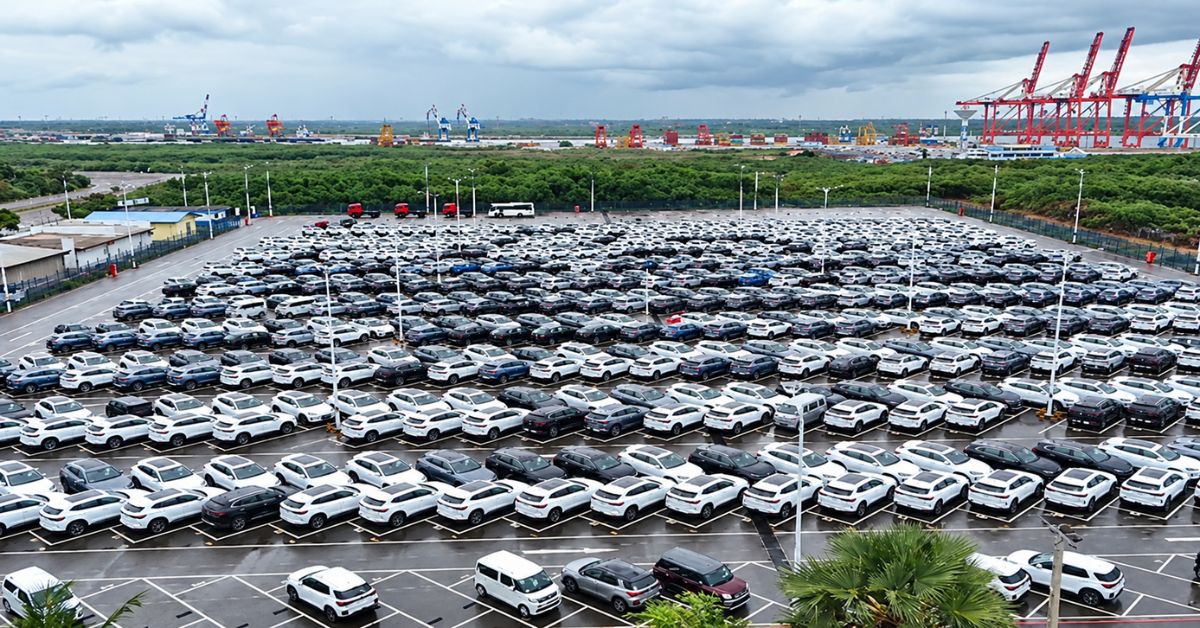
Hambantota announced additional roll-on/roll-off yard capacity in March 2026 as part of its automotive logistics development.
The expansion added parking capacity for 4,500 vehicles, supporting storage arrangements, vehicle circulation and terminal planning. The port also outlined an ambition to expand annual RoRo handling capacity towards one million vehicles in subsequent development phases.
That figure is a development target, rather than confirmed annual throughput. Similarly, parking capacity describes the number of vehicles that can occupy a yard at a given time; it differs from the volume handled over a year.
The port’s deep-water berths and dedicated automotive facilities accommodate large pure car and truck carriers, supporting both Sri Lankan imports and international vehicle transhipment. hipg.lk
Delivery statistics differ from overall RoRo throughput
Hambantota’s broader automotive activity includes vehicles moving between overseas markets as well as those entering Sri Lanka.
In June 2026, the port separately reported monthly RoRo throughput of 90,219 vehicles, alongside container throughput of 80,325 TEUs. Those operational measures should be kept separate from the latest delivery figures, which use a different reporting basis.
For shipping lines and customers, terminal performance also depends on vehicle tracking, release procedures and coordination between the parties handling each consignment.
Hambantota’s published service arrangements include a terminal operating system, barcode scanning and electronic release facilities supporting customs clearance. These systems provide tools for monitoring cargo and exchanging operational information.
The latest figures therefore highlight two connected requirements for automotive logistics: sufficient infrastructure to accommodate vehicle flows and practical arrangements to manage cargo when market conditions interrupt movement.
For importers, the commercial test remains the complete journey—from vessel arrival and terminal storage to clearance and delivery. Handling capacity, timely information and predictable charges all influence the reliability and final cost of that journey.
FAQs
How many vehicles were delivered?
The combined total was 167,569 across the two reporting periods.
Were most vehicles new or used?
Used vehicles accounted for approximately two-thirds.
Does this represent total annual RoRo throughput?
No. Delivery figures and overall RoRo throughput use different reporting bases.
What support did importers receive?
Measures included demurrage concessions and a storage-cost cap for affected vehicles.
What is the port’s RoRo capacity ambition?
Hambantota has outlined a target of approximately one million vehicles annually through future development phases.
 Join our WhatsApp channel for more updates:
 Subscribe to our YouTube channel for more updates: