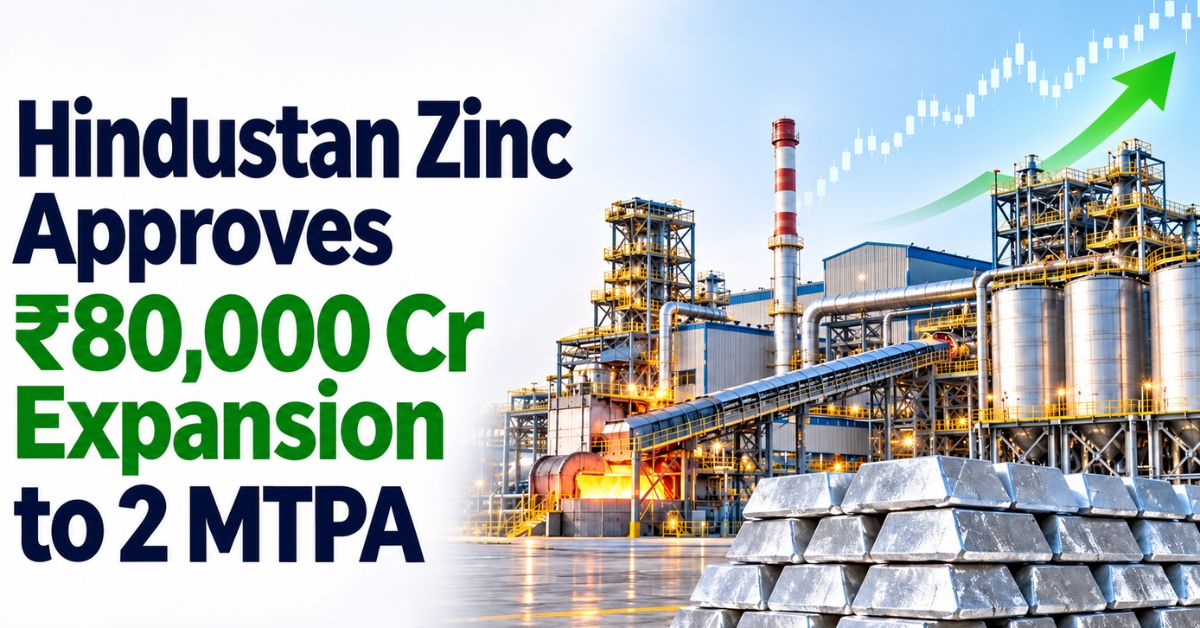

Hindustan Zinc’s board approved a roughly ₹80,000 crore expansion on 16 November 2026 to raise annual refined zinc and lead capacity from about 1.1 million tonnes to 2 million tonnes over three to five years. The programme includes new smelters, a silver refinery and expanded mining and milling operations in Rajasthan. The company is counting on rising zinc demand from India’s steel and infrastructure sectors and plans to fund the investment through internally generated funds and debt.
Which smelters and refineries will Hindustan Zinc add?
The first stage centres on the integrated zinc smelter at Debari, Rajasthan. The board approved the plant in June 2025 with an annual capacity of 250,000 tonnes. Hindustan Zinc has since increased its planned capacity to 265,000 tonnes within the same budget. It expects to commission the smelter in the second quarter of the 2028–29 financial year and reach about 1.4 million tonnes of annual refined metal capacity by that financial year.
The broader programme adds a zinc smelter with annual capacity of 500,000 tonnes and a lead smelter capable of producing 200,000 tonnes a year. Hindustan Zinc plans to retire an existing 88,000-tonne-a-year zinc cell house at Debari as it expands. Once the projects are complete, annual smelting capacity is projected to reach 1.61 million tonnes of zinc and 410,000 tonnes of lead. A separate 700-tonne-a-year silver refinery will lift annual silver refining capacity from 800 tonnes to 1,500 tonnes.
How will mine output support the expansion?
Hindustan Zinc plans to raise annual ore production capacity from 19.3 million tonnes to 35 million tonnes. The largest proposed additions are 5.4 million tonnes at Rajpura Dariba and 4.3 million tonnes at Zawar. The company also plans to develop 3.5 million tonnes of annual capacity at Bamnia Kalan and expand operations at Rampura Agucha, Kayad and Sindesar Khurd. These mine capacity estimates may change as project designs are finalised.
The company has identified a further ₹3,823 crore investment in a tailings reprocessing plant at Rampura Agucha. The plant will recover material from previously processed mine waste for use as feed at the smelters.
What is driving Hindustan Zinc’s investment?
Hindustan Zinc operated at about 92% of existing metal capacity in 2025–26. The company expects domestic zinc demand to double over the next five to ten years as steel production expands. Zinc is used to galvanise steel for applications including rail infrastructure, transmission towers and renewable energy installations. In 2025–26, the company sold about 70% of its refined zinc in India and exported the rest to Southeast Asia, the Middle East, the United States and Europe.
FAQs
Does the ₹80,000 crore include the Debari smelter?
Yes. The estimate includes the previously approved Debari project, the new zinc and lead smelters, the silver refinery, mine and milling expansion, exploration and related infrastructure.
When does Hindustan Zinc expect to reach 2 million tonnes of annual capacity?
The company expects to reach that level within three to five years of the November 2026 approval. Its interim target is about 1.4 million tonnes in the 2028–29 financial year.
 Join our WhatsApp channel for more updates:
 Subscribe to our YouTube channel for more updates: