



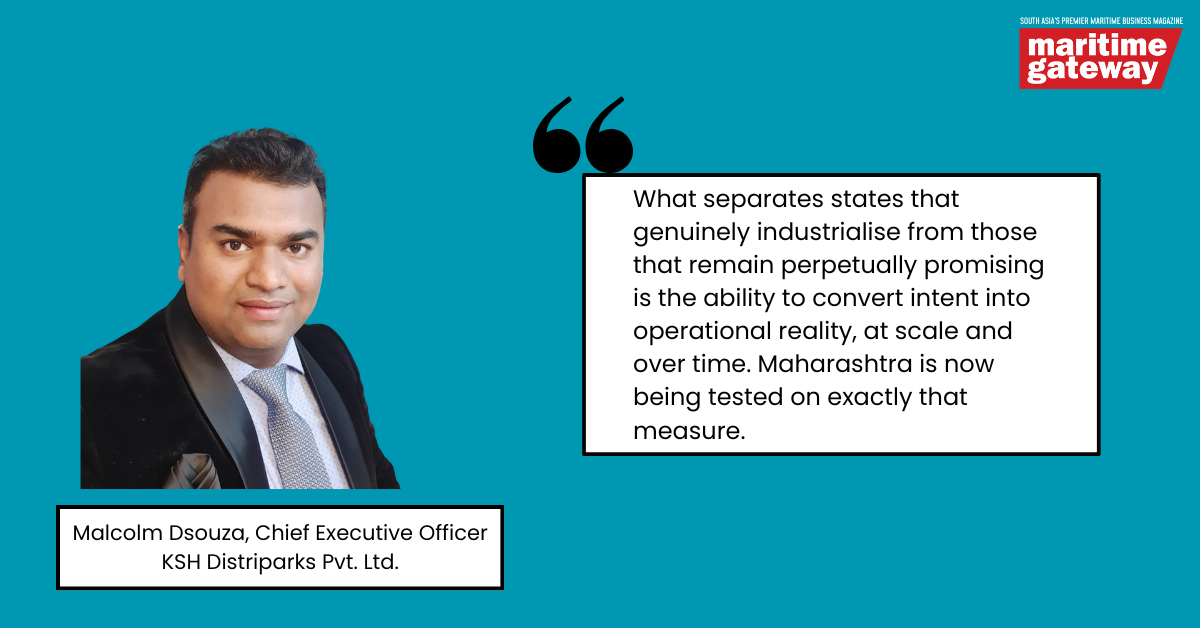

By Malcolm Dsouza, Chief Executive Officer, KSH Distriparks Pvt. Ltd.
India’s journey toward a $5 trillion economy will be written across many states, each contributing its distinct strengths. Among them, Maharashtra stands out as a compelling case study in how infrastructure-focused policy, when designed with intent and executed at scale, can fundamentally transform a state’s manufacturing and export potential.
The state has been building an interconnected architecture: expressways feeding into freight corridors, deep-draft ports anchoring global trade flows, and industrial nodes activated by a policy framework that brings incentives, land, talent, and capital together in one place. The results are beginning to show, and the trajectory is steep.
The economic foundation
Maharashtra’s nominal Gross State Domestic Product (GSDP) is estimated to cross ₹51 lakh crore (approximately $615 billion). Per capita income stands at approximately ₹3.47 lakh and continues to climb.
On trade, total merchandise exports from Maharashtra touched ₹5,83,256 crore (approximately US$65.86 billion) in FY25, spanning engineering goods, pharmaceuticals, electronics, gems and jewellery, and chemicals. Maharashtra accounts for over 15% of India’s total exports, attracts the highest share of foreign direct investment among all states, and has been ranked first in NITI Aayog’s Export Preparedness Index 2024, ahead of Tamil Nadu, Gujarat, Uttar Pradesh, and Andhra Pradesh.
The state’s ambition is calibrated to match this base. Maharashtra is targeting a trillion-dollar economy, backed by infrastructure projects worth approximately ₹4 lakh crore currently under execution across the Mumbai Metropolitan Region alone.
A framework built for scale
The Maharashtra Industries, Investment and Services Policy 2025 (MIISP) is a landmark policy introduced by the Government of Maharashtra to attract large-scale investments in manufacturing and services. Its headline numbers are striking: a targeted investment of ₹70.5 lakh crore and the creation of close to 50 lakh direct jobs in manufacturing and services over the policy period from December 2025 through December 2030.
Equally important is the policy’s forward orientation. It explicitly targets frontier and emerging sectors: optics and sensors, bio-based polymers, modular nuclear reactors, autonomous vehicle components, telecom infrastructure for 6G, quantum computing hardware, and drone logistics. This is a state positioning itself for the industries of the next decade, alongside those of the current one.
Complementing the industrial policy is the Maharashtra Logistics Policy 2024, built on the recognition that logistics is the circulatory system of any manufacturing economy. The policy targets the development of over 10,000 acres of dedicated logistics infrastructure, structured as a clear hierarchy: one International Logistics Hub, one National Logistics Hub, five Regional Logistics Hubs, and 25 District Logistics Nodes. More than 200 logistics parks, complexes, and truck terminals are envisaged, expected to generate approximately five lakh new jobs.
The objective is to convert physical assets into a genuinely world-class logistics ecosystem, one that reduces logistics costs as a share of GDP and strengthens India’s overall supply chain competitiveness.
The corridors reshaping economic geography
Physical infrastructure is where policy intent meets ground reality. Maharashtra is investing heavily in both, and the projects now underway are redrawing the state’s industrial map.
The Hinduhrudaysamrat Balasaheb Thackeray Maharashtra Samruddhi Mahamarg is the most consequential of these investments. The 701-kilometre, six-lane, access-controlled expressway connecting Nagpur to Mumbai has cut travel time between the two cities from nearly 16 hours to 8 hours, unlocking industrial potential across ten districts, including Nashik, Chhatrapati Sambhajinagar, and Nagpur.
Equally significant is the Missing Link project on the Mumbai-Pune Expressway, one of the busiest industrial corridors in the country. At an estimated cost of ₹6,695 crore, the project comprises two twin tunnels of 1.75 km and 8.92 km, two cable-stayed bridges of 770 metres and 645 metres, and supporting viaduct infrastructure connecting Khopoli to Kusgaon.
The link bypasses the Khandala ghat entirely, eliminating the steep gradients and sharp curves that have long created bottlenecks, cutting travel time between Mumbai and Pune by up to 45 minutes. For manufacturers and logistics operators on this corridor, the gains translate directly into lower transit costs, fewer disruptions, and measurably improved supply chain reliability between two of Maharashtra’s most productive industrial clusters.
Building the gateway infrastructure
Maharashtra’s maritime infrastructure is undergoing a generational transformation, with consequences for every exporter and manufacturer in the state.
With the inauguration of the Bharat Mumbai Container Terminal at JNPT in September 2025, Maharashtra now commands India’s largest container handling capacity at 10 million TEUs.
The more transformative project ahead is Vadhvan Port. Planned as a greenfield deep-draft port in Palghar district, approved by the Union Cabinet in June 2024 at a cost of ₹76,220 crore, Vadhvan is designed to handle 250 million tonnes of cargo annually and accommodate the world’s largest container vessels. At full build-out, it is projected to rank among the top ten container ports globally.
A hyperloop cargo corridor linking JNPT and Vadhvan, under an MoU signed in August 2025, adds a further layer of ambition to the maritime cluster taking shape along Maharashtra’s coastline.
Each of these investments makes the others more valuable, and the whole makes Maharashtra’s case as a manufacturing and export destination substantially stronger.
Delivery is the differentiator
Infrastructure announcements are common. Policies get launched, corridors get named, and investment summits produce headlines. What separates states that genuinely industrialise from those that remain perpetually promising is the ability to convert intent into operational reality, at scale and over time. Maharashtra is now being tested on exactly that measure. The expressways, the port expansions, the policy frameworks, and the investment commitments are all on the table.
The next phase belongs to implementation, and it is in that phase that Maharashtra’s true standing as a manufacturing and export hub will be determined.
Malcolm D’souza is the CEO of KSH Distriparks, known for delivering reliable, efficient, and scalable solutions at ICD Talegaon, Pune.
 Join our WhatsApp channel for more updates:
 Subscribe to our YouTube channel for more updates: