



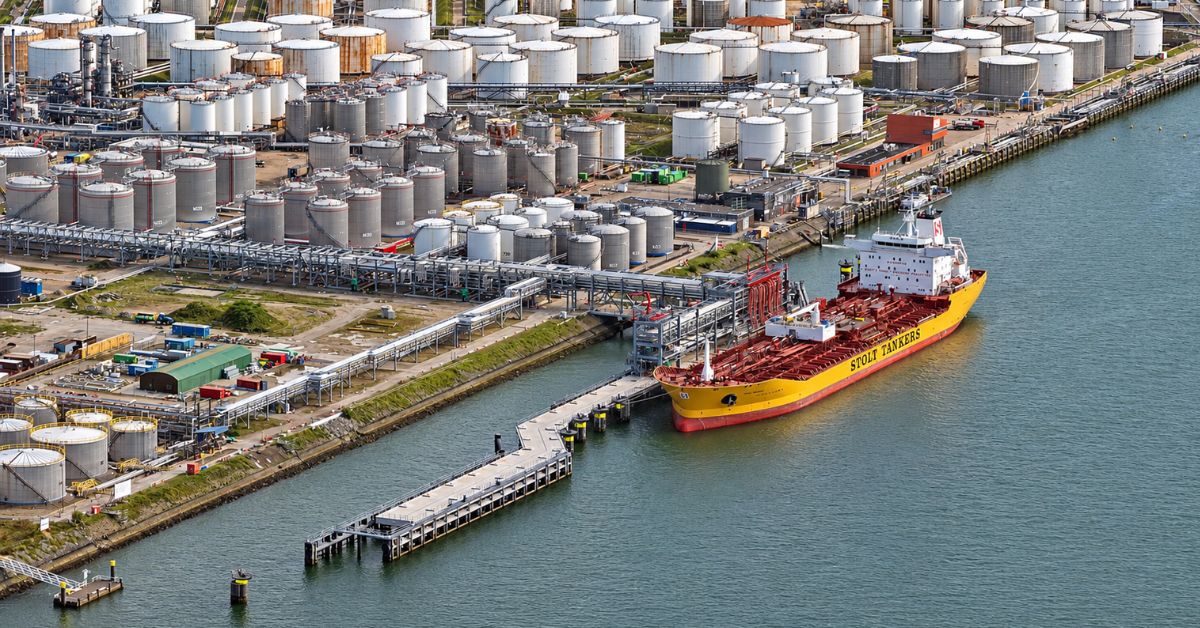

The global oil tanker fleet could expand by 45% and the liquefied natural gas (LNG) carrier fleet by 80% by 2050 under the International Energy Agency’s (IEA) Current Policies Scenario. The projections accompany a new assessment warning that growing seaborne energy trade will require more resilient ports and shipping routes.
Published on 18 November 2026, Extreme Weather Risks to International Oil and Natural Gas Shipping examines how storms, flooding, drought and other hazards could affect energy deliveries. The fleet projections are conditional scenarios, rather than a single forecast of future vessel demand.
How do fleet requirements differ between scenarios?
Under the Current Policies Scenario, oil and gas shipping activity increases from approximately 32 trillion tonne-kilometres today to 47 trillion by 2050.
Growth is lower under the Stated Policies Scenario, which incorporates faster efficiency improvements and clean-technology deployment. Even in that case, the oil tanker fleet expands by 35% and the LNG carrier fleet by 60% by mid-century.
The report uses scenarios from the World Energy Outlook 2025. The Current Policies Scenario considers measures already adopted in legislation and regulation. The Stated Policies Scenario takes a broader view, including formally proposed policies and official strategies, without assuming that every aspirational target will be achieved.
The IEA also identifies replacement of ageing vessels as a source of newbuilding demand alongside fleet expansion.
Why can shipping demand outgrow cargo volumes?
Transport distance is a major factor. Since 2000, seaborne crude oil volumes have increased by around 15%, while oil tanker activity measured in tonne-kilometres has risen by approximately 40%.
The difference reflects the movement of refining capacity and crude import demand towards Asia, lengthening voyages between suppliers and consumers. LNG trade volumes have quadrupled over the same period.
A tonne-kilometre measures one tonne of cargo transported over one kilometre. Longer voyages therefore increase transport activity even when the quantity of cargo changes little, keeping vessels occupied for more time.
How do diversions affect vessel availability?
The report illustrates the cost of disruption through a tanker voyage from the US Gulf Coast to Japan. Routing around the Cape of Good Hope instead of using the Panama or Suez canals would add approximately 13,000 kilometres and 26 days, increasing fuel consumption by 75% at unchanged speed.
Such diversions absorb shipping capacity because each vessel takes longer to complete its journey. The IEA says prolonged disruption can raise freight rates globally, although the report does not establish a guaranteed long-term freight-rate outcome.
What risks face energy ports and terminals?
Tanker-handling ports currently experience average weather-related downtime of about 1.5 days annually, according to the IEA. Individual severe events can interrupt operations for weeks or months.
The agency identifies tropical cyclones, flooding and extreme heat as important port hazards. Along shipping routes, cyclones can disrupt the Luzon Strait, while low visibility can interrupt passage through the Turkish Straits. Drought creates additional restrictions on inland waterways.
These vulnerabilities matter because maritime transport carried part of the journey for approximately 40% of global crude oil supply, 30% of petroleum products and 15% of natural gas supply in 2024.
What does the IEA recommend?
The agency calls for extreme-weather resilience to become part of national energy-security planning. Recommended measures include stronger port infrastructure, better early-warning systems, diversified supply chains and closer international information sharing.
For energy shipping, the findings place fleet investment and infrastructure resilience within the same planning challenge: additional ships need dependable terminals and navigable routes to deliver their intended transport capacity.
 Join our WhatsApp channel for more updates:
 Subscribe to our YouTube channel for more updates: