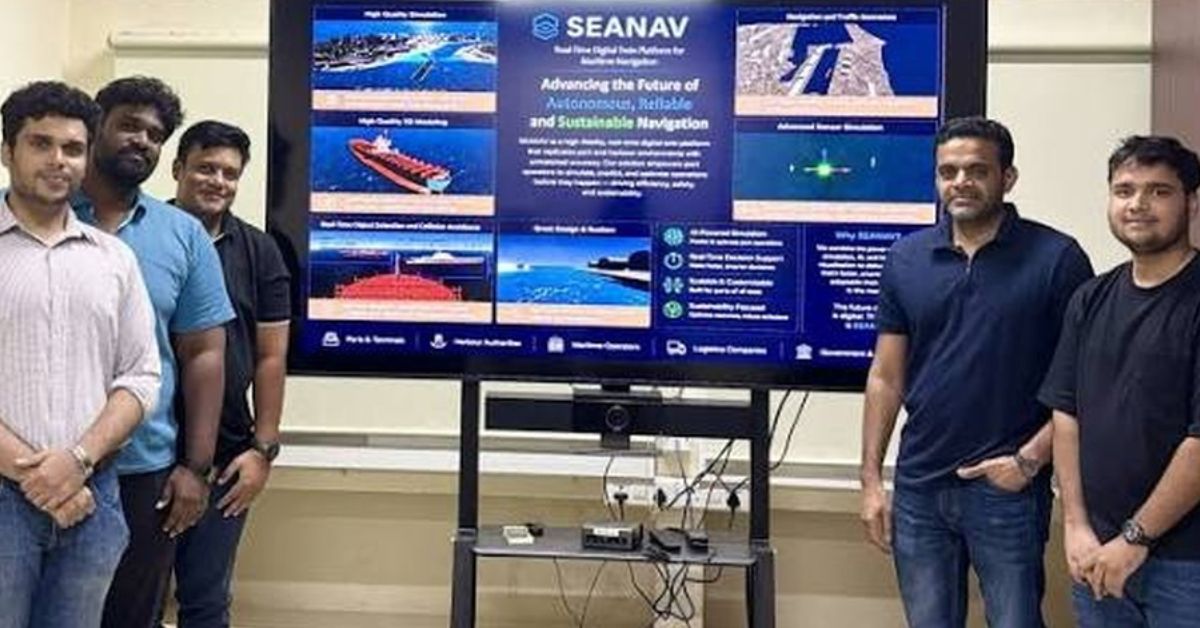

Researchers at the Indian Institute of Technology Madras (IIT Madras) have developed a real-time simulator to test how autonomous ships follow routes and avoid collisions in conditions such as rough seas, poor visibility and heavy traffic. The Chennai institute announced the platform, called SEANAV, on 12 November 2026. Its research team has demonstrated autonomous route-following and collision avoidance in simulated wave and sensing conditions.
How SEANAV tests autonomous ship navigation
Developed by IIT Madras’s Department of Ocean Engineering, SEANAV models vessel motion, waves and surrounding traffic using the Unity 3D engine. The researchers calibrated the simulator against a benchmark tanker about 320 metres long. Developers can use the platform to run navigation scenarios repeatedly before moving to trials with physical vessels.
The simulator combines readings from marine radar, light detection and ranging (LiDAR), and stereo cameras. It also models sensor noise and delays, allowing researchers to test how navigation software responds when readings are imperfect or arrive late. Scenarios can include fog, rain and other conditions that limit visibility.
SEANAV can simulate several vessels making navigation decisions at the same time. That lets researchers study how artificial intelligence (AI) systems respond to multiple ships manoeuvring in a harbour approach or busy shipping lane while accounting for the International Regulations for Preventing Collisions at Sea (COLREGs).
Virtual bridge training and port models are next
SEANAV includes a virtual reality (VR) bridge that users can access through Meta Quest headsets. The interface allows trainees to practise port approaches, vessel manoeuvres, collision avoidance and emergency response from the perspective of a ship’s bridge. The team’s next steps include testing with physical scale models, developing digital twins of major Indian ports and working towards certified VR-based pilot training.
Suresh Rajendran, associate professor in IIT Madras’s Department of Ocean Engineering, led the work with Athira M. Nambiar of SRM Institute of Science and Technology and an IIT Madras research team. Rajendran identified Chennai, Mumbai, Visakhapatnam and Kochi as ports where the technology could support development of navigation tools aimed at reducing collision and grounding risks. The research was published in the Journal of Offshore Mechanics and Arctic Engineering.
Autonomous cargo ships now have an international safety framework
The research comes as the International Maritime Organization (IMO) begins applying its first International Code of Safety for Maritime Autonomous Surface Ships (MASS Code). The non-mandatory code took effect on 1 July 2026 for cargo ships covered by Chapter I of the International Convention for the Safety of Life at Sea. It sets safety, security and environmental protection goals for remotely controlled and autonomous vessels, with the IMO targeting adoption of a mandatory code by July 2030.
FAQs
What has IIT Madras demonstrated with SEANAV?
The team demonstrated autonomous route-following and AI-assisted collision avoidance under simulated wave and sensor conditions. Validation using physical scale models is planned.
How can SEANAV be used for maritime training?
Its virtual bridge allows trainees to practise manoeuvring, port approaches and emergency response. The researchers are working towards certified VR-based training for maritime pilots.
 Join our WhatsApp channel for more updates:
 Subscribe to our YouTube channel for more updates: