



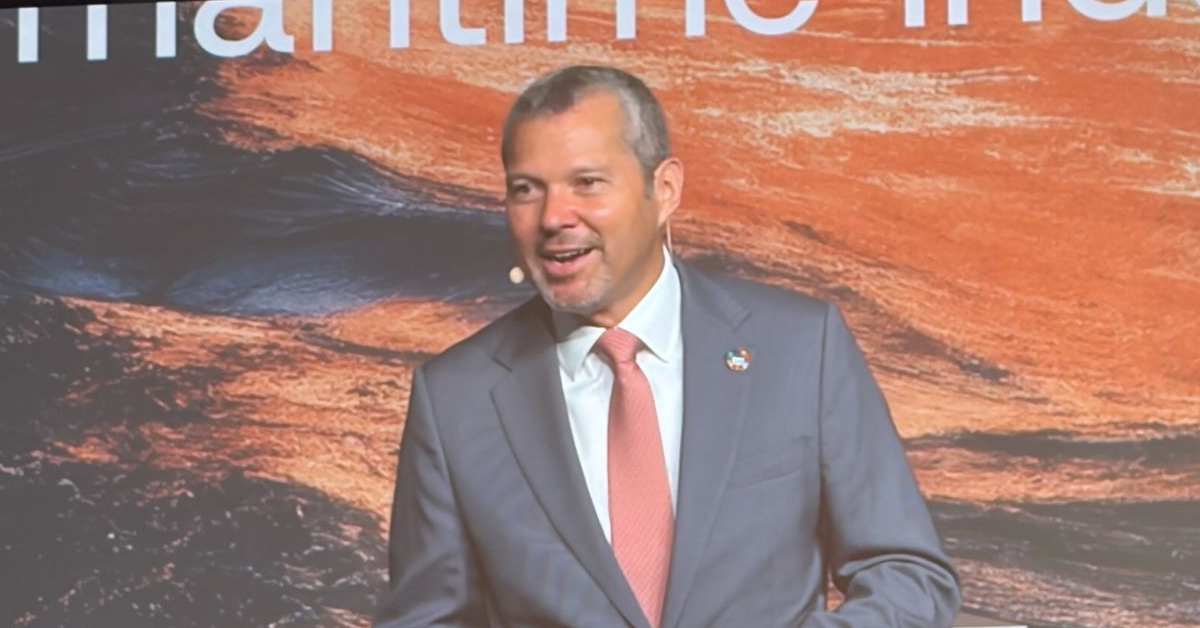

Opening one of shipping’s most closely watched global gatherings, the International Maritime Organization’s Secretary-General used the SMM stage to deliver a pointed message to the industry: don’t judge IMO’s priorities by what makes the news. In a wide-ranging address that touched on decarbonisation, alternative fuels, global regulation, and the need for broader industry engagement, the Secretary-General pushed back against the perception that decarbonisation has slipped down the agenda simply because it has faded from headlines.
Why doesn’t decarbonisation dominate headlines anymore?
The Secretary-General opened by directly addressing a narrative that has circulated in shipping circles this year, the idea that decarbonisation has cooled as a priority because it no longer commands the same media attention it once did. Drawing a parallel to safety, the address noted that IMO devotes enormous resources to safety and security work that rarely surfaces in headlines either, yet no one would argue safety has become less important as a result.
The point was framed as a broader caution against equating visibility with substance. Headlines, the Secretary-General said, function as an opening for the organisation to keep reinforcing why shipping matters globally, how deeply interconnected the sector is, and how it underpins the daily lives of people around the world. But headline volume was explicitly separated from the actual scale of work happening inside IMO across its many technical and policy tracks. The message to delegates was straightforward: the absence of a topic from the news cycle is not evidence of institutional neglect.
Where do global emissions regulations currently stand?
Turning to the regulatory track, the Secretary-General acknowledged that the pace of global rulemaking has drawn criticism, and reframed the delay as a natural consequence of how consequential the outcome is. The observation that “everyone wants a piece of it” was used to explain why reaching consensus among IMO’s member states takes time when the stakes, covering fuel standards, emissions pricing, and compliance mechanisms for a truly global fleet, are this high.
The Secretary-General also addressed the elephant in the room for many delegates: the European Union’s decision to move ahead with its own regional framework, including emissions trading obligations for shipping, ahead of a global IMO agreement. Rather than treating this as a setback, the address characterised it as one example among several, noting that the EU’s own path has not been without friction. The clear signal was that IMO does not view regional first-movers as undermining the case for a global framework, but as one data point in a broader process that continues to move forward regardless.
Concretely, the Secretary-General revealed that the next round of IMO negotiations on the topic had opened barely an hour before the SMM address, underscoring that the regulatory track remains actively in motion even when it is not generating headlines.
What role does early investment play in the fuel transition?
A significant portion of the address was devoted to a direct appeal to industry and government alike: invest now, ahead of returns, or risk being left behind when the transition accelerates. The Secretary-General cited India as an example worth following, pointing to capital already flowing into green technologies, alternative fuels, and shipbuilding capacity well ahead of any guaranteed payoff.
This was framed as the model IMO wants to see replicated more broadly. Alternative fuels, the address noted, are not a theoretical proposition. The underlying technologies and fuel types have already been developed. What has not yet happened is scale. Getting fuels like ammonia, methanol, and other alternatives from pilot projects to fleet-wide adoption requires the kind of early capital commitment that only pays off once volumes rise and costs fall, a dynamic familiar from other energy transitions.
On the safety side of that same transition, the Secretary-General pointed to concrete IMO deliverables already in place, including guidelines issued for the use of ammonia as a marine propulsion fuel, a necessary regulatory foundation given ammonia’s toxicity and handling risks compared to conventional bunker fuel. Work has also begun on nuclear propulsion, which the Secretary-General described as now high on the agenda for the sector, reflecting growing industry interest in next-generation power sources for large vessels as decarbonisation targets tighten.
Who else needs a seat at the table?
Perhaps the most striking part of the address was its emphasis on who shipping needs to be listening to, rather than what it needs to be building. The Secretary-General was explicit that IMO does not expect to solve the sector’s challenges from within its own membership alone. Solutions, the address argued, will require sustained engagement with the energy sector, organised labour, environmental groups, and technology developers, alongside the traditional shipowner and flag-state constituencies that have historically driven IMO’s agenda.
Two groups were singled out by name: the younger generation entering the industry, and seafarers themselves, who the Secretary-General said should have a greater voice in shaping the policies that will define their working lives at sea. This is a notable shift in framing for an organisation often associated with government delegations and shipowner associations, and it signals an intent to widen participation beyond the traditional IMO negotiating table.
Governments and ministries were also called on to engage more actively, not simply as regulators but as enablers, using incentive structures to support the sector’s transition rather than relying solely on mandates.
What’s the economic case for a secure, sustainable shipping sector?
Closing the address, the Secretary-General connected the decarbonisation and safety agendas back to a broader economic argument. Shipping, the address noted, is a major global employer, and demonstrating that the sector can be both secure and sustainable is itself a tool for supporting economies around the world. A shipping industry that manages the transition successfully protects the jobs and trade flows that countries depend on, making the case for investment as much an economic argument as an environmental one.
The Secretary-General ended on a note of shared responsibility rather than institutional ownership, making clear that IMO alone cannot deliver on the scale of change required. Running short on time, the address closed with a direct acknowledgment that the path ahead depends on collective action across the sector, not decisions made unilaterally by the organisation itself.
The takeaway for SMM delegates
The address set a clear tone for this year’s SMM: decarbonisation has not been deprioritised, it has simply moved from headline-grabbing announcements into the harder, slower work of negotiation, technical standard-setting, and investment mobilisation. For an industry gathered to take stock of where shipping stands on its energy transition, the Secretary-General’s message was as much a challenge as a reassurance, urging delegates to invest ahead of certainty and to widen the circle of voices shaping shipping’s next chapter.
 Join our WhatsApp channel for more updates:
 Subscribe to our YouTube channel for more updates: