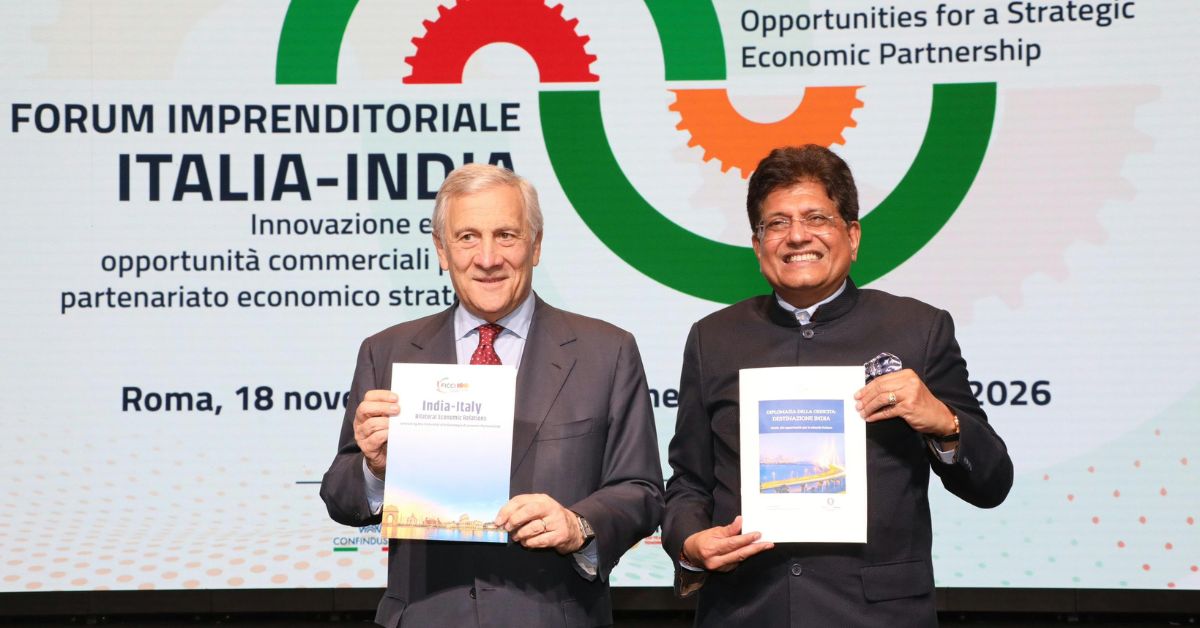

India and Italy have reaffirmed their target of increasing bilateral trade to €20 billion by 2029, with connectivity, manufacturing partnerships and investment facilitation central to discussions in Rome on 18 November 2026.
Commerce and Industry Minister Piyush Goyal co-chaired the 23rd India–Italy Joint Commission for Economic Cooperation (JCEC) with Antonio Tajani, Italy’s Deputy Prime Minister and Minister of Foreign Affairs and International Cooperation. The meeting reviewed measures to expand commercial ties under the countries’ Special Strategic Partnership.
Italy’s Foreign Ministry said bilateral trade stood at €14.2 billion in 2025. Italian exports to India increased by 5.5% during the first nine months of 2026, while Indian investment in Italy rose by 9% in 2025.
How will the countries address trade barriers?
The ministers agreed to establish task forces in their respective countries to help businesses navigate administrative procedures and remove obstacles to bilateral commerce.
Their discussions covered supply-chain resilience and diversification of trade routes, alongside advanced manufacturing, infrastructure and critical raw materials. Italy also highlighted work towards a possible innovation hub in India, modelled on its INNOVIT centre in San Francisco, to connect businesses, start-ups and researchers.
The accompanying business forum brought together more than 250 representatives from companies and start-ups across both countries, according to the Italian government.
What role will ports and transport connectivity play?
The India–Middle East–Europe Economic Corridor (IMEC) received particular attention during the talks. Italy identified the proposed corridor as an opportunity to improve Asia–Europe connectivity and strengthen the role of Italian and Mediterranean ports.
Maritime cooperation already forms part of the bilateral agenda. During Prime Minister Narendra Modi’s visit to Italy on 19–20 May 2026, the two governments welcomed a memorandum of understanding on maritime transport and ports. They directed their ministries and departments to establish a joint working group to implement it.
The May declaration also encouraged investment in ports, infrastructure, energy, steel and other industrial sectors. It supported closer partnerships between smaller enterprises to deepen supply-chain integration.
These commitments followed the Joint Strategic Action Plan 2025–2029, adopted in November 2024, which identified maritime and land infrastructure cooperation as a priority.
Which sectors attracted business interest?
Around 80 Indian business delegates, including 12 start-ups, participated in the Rome programme.
Three sectoral roundtables examined pharmaceuticals and chemicals, industrial machinery and agri-food, and automotive manufacturing. Discussions included active pharmaceutical ingredients, biotechnology, automation, food-processing machinery, cold-chain infrastructure, packaging and electric mobility.
Goyal also met senior executives from Walter Tosto, Nordimpianti System, Atitech, Magaldi Group and Bracco Group on 17 November to discuss manufacturing, investment and technology partnerships in India.
Participants identified joint ventures and technology-sharing arrangements as potential ways to advance commercial cooperation.
What is the status of the India–EU trade agreement?
The ministers welcomed the conclusion of negotiations on the India–European Union (EU) Free Trade Agreement and discussed its potential to expand market access. Italy emphasised the importance of signing the agreement promptly.
Negotiations concluded in January 2026, and the European Commission submitted proposals for signature and conclusion to the Council of the EU in September.
The Commission’s published procedure requires Council approval, signature, European Parliament consent and a Council decision concluding the agreement. India must also ratify it before it can enter into force.
The distinction matters for exporters: completion of negotiations does not itself activate preferential tariffs. The Rome discussions therefore combined immediate business-facilitation measures with preparation for the opportunities expected from the future trade agreement.
 Join our WhatsApp channel for more updates:
 Subscribe to our YouTube channel for more updates: