




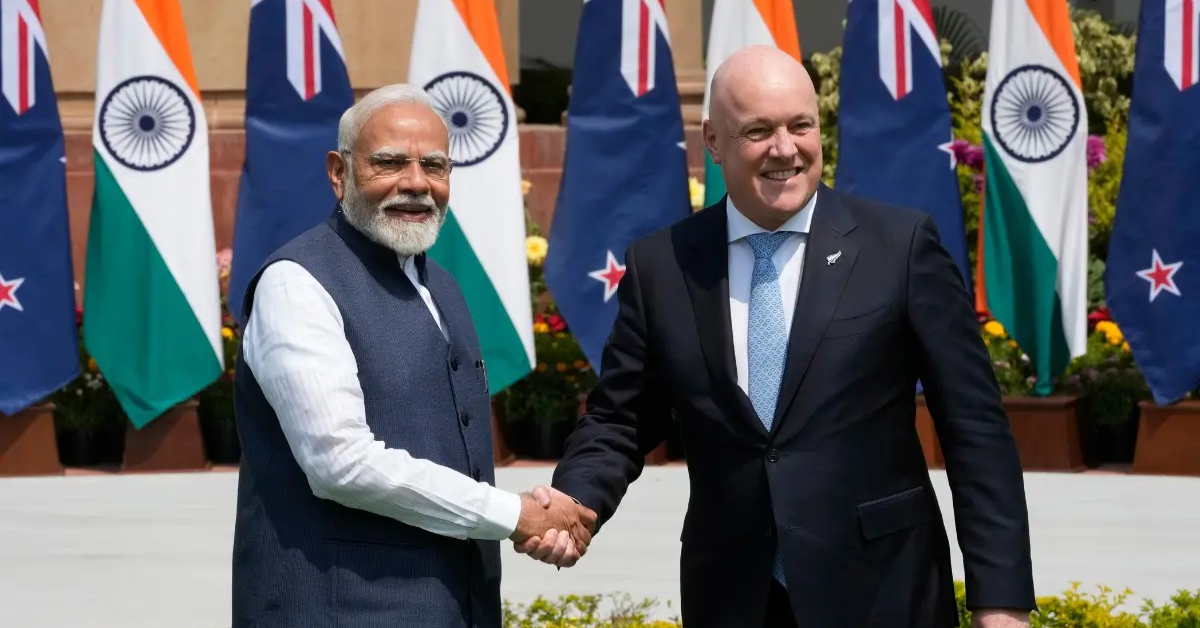

India and New Zealand are set to sign a Free Trade Agreement on Monday — adding a new bilateral trade deal to a week that has already seen the India-UK FTA implementation date confirmed for May and the India-Korea Digital Bridge formalised with the HD Hyundai shipyard MoU. The India-New Zealand FTA covers agriculture, dairy, pharmaceuticals, textiles, engineering goods, and services, and is described by officials from both countries as a balanced framework that addresses sensitivities — particularly in dairy, where New Zealand’s globally competitive industry has historically been a politically difficult negotiating point for India — while opening meaningful new opportunities for Indian exporters.
For India, the FTA’s most commercially significant elements are the improved market access for pharmaceuticals, engineering goods, IT services, and textiles in New Zealand’s market — segments where Indian exporters are competitive globally but have faced tariff and non-tariff barriers that reduced their market penetration in the Antipodean market. The services chapter, which includes professional services mobility provisions, is expected to create new pathways for Indian IT professionals and skilled workers to access New Zealand’s labour market more easily — an outcome that the Indian services sector, which contributed USD 418.31 billion to total exports in FY26, has sought through multiple bilateral FTA negotiations.
New Zealand’s Dairy Interests and India’s Food Security
The dairy chapter has been the most politically sensitive element of the negotiations. New Zealand is the world’s largest dairy exporter and has long sought greater access to India’s massive dairy market. Indian officials have been careful to protect the domestic dairy sector — which supports the livelihoods of approximately 150 million rural dairy farmers — while providing enough market opening to satisfy New Zealand’s core commercial interests. The agreed framework is expected to include tariff reduction on specific dairy product categories over phased timelines, rather than immediate full liberalisation, balancing New Zealand’s export ambitions against India’s rural economy protection imperatives.
The India-New Zealand FTA is also significant in the context of India’s broader Indo-Pacific trade architecture. New Zealand is a member of CPTPP — the Comprehensive and Progressive Agreement for Trans-Pacific Partnership — and the bilateral FTA creates a framework that could eventually serve as a bridge toward deeper India-CPTPP engagement. For New Zealand’s exporters, improved access to one of the world’s fastest-growing consumer markets of 1.4 billion people — particularly in premium food products, tourism services, and education — represents a significant commercial opportunity that the FTA framework will unlock progressively as tariff reductions take effect.
 Join our WhatsApp channel for more updates:
 Subscribe to our YouTube channel for more updates: