
Summary
Commerce and Industry Minister Piyush Goyal met German leaders and businesses in Berlin on 22 October to advance industrial cooperation and investment. The engagements focused on translating the India–EU trade agreement into commercial opportunities, strengthening supply chains and expanding business relationships across manufacturing, technology and healthcare.
Berlin engagements connect policy with business
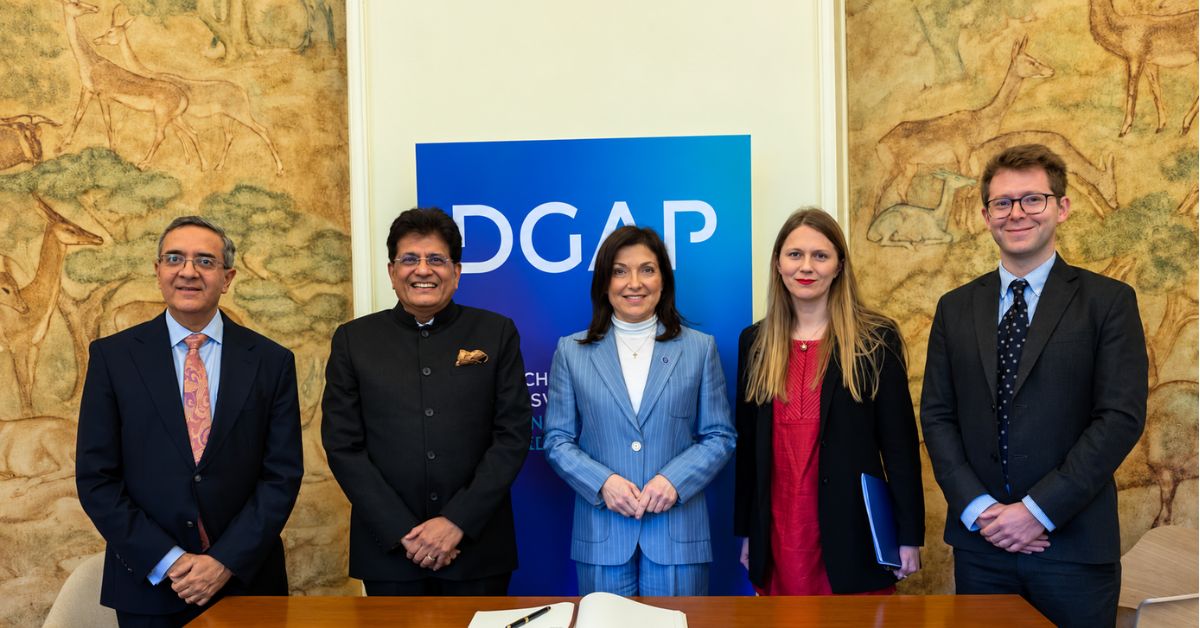
India–Germany trade and investment cooperation were central to Piyush Goyal’s Berlin programme, which included talks with German Federal Minister for Economic Affairs and Energy Katherina Reiche and an interaction with business leaders.
The ministers discussed industrial collaboration and the opportunities associated with the India–EU Free Trade Agreement. They also jointly inaugurated an India Centre at the German Council on Foreign Relations, known as DGAP, to support policy research and bilateral dialogue.
A business roundtable organised with DGAP and the Asia-Pacific Committee of German Business examined how companies could develop concrete trade and investment opportunities. Goyal’s wider visit to Germany and the Netherlands includes a delegation of around 100 Indian businesses and start-ups.
Corporate meetings explore investment opportunities
Goyal separately met senior representatives of Bayer, Knauf Group and Fresenius to explore business cooperation.
At the Berlin Global Dialogue, he emphasised trust, complementary economic strengths and resilient supply chains as foundations for international partnerships.
The programme combined ministerial discussions with direct corporate engagement, providing businesses with opportunities to raise investment interests alongside the wider policy agenda.
Trade agreement moves towards implementation
The Berlin discussions follow an important earlier development: India and the European Union concluded FTA negotiations on 27 January 2026.
On 11 September, the European Commission presented proposals to the Council seeking authorisation for the agreement’s signature and conclusion. These are separate steps from completing negotiations, and the Berlin engagements do not themselves establish that preferential trading arrangements have entered into force.
The agreement sits within a substantial commercial relationship. EU–India goods trade reached €118 billion in 2025, while services trade amounted to €67 billion in 2024.
Machinery, chemicals, transport equipment, textiles and metals feature prominently in bilateral merchandise flows. This gives industrial cooperation a direct connection to manufacturers, suppliers and businesses managing international cargo movements.
Earlier agreements provide an industrial framework
The latest meetings build on German Chancellor Friedrich Merz’s visit to India in January 2026.
During that visit, the two governments highlighted opportunities in automotive manufacturing, shipbuilding, industrial equipment, pharmaceuticals, chemicals, biotechnology, smart infrastructure and energy.
They also welcomed a declaration intended to strengthen economic cooperation through the German–Indian CEO Forum. The mechanism provides a continuing platform for industry engagement beyond individual ministerial visits.
The January joint statement recorded that bilateral goods and services trade had exceeded US$50 billion in 2024. It also identified two-way investment as a contributor to diversifying global supply chains.
Technology cooperation extends to semiconductors, critical minerals, digitalisation and advanced manufacturing. These earlier commitments provide the background against which businesses are now examining specific partnerships and investment proposals.
Longstanding partnership supports commercial engagement
Germany and India marked 75 years of diplomatic relations in March 2026. Their strategic partnership dates to 2000, while intergovernmental consultations have brought together their cabinets every two years since 2011.
Germany’s “Focus on India” strategy, adopted in 2024, set out an agenda for expanding cooperation. Germany remains India’s leading trading partner within the EU.
The relationship also includes vocational training, research, start-up support and the energy transition. These areas matter to industrial investment because companies require skills, technology and supporting institutions alongside market access.
The breadth of that cooperation gives the current business discussions an established institutional foundation.
Commercial outcomes will depend on follow-through
For manufacturers and logistics providers, the significance of the Berlin programme lies in the prospect of stronger production and sourcing relationships between the two markets.
If corporate discussions lead to investment and supply contracts, they could create additional requirements for transporting machinery, components and finished products. The scale and timing would depend on individual commercial decisions.
Companies considering opportunities under the FTA will also need to distinguish anticipated benefits from provisions that have become operational.
The immediate outcome is a broader channel for government and business engagement. Turning that access into sustained trade will require investment decisions, practical partnerships and implementation of the agreed trade framework.
FAQs
When did the Berlin engagements take place?
Piyush Goyal’s meetings took place on 22 October 2026.
Who was his German ministerial counterpart?
Katherina Reiche, Federal Minister for Economic Affairs and Energy.
What was the main commercial focus?
Industrial cooperation, investment, supply-chain resilience and opportunities associated with the India–EU FTA.
Did the meetings bring the FTA into force?
No. Completing negotiations, signing an agreement and bringing it into force are distinct stages.
Which industries feature in the wider partnership?
They include automotive manufacturing, shipbuilding, industrial equipment, pharmaceuticals, chemicals, technology and energy.
 Join our WhatsApp channel for more updates:
 Subscribe to our YouTube channel for more updates: