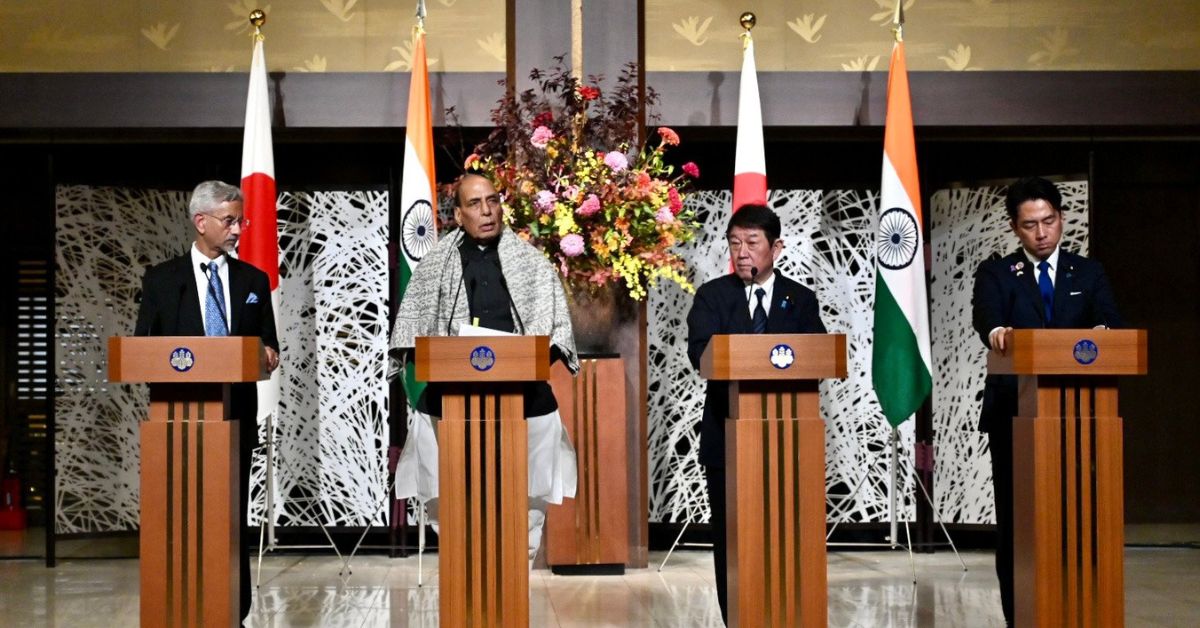

India and Japan have agreed to accelerate cooperation in maritime security, naval technology and defence manufacturing following their fourth Foreign and Defence Ministerial Dialogue in Tokyo on 19 November 2026. Priorities include progressing the Unified Complex Radio Antenna (UNICORN) naval mast programme, strengthening operational coordination and pursuing reciprocal access to ship-repair facilities.
Defence Minister Rajnath Singh and External Affairs Minister S. Jaishankar met Japanese Foreign Minister Toshimitsu Motegi and Defence Minister Shinjiro Koizumi under the bilateral “2+2” format. The discussions focused on strengthening the countries’ Special Strategic and Global Partnership amid growing regional security and supply-chain concerns.
What will maritime security cooperation cover?
The ministers agreed to translate a recently signed Memorandum of Arrangement on Maritime Security Cooperation into practical cooperation between the Indian Navy and the Japan Maritime Self-Defense Force.
The proposed activities cover maritime and air domain awareness, search and rescue, information sharing, humanitarian assistance and disaster relief. Both sides also committed to strengthening mine countermeasure capabilities and exploring joint development in naval shipbuilding and design.
The joint statement welcomed expanding coast guard cooperation, extending the partnership beyond naval operations to maritime law enforcement and related exchanges. These initiatives build on the Joint Declaration on Security Cooperation adopted in August 2025.
How will the UNICORN naval mast programme progress?
During separate bilateral talks on 19 November, Singh and Koizumi expressed their expectation that UNICORN-related arrangements would be concluded early and that India would grant Acceptance of Necessity by February 2027.
The announcement sets a prospective approval milestone. It does not establish a production or delivery schedule for the equipment.
The ministers also agreed to advance research and development cooperation between India’s Defence Research and Development Organisation and Japan’s Acquisition, Technology and Logistics Agency in advanced missile and defence technologies. The bilateral meeting was their third interaction this year, following discussions in August and October.
UNICORN is an integrated communications mast designed to improve the stealth characteristics of naval vessels. India and Japan signed a Memorandum of Implementation for its co-development in Tokyo on 15 November 2024.
That agreement envisaged Bharat Electronics Limited developing the systems in India with Japanese collaboration for installation aboard Indian Navy ships. At the time, the Indian government described the programme, once implemented, as the first instance of defence equipment co-development or co-production between the two countries.
What is planned for ship repair and industrial collaboration?
Singh called for an early agreement on reciprocal access to ship-repair facilities. The proposal remains under negotiation, with the announcement indicating that an agreement has yet to be concluded.
The talks also addressed wider industrial cooperation under the “Design with Japan, Make in India” framework, including underwater, missile and other specialised technologies.
The third India-Japan Defence Industry Forum, held in Tokyo on 13 October, formed part of the recent engagement reviewed by the ministers.
Why are sea-lane security and regional coordination priorities?
Japan’s Foreign Ministry said the ministers agreed to deepen cooperation to maintain maritime order, including the stability of sea lanes of communication. They also emphasised cooperation between maritime law enforcement agencies and support for strengthening coastal states’ maritime security capabilities.
The discussions linked these efforts with wider cooperation through the Quad and the shared objective of a free and open Indo-Pacific.
Both countries also reviewed cooperation since the revised security declaration of August 2025 and agreed to maintain close communication on defence policies. Alongside equipment collaboration, the agenda covered joint exercises and arrangements for Japan’s Self-Defense Forces to use firing ranges in India, reflecting a broader effort to develop practical operational ties.
 Join our WhatsApp channel for more updates:
 Subscribe to our YouTube channel for more updates: