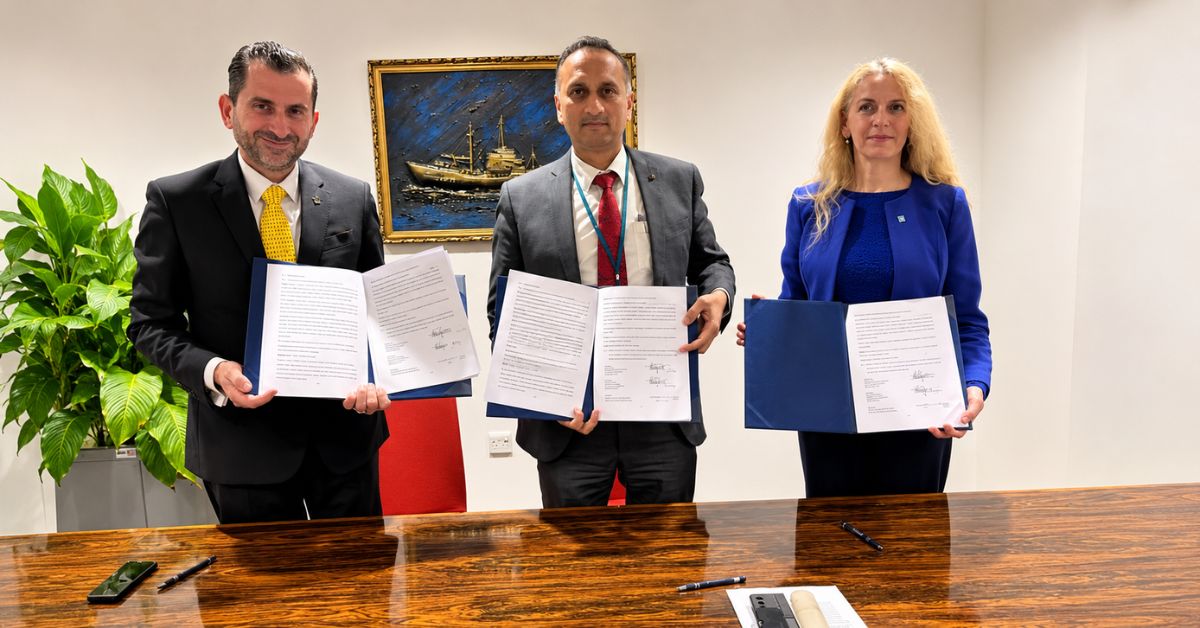

India’s Directorate General of Maritime Administration (DGMA) has joined ISF Verify through an agreement with the International Chamber of Shipping (ICS) and Lloyd’s Register OneOcean to explore connecting Indian seafarer certificates to an international verification platform.
Announced in London on 4 November 2026, the memorandum of understanding provides for a pilot linking India’s existing certification system with ISF Verify. The agreement was marked during the International Maritime Organization (IMO) Council meeting at its London headquarters.
What does India’s participation mean?
India supplies approximately 312,000 seafarers, making it the world’s second-largest source country, according to the 2026 seafarer workforce figures cited by ICS.
Together, India and the Philippines represent around 30% of the estimated global workforce of 2.57 million seafarers. Their participation gives the initiative a substantial potential reach, although the figure represents the workforce of participating countries, rather than seafarers already using the platform.
The Indian pilot will examine integration through an application programming interface (API). The partners will undertake technical discovery, establish requirements and agree a development roadmap. The announcement does not specify a nationwide launch date.
How does ISF Verify work?
Developed by ICS and Lloyd’s Register OneOcean, ISF Verify is intended to connect seafarers, maritime administrations, shipping companies and port state control authorities. It addresses difficulties arising from paper documentation and national digital systems that operate separately.
Privacy and cybersecurity are central to the platform’s design. Its purpose is to make certificate verification accessible to the different organisations involved in employing seafarers, endorsing their qualifications and checking documentation during inspections.
Under the model described for India, seafarers control access to their information, while original certificates remain under the issuing administration’s jurisdiction.
What problems is digital verification intended to address?
Seafarer certificates require periodic renewal, while countries apply different administrative processes. In announcing the original Philippine pilot in February 2025, the partners identified paper-based verification and endorsement as sources of delay, error and administrative work.
The project was designed to test secure access to certificate information for flag administrations, inspectors, employers and seafarers. Its technical and regulatory assessment also examined how national systems could connect to a shared verification service.
For shipping and ship management companies, the practical objective is to simplify checking credentials across jurisdictions. For seafarers, it is to make documentation easier to access and share when employment or regulatory processes require it. These are the programme’s intended benefits, rather than quantified results from the Indian pilot.
How far has the Philippine project progressed?
The Philippines’ Maritime Industry Authority, known as MARINA, signed its agreement with ICS and Lloyd’s Register OneOcean on 12 February 2025. The initial work explored connecting MARINA’s Integrated Seafarers Management Online System to the pilot platform.
ICS now reports that a proof of concept connecting to MARINA’s system has been completed. Filipino seafarers have also tested the mobile application. The wider pilot is focused on involving additional administrations, port state control authorities and shipping companies.
How does this fit international certification rules?
The regulatory foundation for electronic certification predates the initiative. In 2023, the IMO adopted amendments to the International Convention on Standards of Training, Certification and Watchkeeping for Seafarers (STCW) and its associated code concerning electronic certificates.
Those changes recognise electronic certificates alongside physical documents. Norway, for example, permitted international service using its electronic certificates from January 2025 and moved to issuing seafarer certificates exclusively electronically from 20 March 2025. India’s proposed integration forms part of this broader transition towards digital maritime credentials.
 Join our WhatsApp channel for more updates:
 Subscribe to our YouTube channel for more updates: