



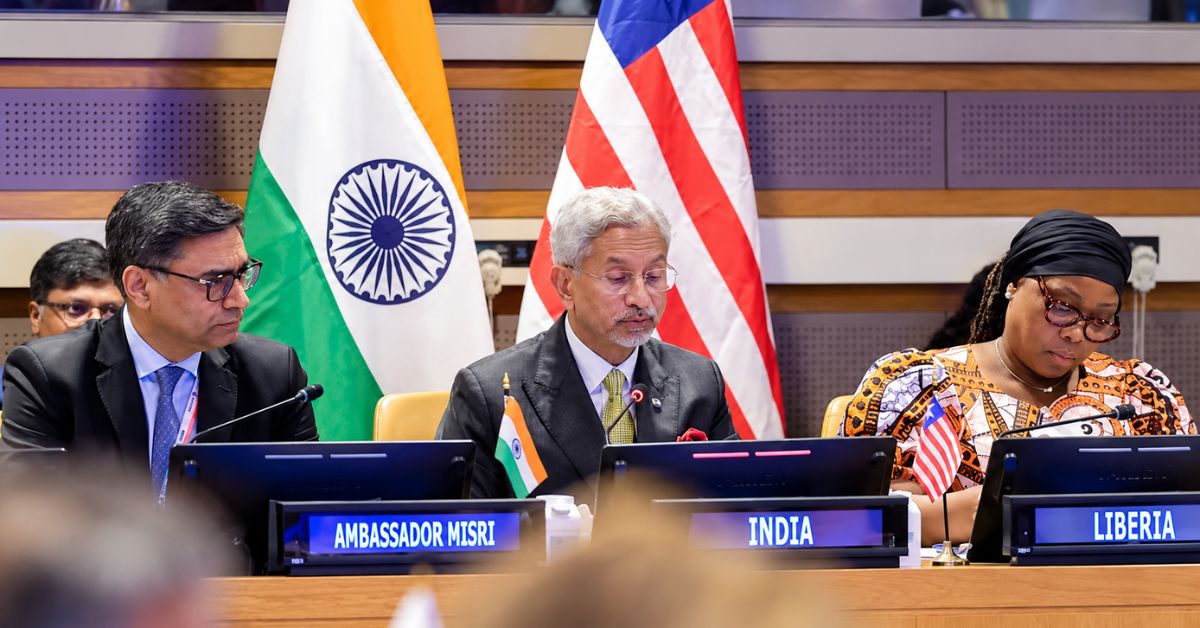

External Affairs Minister S Jaishankar, along with Liberia’s Minister for Foreign Affairs Sara Beysolow Nyanti, launched the “Group of Friends on Safety & Security of Shipping & Seafarers” on the margins of the high-level UN General Assembly session in New York.
India and Liberia will serve as co-chairs of the Group of Friends, which will focus on various aspects of maritime trade, safety and security. As an inclusive platform, Jaishankar said the endeavour has been to bring all relevant stakeholders together, with the group consisting of major ship-owning member states, countries with the largest number of ship registries, and those that provide the maximum numbers of seafaring personnel. Twenty-five countries participated in the meeting of the Friends Group.
Addressing the inaugural meeting, Jaishankar called attacks on commercial shipping and merchant marines “legally and morally indefensible,” saying they must stop. He listed a series of recent attacks against maritime vessels and seafarers, including the deaths of Indian shipping personnel and damage to containers. He cited an attack two days earlier on the Antigua and Barbuda-flagged bulk carrier MV Cape Dove in the Gulf of Oman, which killed an Indian sailor, and, ten days before that, the Panama-flagged oil tanker El Gaya being struck in the Strait of Hormuz, leaving an Indian crew member missing. “These, regrettably, are no longer exceptional occurrences,” he said.
Jaishankar also referenced two separate attacks in the Black Sea: the chief officer of the MV Omorfi, an Indian national, was killed when the vessel was hit within Russian territorial waters on July 18, and the following day, four Indian seafarers lost their lives after the MV Golden Leo was struck upon departing from Odessa. He noted that casualties extended beyond Indian nationals, with sailors from various other countries affected by attacks throughout the year.
“In recent months, commercial shipping and marinas have been subjected to repeated attacks in the Gulf, the Red Sea, and its vicinity. Such unacceptable actions are also occurring in the Black Sea,” Jaishankar said, adding that recent global developments underline the threats posed to the safety and security of seafarers, including prolonged confinement on board, delayed crew changes and repatriation, separation from families, psychological distress and lethal attacks. “Despite the existence of international and regional frameworks for protecting the rights of seafarers, there is a need for stronger and closer international cooperation on this matter,” he said.
Jaishankar said maritime shipping accounts for four-fifths of global trade, valued at $35 trillion last year, with around two million people working in the maritime sector. He said attacks on shipping are threatening the basic needs of the international community, including food, fuel, fertiliser and financial services, describing them as the “four Fs,” and said the initiative is meant to add stability and confidence in what is otherwise an uncertain and perilous world.
Nyanti said the group has three “non-negotiable goals”: demanding uncompromising technical standards, stringent vessel compliance and coordinated environmental stewardship; defending commercial sea lanes against piracy, armed attacks, regional instability and asymmetric threats; and centring the human beings who keep the world running. “Seafarers must never be treated as expendable cargo that can just be dumped over the dock over the sea and thrown into forgetfulness,” she said.
Jaishankar said India was taking the initiative in partnership with Liberia because India is a major source country for seafarers, while Liberia has the world’s largest shipping registry by tonnage. The two countries brought together other states and major ship owners for the group’s first meeting in New York, with the coalition set to work within the frameworks of the IMO and ILO to shape maritime policy and safeguard seafarers going forward.
 Join our WhatsApp channel for more updates:
 Subscribe to our YouTube channel for more updates: