
Summary
Union Minister Sarbananda Sonowal has invited Polish companies to expand manufacturing, investment and technology partnerships in India. Addressing the India–Poland Business Forum on 22 October, he proposed new innovation initiatives and highlighted opportunities in clean energy, engineering and digital technologies as both countries seek stronger commercial ties.
Sonowal seeks deeper industrial partnerships
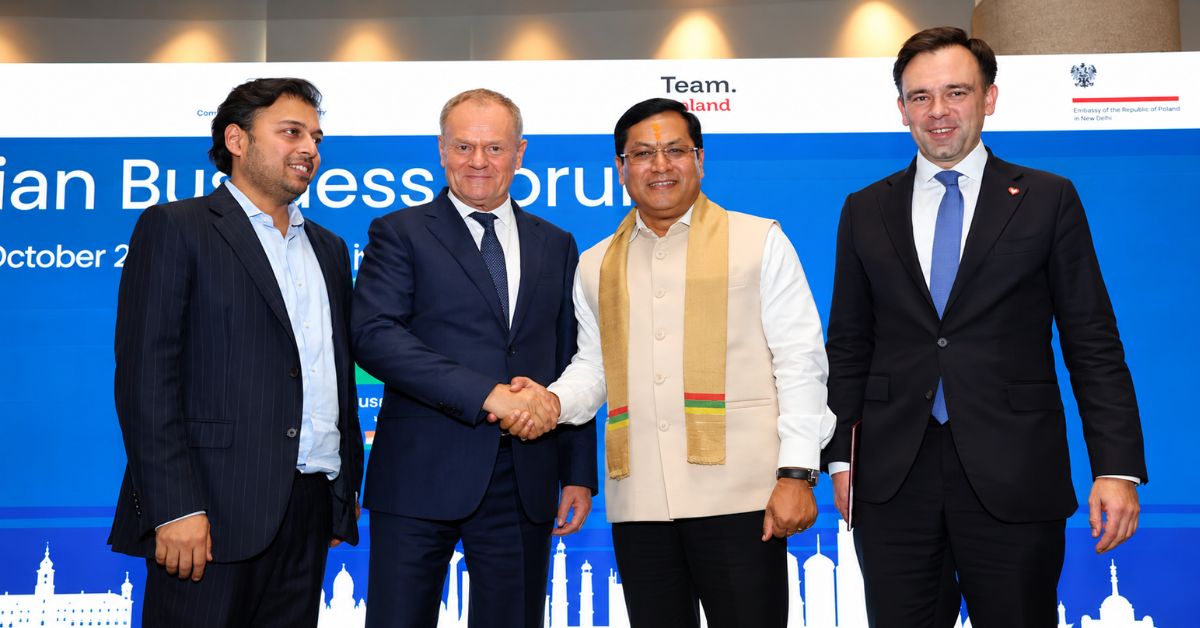
The India–Poland investment agenda gained fresh momentum as Union Minister for Ports, Shipping and Waterways Sarbananda Sonowal encouraged Polish businesses to establish production, develop solutions and form partnerships in India.
Speaking at the India–Poland Business Forum, attended by Polish Prime Minister Donald Tusk, Sonowal highlighted the potential to combine Poland’s industrial capabilities with India’s market, workforce and manufacturing base.
He identified engineering, machinery, mining technology, transport, environmental solutions and advanced manufacturing as areas suited to closer cooperation.
Sonowal also proposed a Startup Bridge, an Innovation Corridor and an AI and Quantum Dialogue to connect companies, researchers and entrepreneurs. These were presented as proposals for strengthening collaboration; the address did not establish their implementation schedules or funding arrangements.
Clean energy offers equipment and technology opportunities
Energy transition featured prominently in the minister’s investment pitch. Sonowal pointed to India’s target of reaching 500 GW of non-fossil electricity capacity by 2030.
He identified opportunities across equipment manufacturing, energy storage, electricity networks, green hydrogen, recycling and environmental technologies. Poland’s experience in mining and industrial engineering was presented as complementary to these requirements.
The technology agenda extended beyond existing information-technology services to artificial intelligence, quantum computing, 5G applications, digital infrastructure, smart manufacturing and space.
For businesses, the proposed direction would broaden cooperation from supplying finished products towards developing technologies and building industrial capabilities together.
Trade growth provides a commercial foundation
The outreach comes against an expanding economic relationship. Bilateral trade reached US$6.36 billion in 2025, compared with US$1.95 billion in 2013, according to India’s embassy in Warsaw.
Poland remains India’s largest trading and investment partner in Central and Eastern Europe. The seventh session of the bilateral Joint Commission for Economic Cooperation took place in New Delhi on 14 July 2026.
These existing commercial and institutional connections provide a foundation for the latest investment proposals. They also offer channels through which companies can identify partners and governments can address obstacles affecting trade and investment.
The embassy’s bilateral overview records continuing cooperation in digital payments, cybersecurity, artificial intelligence and other technology fields, alongside the broader strategic relationship.
Ports and shipping feature in wider bilateral talks
Separately, Prime Minister Narendra Modi and Prime Minister Tusk agreed during their 22 October meeting to pursue a doubling of bilateral trade by 2030.
Their discussions included opportunities in shipping and maritime security, giving the wider economic engagement a direct connection to the ports and logistics sector.
The leaders highlighted cooperation between ports as a way to strengthen transport networks, diversify supply chains and protect critical infrastructure against geopolitical disruption.
They also underlined the importance of improved connectivity, including through the India–Middle East–Europe Economic Corridor initiative.
For logistics businesses, these priorities indicate potential areas for future cooperation. However, the discussions did not themselves announce a new shipping service, a port concession or a committed cargo corridor between the two countries.
Earlier action plan sets the framework
The current engagement builds on the strategic partnership established during Modi’s visit to Poland in August 2024.
The accompanying Action Plan for 2024–2028 identified trade, investment, infrastructure, energy, mining and technology among its priorities. It also committed the countries to strengthening supply-chain resilience and reducing risks associated with trade dependencies.
Transport cooperation was included explicitly, with both sides agreeing to explore infrastructure partnerships and expand flight connections.
On environmental technologies, the plan envisaged cooperation in circular-economy solutions and wastewater management. It also identified advanced mining systems, machinery and safety practices as areas for industrial collaboration.
These earlier commitments help explain the continuity behind Sonowal’s latest proposals. Manufacturing, clean energy and digital cooperation already sit within an agreed bilateral framework, while the business forum seeks to encourage companies to translate that framework into commercial activity.
The practical next step will be identifying partners, defining viable projects and establishing investment commitments. For manufacturers, technology suppliers and logistics providers, the opportunity lies in connecting industrial cooperation with the transport and supply-chain capacity needed to support growing trade.
FAQs
What did Sarbananda Sonowal propose?
He proposed a Startup Bridge, an Innovation Corridor and an AI and Quantum Dialogue.
Which sectors were highlighted?
Engineering, manufacturing, mining technology, transport, clean energy, environmental solutions and digital technologies.
How much was bilateral trade in 2025?
Trade between India and Poland reached US$6.36 billion.
What is the bilateral trade target?
The prime ministers agreed to pursue a doubling of trade by 2030.
When was the strategic partnership established?
India and Poland elevated their relationship to a strategic partnership in August 2024, supported by an Action Plan for 2024–2028.
 Join our WhatsApp channel for more updates:
 Subscribe to our YouTube channel for more updates: