
Summary
India is discussing cargo digitalization with the Port of Rotterdam to accelerate clearance and reduce vessel turnaround times, Commerce and Industry Minister Piyush Goyal said during his Netherlands visit. The engagement comes as India prepares for wider European trade opportunities and seeks to improve port efficiency alongside physical capacity expansion.
Customs cooperation targets faster cargo movement.
India–Rotterdam cargo digitalization discussions are focusing on modernizing Indian cargo processes, with customs authorities and Dutch port officials examining ways to improve the speed and efficiency of maritime logistics.
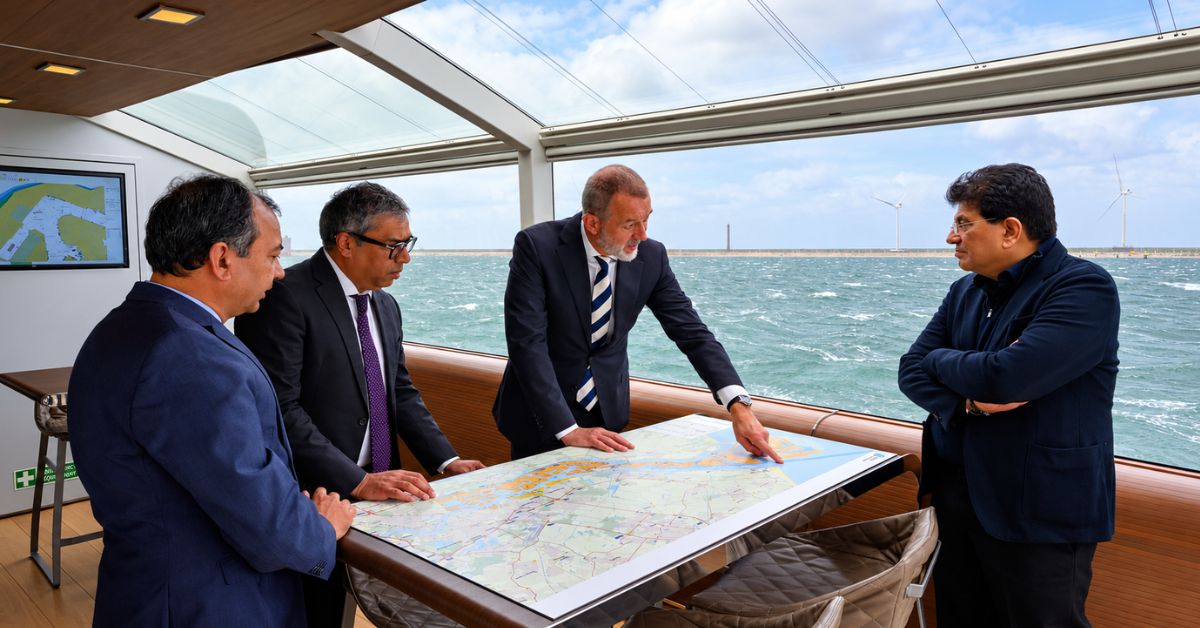
Goyal outlined the engagement after visiting Rotterdam on 25 October and meeting Port of Rotterdam Authority chief executive Boudewijn Siemons. He identified faster cargo evacuation and shorter ship turnaround times as priorities, linking operational improvements with India’s expanding infrastructure requirements.
The discussions have not yet been accompanied by a disclosed implementation schedule, list of participating Indian ports, or technology procurement program. The development therefore represents cooperation on potential improvements, with the detailed scope and delivery arrangements still to be established.
Goyal said India had doubled its port capacity over the past decade and expected capacity to double twice more by 2047. His remarks placed digital reform alongside infrastructure investment as India prepares to accommodate growing economic activity and international commerce.
Rotterdam’s European gateway role
The port visit formed part of Goyal’s wider trade and investment program in the Netherlands. Maritime and logistics engagements were among the opening activities of the visit, which also sought to strengthen commercial ties between the two countries.
Rotterdam, Europe’s largest port, occupies an important position in those discussions because of its role as an entry point for Indian goods into European markets. Its transport connections and logistics infrastructure make the Netherlands a significant partner in efforts to strengthen India–Europe supply chains.
For exporters, the commercial opportunity extends beyond access to a European destination port. Predictable cargo processing at both ends of a shipping route can help businesses plan dispatches, coordinate inland transport and meet customer delivery schedules.
Those potential benefits will depend on the processes ultimately adopted and the extent to which customs, terminals, shipping lines and inland logistics providers can exchange information effectively.
The trade agreement provides the wider context.
The engagement comes against the backdrop of the India–European Union free trade agreement, negotiations for which concluded in January 2026. The European Commission subsequently submitted proposals for the agreement’s signature and conclusion in September.
The agreement remains subject to the necessary approval procedures before entering into force. These include steps involving the Council of the EU, signature, European Parliament consent and Indian ratification. Its prospective trade benefits should therefore be distinguished from concessions already available to businesses.
Alongside tariff reductions, the agreement envisages simpler customs procedures and lower administrative barriers. That makes cargo processing a relevant part of preparations: improved market access delivers greater practical value when shipments can move reliably through border and transport systems.
India already has a digital foundation
The Rotterdam discussions build on earlier Indian initiatives to digitise maritime logistics.
In March 2023, India launched Sagar Setu, the mobile application of the National Logistics Portal Marine. Its announced functions included shipment tracking, access to vessel and gate information, approvals and digital transactions connected with import and export clearance.
The application was designed to give importers, exporters, customs brokers and service providers better visibility across logistics activities. Payment functions covered charges associated with container freight stations, shipping lines and transportation.
This existing framework provides relevant background to the latest engagement. Any future cooperation would need to address how additional capabilities fit into India’s established systems and the working practices of participating agencies.
The Dutch experience offers practical lessons.
Rotterdam’s digital operations include Portbase’s Port Community System, which supports information exchange between shipping agents, freight forwarders, carriers, terminals and public authorities.
Its services cover import and export documentation, vessel notifications and container transport coordination. Participating container terminals also use electronic pre-notification, while additional authorisation controls support secure container release and collection.
These arrangements illustrate the operational experience available through the Dutch engagement. However, no announcement has established that India will adopt Portbase or reproduce Rotterdam’s systems.
For Indian port users, the next developments to watch are the selection of specific processes, participating agencies and measurable delivery targets. These details will determine how the discussions translate into changes in everyday cargo movement.
FAQs
What are India and Rotterdam discussing?
Indian customs authorities and Rotterdam officials are examining digital processes to accelerate cargo movement and reduce vessel turnaround times.
Has a rollout date been announced?
No implementation timetable or list of participating Indian ports has been disclosed.
Will India adopt Rotterdam’s Portbase system?
No such decision has been announced. Portbase provides relevant background on Rotterdam’s digital capabilities.
Is the India–EU trade agreement operational?
Negotiations concluded in January 2026, but the agreement must complete the required approval and ratification procedures before entering into force.
What is Sagar Setu?
It is the mobile application of India’s National Logistics Portal Marine, launched in March 2023 to support tracking, approvals, information access and logistics payments.
 Join our WhatsApp channel for more updates:
 Subscribe to our YouTube channel for more updates: