



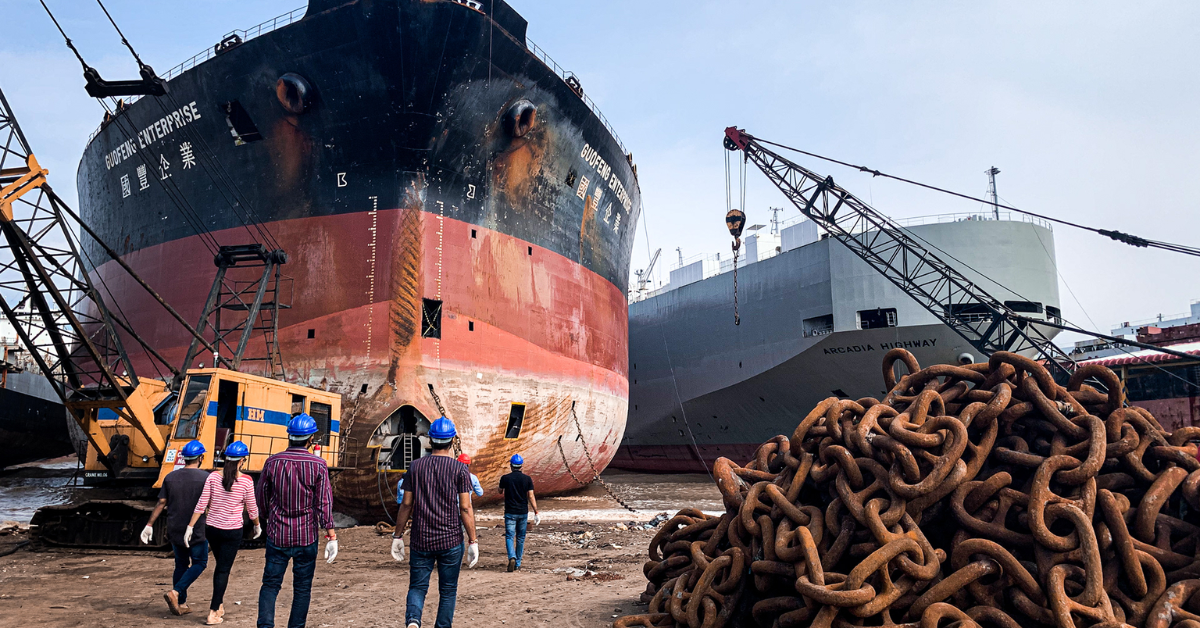

India is moving to transform Gujarat’s Alang ship recycling cluster into a globally competitive, green ship recycling hub, with plans to invest about ₹20,000-25,000 crore over the next decade to sharply expand capacity and raise its share of the global ship recycling market from roughly 35% to nearly 50%. The push aligns with tightening global sustainability norms and growing preference among shipowners, especially in Europe, for environmentally compliant recycling facilities when deciding where to dismantle ageing vessels.
The planned investment is expected to almost double Alang’s recycling capacity from the current 4-4.5 million light displacement tonnes (LDT) to around 9 million LDT through yard expansion and infrastructure upgrades. The Gujarat government is likely to put in more than ₹1,000 crore, while the remaining capital will come from the Centre and private recyclers over the coming years. The Centre has already earmarked around $8 billion to support India’s shipbuilding and ship recycling ecosystem, with over one‑fourth of this expected to be channelled into upgrading recycling infrastructure at Alang.
Projects at Alang will also be eligible for financing from the ₹25,000‑crore Maritime Development Fund, which combines a ₹20,000‑crore investment fund with a ₹5,000‑crore interest subvention window announced earlier. The broader revamp is being driven by the implementation of the Hong Kong International Convention for the Safe and Environmentally Sound Recycling of Ships (HKC), which came into force globally this year and is reshaping compliance benchmarks for yards worldwide.
To support compliance, the Centre has released ₹53.5 crore from the Ferrous Scrap Development Fund to help Alang plots upgrade infrastructure and meet international environmental standards. A large majority of plots at the cluster are now HKC compliant, covering 115 out of 128 plots, reflecting rapid adoption of global norms. However, some industry participants have cautioned that capacity expansion alone may not be sufficient, noting that Alang’s capacity utilisation has been under pressure due to weaker competitiveness against yards in Bangladesh and Pakistan.
Stakeholders point to subdued demand for value‑added re‑rolled steel plates following the 2014 BIS Quality Control Order as a key structural headwind, arguing that stimulating demand for processed steel output from recycled ships should go hand‑in‑hand with any expansion in recycling capacity. Alongside HKC compliance, the next strategic milestone for Alang is certification under the European Union Ship Recycling Regulation (EU‑SRR), which is mandatory for dismantling many Europe‑owned vessels.
Several yards at Alang have initiated the EU‑SRR process, with 34 facilities having applied for certification and inspections already completed at three yards, enabling them to seek inclusion in the EU’s approved ship recycling list. India and the European Union recently reaffirmed their intention to deepen cooperation on sustainable ship recycling, including facilitating the inclusion of Indian facilities under the EU‑SRR, during a meeting between the minister for ports, shipping and waterways and the European Commissioner for Environment, Water Resilience and a Competitive Circular Economy.
The planned expansion is expected to raise India’s annual ship recycling throughput from the present 500-600 vessels to about 1,000-1,200 ships over the next decade, with Alang alone estimated to recycle nearly 16,000 vessels in this period. To boost domestic recycling activity, the government has operationalized a ₹4,000‑crore Shipbreaking Credit Note Scheme under the Shipbuilding Financial Assistance Policy, under which the first credit note—equivalent to 40% of the scrap value of a recycled ship—was issued in May this year.
Officials view the modernisation of Alang as central to India’s wider maritime strategy of building an integrated ecosystem that spans shipbuilding, repair and recycling, thereby enhancing the country’s position across the maritime value chain. Environmental compliance is increasingly seen as a commercial requirement rather than just a regulatory obligation, and policymakers believe Alang’s transformation can significantly reinforce India’s competitive edge in global ship recycling.
According to estimates by the Baltic and International Maritime Council (BIMCO), more than 16,000 vessels are likely to be recycled worldwide over the next decade, representing a sizable opportunity for India, which already leads the global ship recycling market by share. Market participants suggest that a major opportunity lies in creating clear, legal and regulator‑approved pathways for ageing sanctioned or dark‑fleet‑linked vessels to be responsibly recycled at compliant Indian yards, subject to robust approvals, traceability, payment safeguards and environmental standards.
They argue that with adequate safeguards in place, India can capture this tonnage responsibly while reinforcing its leadership in the recycling segment. At the same time, global shipowners emphasise that international certifications like HKC and EU‑SRR, while necessary, are not sufficient on their own, and must be matched by consistently high standards of safety, environmental management, governance and human‑rights protections in day‑to‑day operations.
Industry experts stress that the next phase of Alang’s evolution should move beyond compliance to focus on upgrading technology and capabilities. Priorities include developing expertise in recovering high‑value components from modern vessels and progressively shifting away from the traditional beaching method towards more environmentally sustainable recycling technologies.
Analysts also highlight the importance of sustained policy support in enhancing India’s competitiveness vis‑à‑vis recycling hubs in Europe and East Asia. For a sector that has historically operated on thin margins and informal practices, they note that institutional backing in the form of targeted funds, incentives and regulatory clarity can help Alang retain jobs, deepen material recovery in‑country and compete more effectively with rival clusters.
Queries sent to certain international shipping lines and to the state government on the evolving policy and investment roadmap had not drawn formal responses at the time of publication. Nonetheless, the policy and funding signals around Alang indicate that India is positioning its largest ship recycling hub to anchor its long‑term ambitions in sustainable maritime infrastructure and circular‑economy‑oriented ship lifecycle management.
 Join our WhatsApp channel for more updates:
 Subscribe to our YouTube channel for more updates: