





Summary
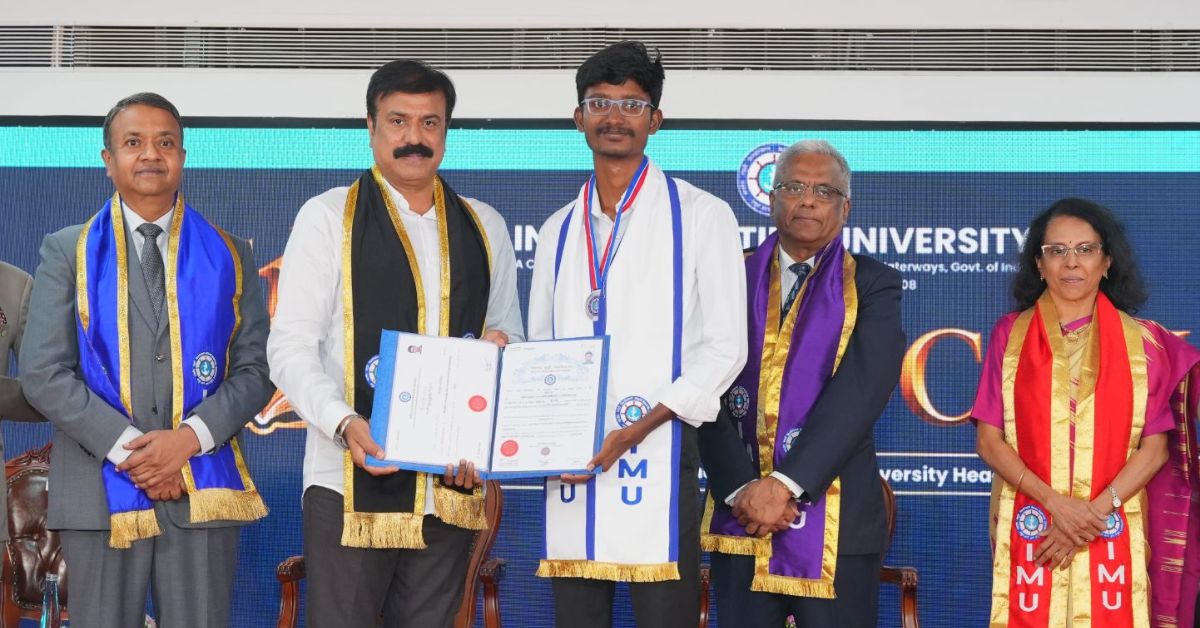
Indian Maritime University awarded qualifications to 1,993 students at its 11th convocation in Chennai on October 15, including 1,605 seafarers. The ceremony also highlighted institutional partnerships and expanded academic offerings, placing workforce development alongside research and entrepreneurship as priorities for India’s evolving maritime industry.
Article
Graduating cohort strengthens the maritime talent pool
The Indian Maritime University convocation brought together students from its campuses and affiliated institutes, alongside faculty, university officials and maritime industry representatives.
The university awarded 13 gold medals and 11 silver medals. Former Vice-Chancellor Malini Shankar and Rajya Sabha member L K Sudhish attended.
IMU also highlighted agreements with the Maritime India Foundation, IRCTC and Norway’s Nord University. Pro-Vice-Chancellor Rajoo Balaji pointed to 22 new value-added programmes supplementing its longer-duration courses.
These developments extend the university’s role across professional education, institutional cooperation and innovation.
University mandate extends beyond seafaring
Established by an Act of Parliament on November 14, 2008, IMU brought together seven existing institutions with established maritime training backgrounds.
Its teaching and research span marine engineering, nautical studies, naval architecture and ocean engineering, and maritime management.
That breadth reflects the different professions supporting maritime trade. Shipping requires qualified personnel at sea, while ports, logistics businesses, shipyards and related organisations need technical and management capabilities ashore.
A multidisciplinary university can connect these fields through education and research. For students, it also creates pathways into different parts of the industry rather than limiting maritime careers to shipboard employment.
The continuing task is to keep academic programmes aligned with the practical requirements of employers and the technologies entering service.
Innovation hubs connect research with operational problems
IMU’s relationship with the Maritime India Foundation forms part of the Sagarmala Startup and Innovation Initiative, launched on March 19, 2025.
The foundation is the designated implementing agency for the programme. An August 2026 government update identified Maritime Innovation Hubs at IMU Chennai, IIT Madras, IIT Bombay and IIT Kharagpur.
Their intended role includes technology development, testing, validation, capacity building and assistance to startups demonstrating maritime solutions.
The framework seeks to connect problems identified by ports with research, pilot projects and potential commercial deployment.
For a maritime university, this provides a route through which academic expertise can address operational requirements. It also gives students and researchers opportunities to engage with challenges defined by industry users.
Earlier startup programme demonstrates industry participation
The wider initiative has already attracted participation across several maritime disciplines.
MAR-a-THON 2025 received 330 startup applications addressing 51 problem statements. Following evaluation, 36 startups were selected for 40 projects.
The themes covered port infrastructure, integrated operations, multimodal logistics, sustainability, safety and shipbuilding.
These earlier results provide context for the innovation partnership highlighted at the convocation. They demonstrate demand for practical solutions across the sector, although selection for a project does not establish successful commercial deployment.
The value of university participation will depend on whether research and demonstrations progress into solutions that users can operate and maintain.
Changing ship technology raises training requirements
The graduating cohort enters an industry whose skills requirements are changing alongside propulsion systems and digital technology.
In September 2025, the International Maritime Organization issued generic interim guidance for training seafarers on ships using alternative fuels and new technologies.
Further fuel-specific guidance followed. In May 2026, IMO’s Maritime Safety Committee approved interim training guidelines for ships using methyl or ethyl alcohol and for ships using ammonia.
These developments underline the importance of continuing professional education after graduation. Existing qualifications provide a foundation, while new vessel technologies can require additional competence and familiarisation.
Practical competence remains central
The international training effort emphasises understanding fuel hazards, handling arrangements, bunkering and emergency response.
An IMO-supported seminar in August 2026 combined technical sessions with scenario exercises, demonstrations and industry engagement to help educators translate regulatory developments into competency-based training.
For India’s maritime education institutions, the implication is clear: expanding student numbers must be accompanied by relevant teaching, practical exposure and opportunities to update skills.
IMU’s convocation marks the completion of academic programmes. The next stage will be the graduates’ progression into professional roles, supported by employers, training institutions and continuing links between education and industry.
FAQs
When and where was the convocation held?
On October 15, 2026, at IMU’s headquarters in Chennai.
How many students graduated?
A total of 1,993, including 1,605 seafarers.
When was IMU established?
November 14, 2008, through an Act of Parliament.
What is the Maritime Innovation Hub’s role?
Supporting maritime technology development, testing, startup assistance and practical demonstrations.
Why is continuing training important?
Alternative fuels and new ship technologies introduce additional operational and safety competencies.
 Join our WhatsApp channel for more updates:
 Subscribe to our YouTube channel for more updates:



