



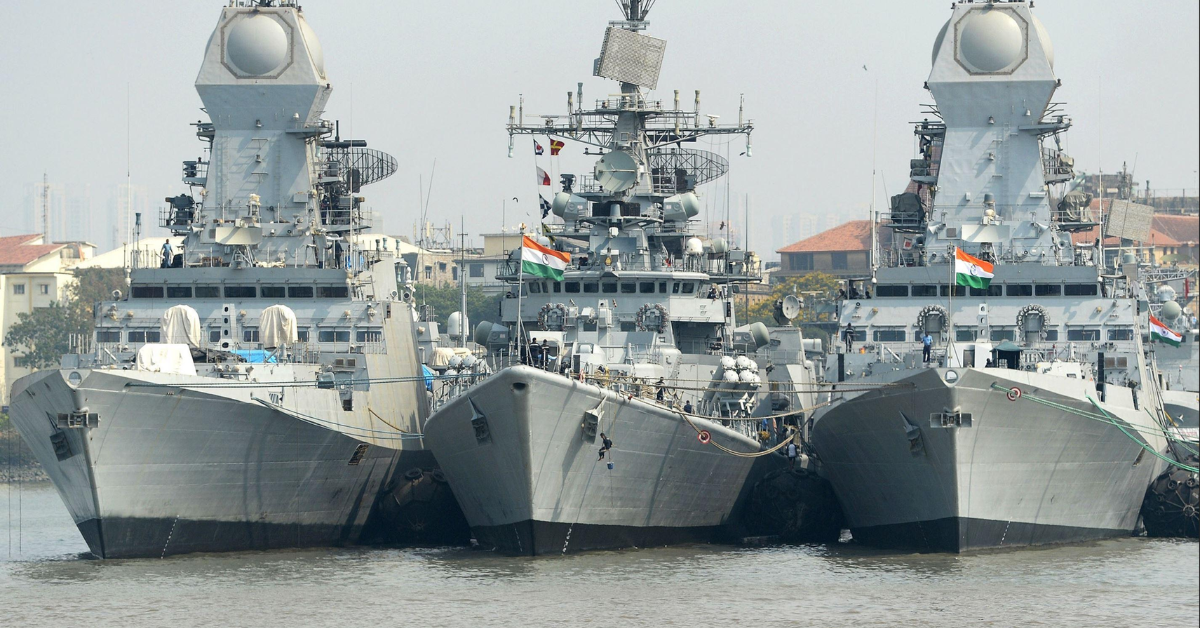

India’s Navy stands at a pivotal “inflection point” as escalating maritime threats demand heightened vigilance and operational readiness, Navy Chief Admiral D.K. Tripathi declared at the ongoing Commanders’ Conference in New Delhi.
In his address on Tuesday, the Admiral underscored a rapidly deteriorating security landscape marked by concurrent global conflicts, advancing adversary capabilities, weakening international institutions, and cheaper arms access for non-state actors. “We have shifted from a competition continuum to a conflict continuum in just five years,” he stated, pointing to West Asia’s turmoil as a stark reminder that “distance from conflict does not equate to distance from its consequences.”
Top commanders conducted a thorough review of India’s maritime security posture, zeroing in on West Asia crisis implications for energy security. Prolonged Red Sea disruptions—triggered by Houthi attacks—have forced 90% of India-bound ships to reroute via Africa’s Cape of Good Hope, inflating freight rates by 200% and delaying critical oil imports that fuel 85% of the nation’s energy needs. Indian naval assets have escorted over 450 merchant vessels since December 2025, ensuring safe passage amid 140+ attacks on commercial shipping.
The conference deliberated critical enablers: jointness across services, capability upgrades like indigenous Vikrant carrier ops and P-75I submarine induction, refit efficiencies to cut downtime by 25%, multi-domain safety protocols, advanced training for drone/missile threats, and deepened foreign military cooperation via QUAD and IONS frameworks. Indigenisation emerged as a cornerstone, with 75% of FY26 procurement budgeted for domestic firms under Atmanirbhar Bharat, targeting missile tech, UAV swarms, and AI-driven maritime domain awareness (MDA).
Admiral Tripathi’s remarks echo broader strategic shifts. The Indian Ocean Region (IOR)—home to 33% of global shipping and $7 trillion in trade—faces hybrid perils: Chinese grey-zone assertiveness near Andaman & Nicobar, piracy resurgence off Somalia, and unmanned threats in the Arabian Sea. The Navy’s IFC-IOR fusion centre, linked to 28 nations, delivers real-time intel fusion, while Mission-Based Deployments maintain persistent presence from Malacca to Mauritius.
For maritime logistics stakeholders, the Navy’s pivot spells dual impacts. Enhanced escorts safeguard EXIM lifelines—India’s ports handled 1.7 billion tonnes in FY25-26 despite disruptions—but force reallocations strain anti-piracy patrols, potentially hiking insurance premiums 15-20% for westbound trades. Operators at JNPA, Mundra, and Chennai report smoother ops thanks to naval overheads, yet urge Gati Shakti integration for faster hinterland evacuation amid vessel bunching.
This inflection demands agility: accelerating Project 18 destroyers, BrahMos NG missiles, and theatre-level drone carriers to counter PLA Navy forays. As global powers contest sea lanes—with China’s 370-ship fleet eyeing IOR chokepoints—India’s blue-water ambitions position it as a net security provider. Yet, with defence spending at 1.9% GDP, fiscal trade-offs loom between capex and welfare.
The conference signals resolve: a battle-hardened Navy, primed for contested seas, safeguarding trade routes that underpin India’s $1.1 trillion exports and 8% GDP growth trajectory in 2026.
 Join our WhatsApp channel for more updates:
 Subscribe to our YouTube channel for more updates: