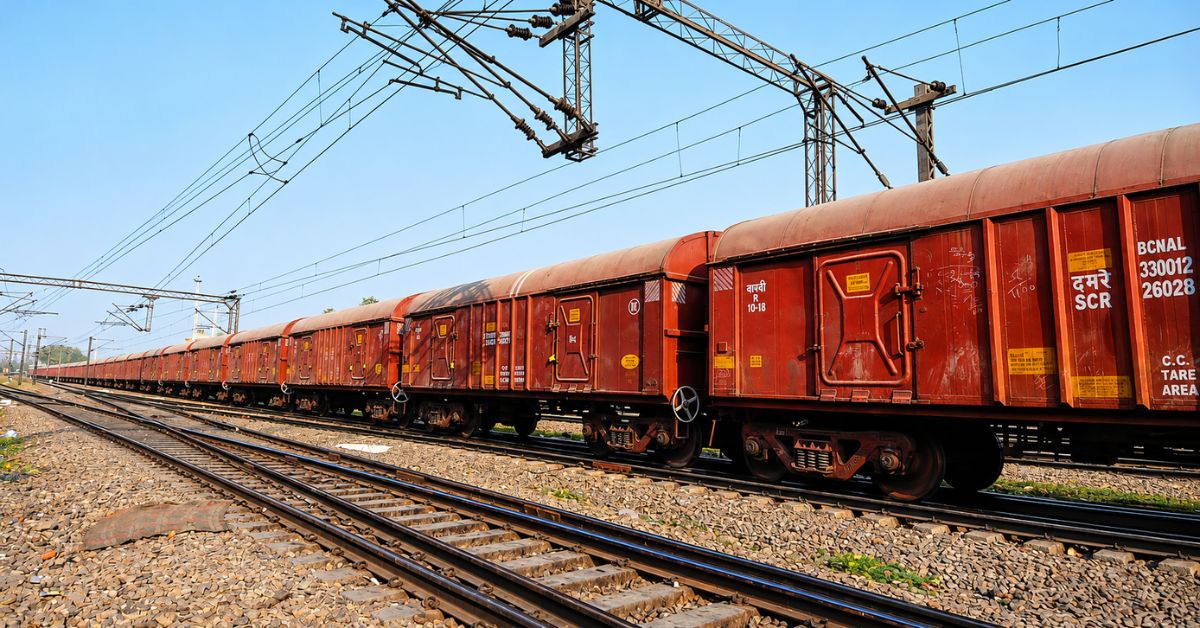

Indian Railways has placed additional orders for 9,638 freight wagons worth approximately ₹3,925.41 crore across five manufacturers, expanding existing procurement contracts to support bulk commodity transportation. Deliveries are scheduled by June 2027.
The Railway Board has exercised an option clause allowing additional procurement of up to 30% under existing contracts. The latest orders represent a 24.57% increase in the quantities covered by the procurement exercise and comprise open wagons for bulk cargo.
Which manufacturers will supply the wagons?
Titagarh has secured the largest allocation, followed by Jupiter Wagons and Texmaco Rail & Engineering. Besco and Oriental Foundry will supply the remaining wagons.
| Manufacturer | Additional wagons | Order value |
|---|---|---|
| Titagarh | 4,955 | ₹2,025.95 crore |
| Jupiter Wagons | 2,583 | ₹1,050.55 crore |
| Texmaco Rail & Engineering | 1,020 | ₹412.32 crore |
| Besco | 720 | ₹291.05 crore |
| Oriental Foundry | 360 | ₹145.53 crore |
| Total | 9,638 | ₹3,925.41 crore |
Jupiter’s allocation covers two contracts, while Besco’s additional orders are distributed across two divisional contracts. The procurement adds to manufacturers’ existing commitments through contractual options.
When will the additional wagons be delivered?
Titagarh Rail Systems’ stock exchange disclosure dated 28 October 2026 provides further detail on its allocation. The company said the Railway Board had ordered 4,955 additional open wagons under the original contract’s option clause, retaining the existing prices, terms and conditions.
The company disclosed a value of ₹1,716.90 crore before goods and services tax (GST), consistent with the approximately ₹2,025.95-crore tax-inclusive value reported for its allocation.
Titagarh’s delivery deadline is 7 June 2027, within 222 days of the contract amendment. The disclosure therefore places its execution schedule within the broader June 2027 delivery window for the additional procurement.
What is driving demand for freight wagons?
The orders follow growth in Indian Railways’ cargo business. During 2025–26, the network transported 1,670 million tonnes of freight, an increase of 3.25% over the previous financial year.
Iron ore transportation increased by 6.74%, while cement traffic rose by 4.74%. Fertiliser and pig iron and steel transportation each recorded growth exceeding 13%, according to the Ministry of Railways. These figures illustrate the continuing importance of industrial commodities to railway freight demand.
Growth continued in August 2026, when freight loading reached 137.9 million tonnes, compared with 130.9 million tonnes a year earlier. Iron ore loading increased by 12.1%, clinker by 10.4% and coal by 6%. Freight revenue rose by 6.27% over August 2025.
How does wagon procurement fit the wider logistics programme?
Rolling stock investment forms one part of Indian Railways’ freight strategy, alongside terminal development, private wagon investment and improvements to first- and last-mile connectivity.
Under the Gati Shakti Multi-Modal Cargo Terminal policy, terminal locations are selected according to industrial demand, cargo potential, available railway infrastructure and local logistics requirements. By 31 August 2026, 149 such terminals had been commissioned, including five added during that month.
Indian Railways also operates schemes encouraging private investment in specialised wagons for commodities including cement, oil, steel and fly ash. In an August update, the ministry reported approximately 275 special-purpose rakes and 397 general-purpose rakes operating under these initiatives.
Dedicated Freight Corridors complement this investment by carrying freight on separate routes and releasing capacity on the conventional railway network. The ministry reported an average of approximately 443 trains a day on these corridors in its August assessment. Together, these programmes address rolling stock availability, cargo handling and network capacity across the rail freight system.
 Join our WhatsApp channel for more updates:
 Subscribe to our YouTube channel for more updates: