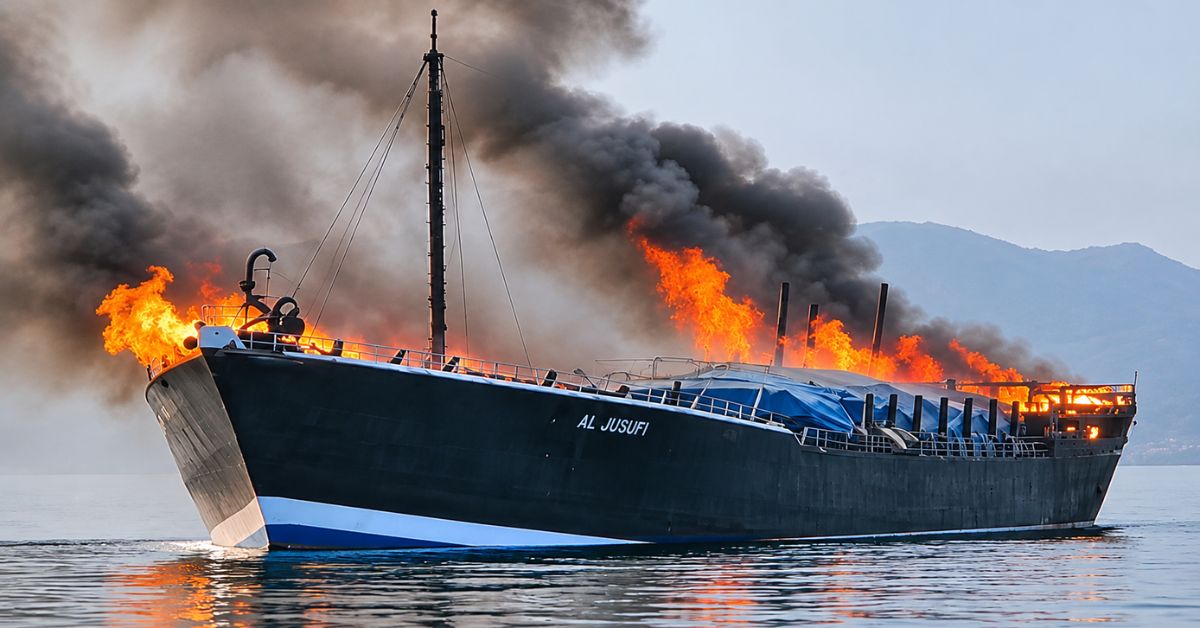

An Indian seafarer died after the commercial vessel MSV Al Jusufi was attacked near Limah, Oman, on the evening of 2 November, India’s Ministry of External Affairs (MEA) confirmed on 3 November. Thirteen other Indian nationals aboard the vessel were rescued.
The attack prompted India to renew its demand for an end to the targeting of commercial shipping and the restoration of safe navigation through the region’s international waterways. The ministry said the Indian Embassy in Oman was coordinating with local authorities to bring home the survivors and the deceased seafarer’s remains.
What happened to Al Jusufi?
Union Minister of Ports, Shipping and Waterways Sarbananda Sonowal said the vessel was struck by an unidentified aerial object while navigating near Oman’s coast. He identified the deceased as Gandhar Nahim Ajij from Gujarat, who succumbed to his injuries.
According to Sonowal, the other 13 crew members evacuated safely and were rescued by the Omani Coast Guard. He said his ministry and the Indian Embassy were working with Omani authorities to provide immediate assistance and facilitate repatriation.
United Kingdom Maritime Trade Operations (UKMTO), which issued a warning concerning the Indian-crewed dhow, said it had been sailing outbound through the Strait of Hormuz. Its notice stated that the vessel’s condition was unknown. The statements reviewed did not identify those responsible for the attack.
India calls for protection of commercial shipping
The MEA condemned the incident and expressed condolences over the loss of life. It described the continuing attacks on merchant vessels as a serious concern and urged an immediate reduction in tensions.
India also called for ongoing negotiations to reach a diplomatic settlement, linking the protection of civilian infrastructure and commercial shipping to the restoration of regional stability. The ministry sought the earliest resumption of unobstructed navigation and commerce in accordance with international law.
Further attacks reported near Oman
The fatal incident came amid additional reports of vessels being struck in nearby waters.
In a separate warning dated 3 November, UKMTO reported that a tanker approximately 14 nautical miles north-east of Lima, Oman, had been hit by two unidentified projectiles in its engine room. No casualties or environmental impact had been reported at the time of the notice.
A warning issued on 2 November described another vessel being struck approximately nine nautical miles north-east of Lima. Its master reported a hole in the starboard side, although the ship and crew were safe and no environmental impact was reported.
UKMTO advised vessels to navigate cautiously and report suspicious activity while authorities investigated. These notices concerned separate reported incidents and did not establish responsibility for the attacks.
What is the wider impact on seafarer safety?
The International Maritime Organization (IMO) listed 128 confirmed incidents and 24 confirmed seafarer fatalities in its Middle East incident update as of 3 November. These regional figures provide broader context and should not be interpreted as casualties from the Al Jusufi incident alone.
The IMO says it validates incident information using flag states, coastal states and verified third-party sources. Its regional monitoring also covers seafarers stranded aboard vessels unable to leave the Strait of Hormuz.
IMO Secretary-General Arsenio Dominguez has previously urged member states to refrain from actions that endanger merchant vessels and their crews, warning against using geopolitical conflicts as a justification for attacks on civilian shipping. The latest fatality adds to the human cost facing seafarers operating along the region’s trade routes.
 Join our WhatsApp channel for more updates:
 Subscribe to our YouTube channel for more updates: